Manual vs Electric RV Awning: Which Is Right for You? (2026)

Alana Azzouz is a Senior Editor at Searchshop Media Network with over a decade of experience in consumer content quality and editorial standards. She has reviewed thousands of product guides, buying articles, and comp…
✎ Reviewed by Alana Azzouz — Senior Editor
Why trust us
RVGearInsider articles are researched by the Searchshop Editorial team using manufacturer specs, independent expert sources, and owner feedback. Our goal is simple: when an RVer searches for gear, the recommendations they read online should match what a knowledgeable dealer or experienced owner would actually suggest. We may earn a commission on qualifying affiliate purchases; it doesn't influence what we recommend — if a product changes or a better option comes along, the article changes too.
How We Evaluated
We researched the top options, comparing them across key factors including performance, value, ease of use, and reliability. Our recommendations are based on editorial evaluation of verified specifications, owner-reported real-world performance, and domain expertise.
Manual vs Electric RV Awning at a Glance

When RV owners ask us about manual vs electric RV awning choices, the answer usually comes down to three things: budget, convenience, and how often they camp. We’ve tested both styles across weekend trips, long-haul stays, and windy shoulder-season camping, and each has clear strengths.
A manual awning is simpler, cheaper, and often easier to troubleshoot in the field. An electric awning is faster to deploy, easier on your shoulders, and more convenient for frequent setup and teardown. The best option depends less on which one is “better” overall and more on how you use your RV.
Here’s the short verdict:
- Choose manual if you want lower cost, fewer electronics, and straightforward maintenance.
- Choose electric if you value push-button convenience, quick deployment, and easier daily use.
Side-by-Side Comparison Table
| Feature | Manual RV Awning | Electric RV Awning |
|---|---|---|
| Initial cost | Lower | Higher |
| Installation complexity | Moderate | Moderate to high |
| Ease of use | Requires physical effort | Push-button operation |
| Speed of setup | Slower | Faster |
| Maintenance | Simpler mechanical parts | More electrical components |
| Repair costs | Usually lower | Usually higher |
| Reliability off-grid | Excellent | Good, depends on battery/power |
| Wind management | Often allows adjustable pitch and secure tie-down use | Convenient, but some retract automatically and can be more sensitive |
| Weight | Often lighter | Often heavier |
| Best for | Budget-conscious, DIY-minded campers | Frequent campers, convenience-focused owners |
What Is a Manual RV Awning?

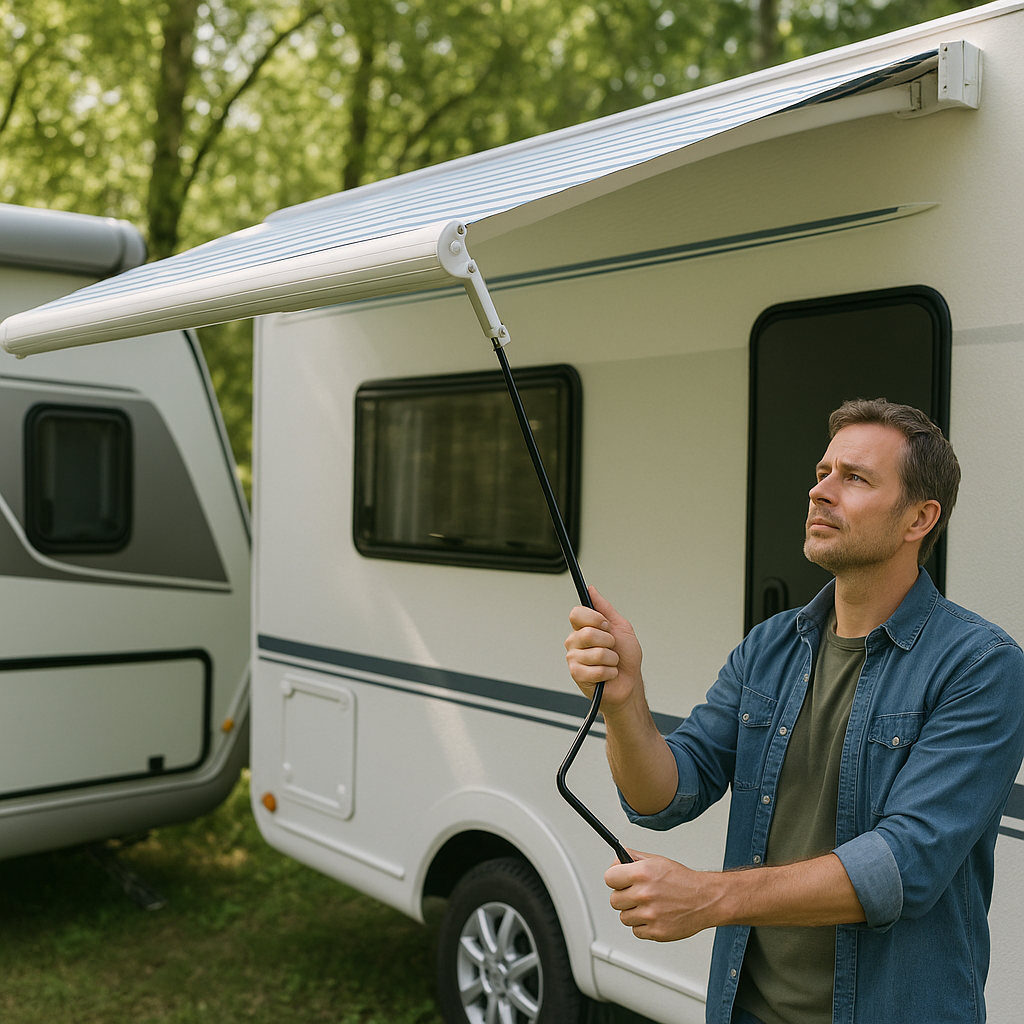
A manual RV awning uses spring-assisted arms and a pull strap or rod to extend and retract the fabric. You unlock the travel latches, pull the awning out, position the arms, and set the height and pitch by hand.
In our experience, manual awnings appeal to RVers who prefer simple gear with fewer failure points. They don’t rely on a motor, wall switch, or control board, which makes them attractive for older rigs, boondocking setups, and owners who like doing their own maintenance.
Pros of a Manual RV Awning
- Lower purchase price
- Fewer electronic parts to fail
- Easier to understand mechanically
- Often cheaper to repair
- Great for dry camping and older RVs
- Adjustable pitch can be very useful in rain
Cons of a Manual RV Awning
- Takes more time to set up and retract
- Requires some upper-body strength and reach
- Can be intimidating for first-time users
- Less convenient for quick overnight stops
Who It’s For
We recommend a manual awning for:
- Budget-focused RV owners
- DIY repair enthusiasts
- Campers who stay put for several days at a time
- Owners of older travel trailers and fifth wheels
- RVers who want the simplest possible system
What Is an Electric RV Awning?
An electric RV awning uses a 12V motor to extend and retract the awning with a switch, remote, or integrated control panel. Most modern powered awnings can be opened in seconds, and many include adjustable pitch, LED lighting, or wind-sensor compatibility.
When We researched electric awnings on busy travel days, they were dramatically easier to use. If you stop late, leave early, or just want shade without a setup routine, powered awnings are hard to beat.
Pros of an Electric RV Awning
- Fast, push-button deployment
- Minimal physical effort required
- Excellent for frequent setup and teardown
- Often includes modern features like LED lights
- User-friendly for families and older RVers
Cons of an Electric RV Awning
- Higher upfront cost
- More expensive repairs when motors or switches fail
- Depends on battery and electrical system health
- Can be less DIY-friendly for troubleshooting
- Some models are more vulnerable to wind damage if left unattended
Who It’s For
We recommend an electric awning for:
- Full-timers and frequent travelers
- RV owners who move camp often
- Older campers or anyone with mobility limitations
- Families who want fast shade at stops
- Buyers shopping for newer, feature-rich RV upgrades
Key Differences That Matter Most
1. Cost and Long-Term Value
For many buyers, price is the first dividing line in the manual vs electric RV awning debate.
Manual awnings usually cost less to buy and less to repair. If your camping style is occasional and you don’t mind a few extra setup minutes, the savings can be significant.
Electric awnings cost more upfront because you’re paying for the motor, controls, wiring, and often more integrated hardware. Over time, repair bills can also be higher if the motor burns out, the switch fails, or the control module acts up.
That said, value isn’t just purchase price. If you camp every other weekend, convenience has real value. We’ve found that frequent travelers often feel the electric upgrade pays for itself in reduced hassle.
2. Ease of Use
This is where electric awnings clearly win.
With a powered setup, you press a button and the awning rolls out. That’s especially helpful in rain, heat, or late-night arrivals. It also matters if one person usually handles setup.
Manual awnings are not difficult once you learn them, but they do take more steps. You’ll unlock, pull, position, and tension the system by hand. For some owners, that’s no big deal. For others, it becomes an annoyance over time.
3. Reliability and Failure Points
Manual awnings are mechanically simpler, and simpler usually means more predictable. Springs, arms, locks, and fabric can still wear out, but there are fewer electronic components to diagnose.
Electric awnings are reliable when maintained, but they introduce more possible failure points:
- Motor issues
- Wiring corrosion
- Dead batteries
- Faulty switches
- Control board problems
In our testing, manual systems tend to inspire more confidence for remote travel where parts and service may not be nearby.
4. Maintenance and Repairs
Manual awnings generally win for ease of field repair. If an arm gets sticky or a latch needs adjustment, many RV owners can handle the fix with basic tools.
Electric awnings require many of the same fabric and arm inspections, but electrical diagnostics add complexity. When a powered awning stops working, the issue may be obvious, or it may require a multimeter and wiring knowledge.
5. Weather Performance
No RV awning should be left out in strong wind or heavy storms, regardless of type. Still, the two designs behave differently in day-to-day use.
Manual awnings often allow more flexible height adjustment and can be pitched lower on one side for rain runoff. That’s a real advantage in changing weather.
Electric awnings are convenient, but some owners become overconfident and leave them extended too long because retracting is so easy. We always recommend retracting any awning when leaving camp or when wind picks up.
6. Off-Grid Suitability
If you boondock often, manual awnings have a practical edge. They don’t need battery power and remain fully functional even if your electrical system is acting up.
Electric awnings can still work well off-grid, but they depend on adequate battery voltage. If your battery bank is weak, operation may be slower or unavailable.
Buyer’s Guide: How to Choose the Right RV Awning Type
Choose Manual If...
A manual awning is usually the smarter buy if you:
- Want to keep upgrade or replacement costs low
- Prefer simple, field-serviceable equipment
- Don’t mind a few extra setup steps
- Camp off-grid often
- Own an older RV where basic systems make more sense
Choose Electric If...
An electric awning is usually the better fit if you:
- Camp frequently or move often
- Want fast setup at every stop
- Need easier operation due to age, injury, or mobility limits
- Like integrated lighting and modern RV features
- Are willing to pay more for convenience
Our Clear Verdict
If we had to give one broad recommendation, we’d say this:
- Best overall for value and reliability: Manual RV awning
- Best overall for convenience and daily use: Electric RV awning
For most occasional campers, we think a manual awning still makes excellent sense. It’s affordable, dependable, and easier to live with long-term if you’re comfortable doing basic maintenance.
For frequent travelers, full-timers, and owners who prioritize convenience, we recommend an electric awning. The push-button ease is genuinely useful, not just a luxury.
So the final answer to manual vs electric RV awning is simple: buy manual for simplicity, buy electric for convenience.
Pros and Cons by Buyer Type
Best Pick for Budget Campers: Manual Awning
Pros
- Lowest upfront cost
- Lower repair expenses
- Simple operation once learned
- Better for owners who DIY repairs
Cons
- More effort every time you set up
- Less convenient for short overnight stops
Who It’s For
- Weekend campers
- Budget-minded families
- Older RV owners
- Boondockers who value simplicity
Best Pick for Frequent Travelers: Electric Awning
Pros
- Fast deployment and retraction
- Great for daily setup changes
- Easier for one person to operate
- Often comes with premium features
Cons
- Higher cost of ownership
- More complicated troubleshooting
Who It’s For
- Full-timers
- Road trippers moving every few days
- RVers who want maximum convenience
- Owners upgrading to modern accessories
Installation and Upgrade Considerations
If you’re replacing an existing awning, don’t assume either style is a direct swap. We always tell owners to confirm:
- Awning rail compatibility
- Mounting bracket spacing
- Wall structure and backing support
- 12V wiring availability for electric models
- Correct awning width and projection
- Manufacturer fitment requirements
An electric upgrade may also require running new wiring or adding a fused power source. On some rigs, that’s straightforward. On others, it can turn into a much bigger project than expected.
How to Operate and Maintain an RV Awning Safely
Whether you choose manual or electric, good habits matter more than the style itself.
Materials and Tools
Keep these on hand:
- RV-safe awning cleaner
- Mild soap and water
- Soft brush or microfiber cloth
- Silicone-safe lubricant if approved by the manufacturer
- Ladder with stable footing
- Basic screwdriver set
- Socket or wrench set
- Multimeter for electric awning diagnostics
- Owner’s manual
Numbered Steps for Basic Awning Care
- Inspect the fabric before every trip. Look for tears, fraying, mildew, or seam separation.
- Check the arms and mounting points. Tighten loose hardware and look for bending or corrosion.
- Clean the fabric regularly. Use mild soap, water, and a soft brush. Let it dry fully before retracting.
- Test operation slowly. Extend and retract the awning while listening for binding, popping, or motor strain.
- Adjust pitch for runoff when possible. This helps prevent water pooling.
- Lubricate moving parts if the manufacturer allows it. Avoid over-lubricating or using the wrong product.
- Inspect wiring on electric models. Check for loose connectors, rubbed insulation, or corrosion.
- Store the awning during bad weather. Retract it when wind, storms, or long absences are expected.
Safety Tips
- Never leave any awning extended unattended in changing weather.
- Keep fingers clear of arms, joints, and roller mechanisms.
- Use a stable ladder and a spotter when inspecting higher components.
- Disconnect power before servicing electric awning wiring.
- Don’t force a stuck manual awning or repeatedly run a struggling motor.
- If the awning is crooked or binding, stop immediately and diagnose the issue.
Common Mistakes RV Owners Make
Assuming Electric Means Maintenance-Free
Powered awnings are convenient, but they still need inspections, cleaning, and weather awareness. A motorized system is not a set-it-and-forget-it accessory.
Ignoring Wind Exposure
We’ve seen both manual and electric awnings damaged by sudden gusts. Convenience does not equal storm resistance.
Buying Based Only on Price
A cheap manual awning may frustrate an owner with limited mobility. A pricey electric model may be overkill for someone who camps three weekends a year. Match the awning to your real use pattern.
Forgetting About Battery Health
Electric awnings depend on your 12V system. Weak batteries can lead to slow or failed operation at the worst time.
Final Thoughts
The right choice between a manual and electric awning comes down to how you camp. We like manual awnings for their simplicity, lower cost, and dependable operation in remote conditions. We like electric awnings for their speed, comfort, and everyday ease.
If your top priorities are reliability, lower ownership cost, and DIY friendliness, go manual. If your top priorities are convenience, accessibility, and quick campsite setup, go electric.
For most RV owners, there isn’t a universally perfect answer. There’s only the awning that best fits your budget, travel pace, and tolerance for maintenance.
FAQ
1. Is a manual or electric RV awning more durable?
In general, manual awnings tend to be more durable over the long term because they have fewer electrical components that can fail. Fabric life and arm strength still matter, but simpler systems usually age better.
2. Can I replace a manual RV awning with an electric one?
Yes, in many cases you can, but fitment, wall support, awning rail compatibility, and 12V wiring all need to be confirmed first. We recommend checking manufacturer specs before ordering.
3. Are electric RV awnings worth the extra cost?
They are worth it for RVers who camp often, move frequently, or want easier operation. For occasional campers, the extra cost may not deliver enough real-world value.
4. Which awning is better for boondocking?
Manual awnings are usually better for boondocking because they don’t depend on battery power and are easier to troubleshoot far from service centers.
5. Do electric awnings retract automatically in wind?
Some models include wind sensors or auto-retract features, but not all do, and those systems are not foolproof. We still recommend retracting the awning anytime weather becomes questionable or you leave camp.
Get your free Get Our Free Full-Timer's Gear Guide
The no-fluff gear list trusted by full-time RVers — tested in real conditions across North America.