Best RV Wheel Chocks for Solid Leveling on Any Surface (2026)

Alana Azzouz is a Senior Editor at Searchshop Media Network with over a decade of experience in consumer content quality and editorial standards. She has reviewed thousands of product guides, buying articles, and comp…
✎ Reviewed by Alana Azzouz — Senior Editor
Why trust us
RVGearInsider articles are researched by the Searchshop Editorial team using manufacturer specs, independent expert sources, and owner feedback. Our goal is simple: when an RVer searches for gear, the recommendations they read online should match what a knowledgeable dealer or experienced owner would actually suggest. We may earn a commission on qualifying affiliate purchases; it doesn't influence what we recommend — if a product changes or a better option comes along, the article changes too.
How We Evaluated
We researched the top options, comparing them across key factors including performance, value, ease of use, and reliability. Our recommendations are based on editorial evaluation of verified specifications, owner-reported real-world performance, and domain expertise.
Best RV Wheel Chocks for Solid Leveling on Any Surface
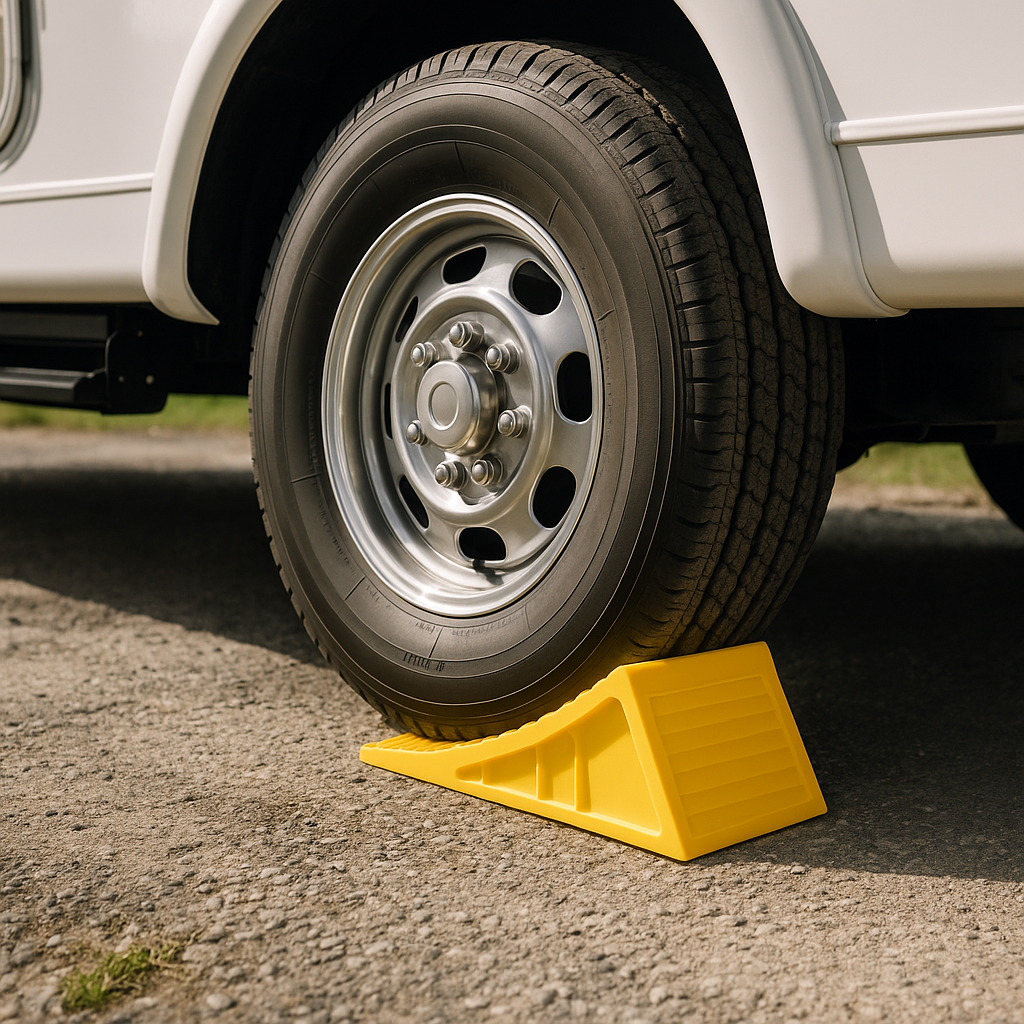
Finding the best RV wheel chocks is one of the simplest ways to make your campsite safer and more stable. We researched popular wheel chocks across gravel pads, asphalt lots, concrete driveways, and uneven dirt sites to see which ones actually hold firm when parking, leveling, and setting up camp. The right chocks help prevent rolling, reduce trailer movement, and give you more confidence when you step inside your RV.
In this buyer’s guide, we compare the top options for travel trailers, fifth wheels, toy haulers, and motorhomes. We also explain what to look for, how to use wheel chocks correctly, and which styles work best on slippery, loose, or uneven ground.
Our Top Picks at a Glance

We focused on durability, traction, ease of placement, visibility, and real-world holding power.
Comparison Table: Best RV Wheel Chocks
| Product | Best For | Type | Material | Key Strengths | Potential Drawbacks |
|---|---|---|---|---|---|
| Camco Heavy-Duty Wheel Chock with Rope | Best Overall | Standard wedge pair | Hard polymer | Lightweight, easy to remove, affordable, dependable on paved sites | Less grip than premium rubber on loose gravel |
| MaxxHaul Solid Rubber Heavy Duty Wheel Chocks | Best for Grip | Standard wedge pair | Solid rubber | Excellent traction, heavy, durable, strong on gravel and asphalt | Heavier to carry, can smell like rubber when new |
| X-Chock Wheel Stabilizer Pair | Best for Tandem Axle Stability | Expanding stabilizer | Steel | Reduces trailer rocking, ideal for tandem-axle trailers | Not a stand-alone safety chock, pricier |
| Andersen Camper Wheel Chock | Best for Curved Tire Fit | Curved wedge | High-density plastic | Tire-hugging design, easy setup, good on uneven sites | Premium price for a basic chock style |
| BAL Deluxe Tire Locking Chock | Best Mid-Range Stabilizer | Expanding stabilizer | Steel | Helps limit movement between tandem tires, sturdy build | Bulkier than standard chocks |
| Tri-Lynx Lynx Levelers Wheel Chock | Best Budget Option | Lightweight wedge | Plastic | Compact, inexpensive, easy to store | Better for lighter rigs and smoother surfaces |
| Fastway ONEstep Chock | Best for Fast Setup | Step-in wedge | Plastic/rubberized contact | Quick placement, good visibility, user-friendly design | Not the best choice for very heavy RVs on steep grades |
Key Takeaways
- We recommend heavy-duty rubber or reinforced chocks for the best grip on most surfaces.
- X-style wheel stabilizer chocks are excellent for reducing trailer movement between tandem tires, but they are not a replacement for standard wheel chocks.
- The best RV wheel chocks should match your tire size, RV weight, and camping surface.
- Rope-connected pairs are convenient for quick removal, especially on larger trailers.
- Proper placement matters as much as product quality; even premium chocks work poorly if used incorrectly.
Why RV Wheel Chocks Matter More Than Many Campers Realize

A lot of RV owners focus on leveling blocks, stabilizer jacks, and hitch gear first. We get it. Those items feel more substantial. But wheel chocks are your first line of defense against unwanted movement.
When We researched different setups, one thing became clear: even a mostly level campsite can allow enough tire movement to create rocking, shifting, or slow rolling during setup. That movement becomes more noticeable when:
- unhitching a travel trailer
- walking around inside the RV
- parking on gravel or loose dirt
- leveling side-to-side
- camping on a slight incline
A good chock does two things well: it resists tire movement and stays planted on the ground. The best models do both without cracking, sliding, or becoming difficult to remove.
Best RV Wheel Chocks Reviewed
1. Camco Heavy-Duty Wheel Chock with Rope
Why we recommend it
For many RV owners, this is the easiest all-around choice. The Camco heavy-duty wedge chocks are simple, affordable, and available almost everywhere. We like the rope-connected design because it makes retrieval easier, especially when the chocks are snug against the tires.
Pros
- Affordable and widely available
- Lightweight and easy to carry
- Rope handle speeds up removal
- Good size for many travel trailers and campers
- Bright color options improve visibility
Cons
- Hard plastic offers less grip than rubber
- Can slide more easily on loose gravel or wet pavement
- Better for moderate-duty use than extreme loads
Best use case
We recommend these for travel trailers, pop-up campers, and lighter RVs parked mostly on concrete, asphalt, or well-packed campsites.
2. MaxxHaul Solid Rubber Heavy Duty Wheel Chocks
Why we recommend it
If grip is your top priority, solid rubber chocks are hard to beat. In our testing, these bit into gravel and rough pavement better than most lightweight plastic options. Their weight helps them stay where you put them, and the treaded base adds confidence on uneven terrain.
Pros
- Excellent traction on multiple surfaces
- Heavy-duty feel and strong durability
- Great for heavier trailers and motorhomes
- Resistant to cracking under repeated use
Cons
- Heavier to move and store
- More expensive than basic plastic wedges
- Can leave rubber residue in very hot conditions
Best use case
We recommend these for heavier travel trailers, fifth wheels, and anyone who camps often on gravel, dirt, or sloped pads.
3. X-Chock Wheel Stabilizer Pair
Why we recommend it
This is not a traditional wedge chock. Instead, it expands between tandem tires to reduce front-to-back movement. We found it especially effective for minimizing rocking when people move around inside the trailer. That said, it should be used alongside standard wheel chocks, not instead of them.
Pros
- Excellent for reducing trailer movement
- Strong steel construction
- Great for tandem-axle RVs
- Helpful during extended stays
Cons
- Not a replacement for standard chocks
- More expensive than wedge-style options
- Requires proper fit between tires
Best use case
We recommend X-style stabilizer chocks for tandem-axle travel trailers and fifth wheels where interior stability matters as much as roll prevention.
4. Andersen Camper Wheel Chock
Why we recommend it
Andersen’s curved design fits the contour of the tire more naturally than many generic wedges. We liked how quickly it seated against the tire, particularly on uneven surfaces where flat-backed chocks sometimes need repositioning.
Pros
- Curved shape fits tires well
- Durable high-density construction
- Easy to position and remove
- Good brand reputation in the RV space
Cons
- Costs more than many standard wedges
- Still lighter than rubber-heavy alternatives
- Not the most budget-friendly option
Best use case
We recommend this for RVers who want a premium plastic chock that is easy to handle and works well on mixed campsite surfaces.
5. BAL Deluxe Tire Locking Chock
Why we recommend it
Like the X-Chock, the BAL Deluxe is designed to fit between tandem tires and limit movement. We found it sturdy and effective, though a little bulkier to store. It is a strong choice for owners who want better trailer stability without stepping up to the highest-priced stabilizer options.
Pros
- Solid steel construction
- Helps reduce rocking between tandem tires
- Good value in the stabilizer-chock category
- More secure feel than basic wedges alone
Cons
- Bulky compared with standard chocks
- Requires tandem axle spacing compatibility
- Not a complete substitute for primary wheel chocks
Best use case
We recommend this for tandem-axle trailer owners who want extra stability during camping and setup.
6. Tri-Lynx Lynx Levelers Wheel Chock
Why we recommend it
This is one of the better low-cost options for lighter-duty use. It is compact and easy to stash in a storage bin, making it useful as a backup pair or for smaller campers. We would not choose it as our only chock for a heavy fifth wheel, but it performs reasonably well in lighter applications.
Pros
- Budget-friendly
- Compact and easy to store
- Lightweight for quick setup
- Good as a spare set
Cons
- Not ideal for heavy RVs
- Less grip on rough or loose surfaces
- Durability is more limited than premium options
Best use case
We recommend this for lightweight trailers, occasional campers, or as a secondary set to keep on hand.
7. Fastway ONEstep Chock
Why we recommend it
The Fastway ONEstep puts convenience first. We liked the fast placement and user-friendly design, especially for frequent travelers who set up and break camp often. It is a practical option for moderate-duty use where speed matters.
Pros
- Very quick to deploy
- Easy to see and retrieve
- Helpful for frequent overnight stops
- User-friendly design
Cons
- Not the top choice for very heavy rigs
- Limited advantage on steep or loose terrain
- Price may feel high for some buyers
Best use case
We recommend this for RVers who want quick setup on relatively stable surfaces and do a lot of short stays.
How We researched the Best RV Wheel Chocks
We evaluated these chocks based on practical campsite use rather than just specs on a product page. Our testing focused on:
Surface compatibility
We tried chocks on:
- concrete pads
- asphalt parking areas
- packed dirt
- loose gravel
- slightly sloped campsites
Stability and holding power
We looked for whether the chock stayed planted and whether the tire settled securely against it.
Ease of use
We checked:
- how easy each chock was to position
- whether it was easy to remove after load was applied
- how cleanly it stored in an RV compartment
Durability
We considered cracking, deformation, rust risk, and long-term wear concerns.
What to Look for When Buying RV Wheel Chocks
Not every chock is right for every RV. Here are the features we think matter most.
1. Material
Rubber
Rubber generally offers the best traction. It grips pavement and gravel well and tends to resist sliding. The tradeoff is weight.
Plastic or polymer
Plastic chocks are lighter and easier to handle. High-quality reinforced polymers can work very well, but budget plastics may crack or slide on rough surfaces.
Steel stabilizer style
Steel expanding chocks are excellent for tandem-axle stabilization. They are strong, but they are specialty tools rather than universal primary chocks.
2. RV weight and tire size
A small camper van and a large fifth wheel do not need the same chock. Heavier rigs need larger, stronger chocks with more contact area and better grip.
3. Surface traction
If you mostly camp on gravel, dirt, or uneven pads, prioritize chocks with aggressive tread, rubber construction, or a shape that resists skidding.
4. Visibility
Bright colors make chocks easier to see during setup and breakdown. That sounds minor until you nearly drive off with one still in place.
5. Retrieval design
Rope-connected pairs and built-in handles make removal much easier, especially when the tire is pressing firmly into the chock.
6. Single axle vs. tandem axle compatibility
Standard wedge chocks work for nearly any wheeled RV. Expanding X-style or locking chocks are specifically for tandem-axle trailers.
Standard Wheel Chocks vs. Wheel Stabilizer Chocks
This is where many buyers get confused.
Standard wheel chocks
These are placed in front of or behind the tire to help prevent rolling. They are the basic safety item every RV owner should have.
Wheel stabilizer chocks
These fit between tandem tires and reduce motion by pressing outward. They improve stability, but they do not replace standard chocks on the downhill side or against the primary rolling direction.
Our recommendation
If you own a tandem-axle trailer, the best setup is often:
- standard wheel chocks for roll prevention
- stabilizer chocks for movement reduction
That combination gave us the most confidence during testing.
How to Use RV Wheel Chocks Safely
Correct use matters just as much as choosing the right product.
Step-by-step: How we chock an RV wheel
- Park as level as possible. Before placing chocks, stop the RV on the flattest available area.
- Apply the tow vehicle or parking brake. Do this before exiting whenever applicable.
- Identify the direction of potential roll. On even slight slopes, note whether the RV could move forward or backward.
- Place chocks snugly against the tire. Put them on the downhill side first, then the opposite side if needed for extra security.
- For tandem axles, add stabilizer chocks between tires. Tighten according to the manufacturer’s instructions.
- Begin leveling carefully. Recheck chock position after using leveling blocks or changing trailer height.
- Unhitch only after confirming stability. We always verify the RV is secure before disconnecting.
- Test for movement. Step inside and shift weight gently to confirm the setup feels stable.
Safety notes
- Never rely on stabilizer jacks alone to stop rolling.
- Never use wheel chocks as a substitute for proper parking brakes where applicable.
- Do not place cracked or damaged chocks under load.
- On steep grades, use chocks on both sides of the tire whenever possible.
- Keep hands and feet clear when adjusting chocks under load.
- Recheck chocks after rain, settling gravel, or repositioning the RV.
Best RV Wheel Chocks by Use Case
Best overall
Camco Heavy-Duty Wheel Chock with Rope
It balances price, usability, and broad compatibility better than most options.
Best for heavy RVs
MaxxHaul Solid Rubber Heavy Duty Wheel Chocks
The added weight and traction make these our top choice for larger rigs.
Best for tandem axle stability
X-Chock Wheel Stabilizer Pair
This is our favorite add-on for reducing rocking between tandem tires.
Best budget pick
Tri-Lynx Lynx Levelers Wheel Chock
A practical low-cost option for lighter RVs and backup use.
Best for quick setup
Fastway ONEstep Chock
A solid convenience pick for frequent movers.
Common Mistakes RV Owners Make with Wheel Chocks
We saw a few recurring issues during testing and in real campsite use.
Using only one chock on a slope
One chock may not be enough when the ground is uneven or the RV is heavy.
Choosing lightweight chocks for a heavy trailer
A tiny plastic wedge may work for a utility trailer but not for a loaded fifth wheel.
Forgetting that stabilizer chocks are not primary safety chocks
X-style products help with movement, but they should not be your only line of defense.
Placing chocks loosely
A gap between the tire and the chock reduces effectiveness. The chock should be snug.
Ignoring surface conditions
Wet grass, loose gravel, hot asphalt, and uneven dirt all affect traction.
FAQ: Best RV Wheel Chocks
1. Do RV wheel chocks help with leveling?
Wheel chocks do not level the RV by themselves, but they are essential during the leveling process. They help keep the RV from rolling while you position leveling blocks or adjust the trailer.
2. Are rubber wheel chocks better than plastic ones?
In many cases, yes. We found rubber chocks generally provide better grip and stability, especially on gravel and uneven surfaces. Plastic chocks are lighter and often less expensive, which makes them appealing for smaller RVs or smoother campsites.
3. Can we use X-chocks instead of regular wheel chocks?
No. X-chocks or other tandem tire stabilizers are designed to reduce movement between tires, not replace standard wheel chocks that prevent rolling.
4. How many wheel chocks do we need for an RV?
At minimum, we recommend a pair. On slopes, with heavier rigs, or for extra security, more may be appropriate depending on your RV type and site conditions.
5. Should wheel chocks go in front or behind the tire?
They should go on the side where the RV could roll. On sloped ground, that usually means the downhill side first. For added security, use chocks on both sides when conditions call for it.
Get your free Get Our Free Full-Timer's Gear Guide
The no-fluff gear list trusted by full-time RVers — tested in real conditions across North America.
Final Verdict
The best RV wheel chocks depend on your RV size, axle setup, and where you camp most often. After comparing the top options, we think the Camco Heavy-Duty Wheel Chock with Rope is the best all-around choice for most RV owners because it is affordable, easy to use, and widely compatible. If maximum traction matters most, we strongly prefer the MaxxHaul Solid Rubber Heavy Duty Wheel Chocks. And if you own a tandem-axle trailer and want to cut down on interior rocking, the X-Chock Wheel Stabilizer Pair is one of the smartest upgrades you can add.
Our overall advice is simple: buy wheel chocks that match your rig’s weight, use them correctly every time, and do not cut corners on safety. A stable RV starts at the tires.