Best TPMS Systems for RVs to Prevent Dangerous Blowouts (2026)

Alana Azzouz is a Senior Editor at Searchshop Media Network with over a decade of experience in consumer content quality and editorial standards. She has reviewed thousands of product guides, buying articles, and comp…
✎ Reviewed by Alana Azzouz — Senior Editor
Why trust us
RVGearInsider articles are researched by the Searchshop Editorial team using manufacturer specs, independent expert sources, and owner feedback. Our goal is simple: when an RVer searches for gear, the recommendations they read online should match what a knowledgeable dealer or experienced owner would actually suggest. We may earn a commission on qualifying affiliate purchases; it doesn't influence what we recommend — if a product changes or a better option comes along, the article changes too.
How We Evaluated
We researched the top options, comparing them across key factors including performance, value, ease of use, and reliability. Our recommendations are based on editorial evaluation of verified specifications, owner-reported real-world performance, and domain expertise.
Best TPMS Systems for RVs to Prevent Dangerous Blowouts
If you are shopping for the best RV TPMS system, you are already thinking about one of the smartest safety upgrades you can make. We researched and compared leading RV tire pressure monitoring systems to see which ones are easiest to install, most reliable at highway speeds, and best at warning drivers before a dangerous blowout happens. For motorhomes, fifth wheels, and travel trailers alike, a quality TPMS can protect your tires, wheels, suspension, and most importantly, everyone riding with you.
Best RV TPMS System Comparison Table

Before we get into the full reviews, here is a quick side-by-side look at our top picks.
| Product | Best For | Sensor Type | Tire Capacity | Repeater Included | Standout Strength | Potential Drawback |
|---|---|---|---|---|---|---|
| TireMinder i10 | Best overall | Cap | Up to 20 | Yes | Excellent monitor and broad RV support | Premium price |
| EEZTire-TPMS Real Time System | Best for long rigs | Cap or flow-through | Up to 26 | Yes | Strong signal reliability | Setup takes a little time |
| TST 507 System | Best sensor options | Cap or flow-through | Up to 115 | Often yes by kit | Flexible and expandable | Can be overkill for small RVs |
| Tymate RV TPMS | Best budget pick | Cap | Up to 10 or more by kit | Sometimes no | Good value and simple interface | Fewer premium features |
| GUTA RV TPMS | Best for larger trailers on a budget | Cap or flow-through | Up to 22 | Yes | Large display and solid range | Instructions can be clearer |
Key Takeaways
- A dedicated RV TPMS helps detect slow leaks, rapid air loss, overheating, and pressure changes before they become blowouts.
- The best systems for RVs offer strong signal range, user-set pressure thresholds, accurate temperature readings, and support for many tires.
- Signal repeaters matter on longer rigs, especially for fifth wheels, toy haulers, and towed vehicles.
- Cap sensors are easier to install, while flow-through sensors make airing up easier but add weight.
- We recommend choosing a system based on tire count, monitor readability, alert reliability, and long-term sensor battery convenience.
Why an RV TPMS Matters

RV tires live a hard life. Long periods of storage, heavy loads, sun exposure, underinflation, and heat buildup all increase the risk of failure. Unlike a passenger car, an RV may be carrying thousands of extra pounds, and a single tire issue can quickly become a shredded sidewall, body damage, or loss of control.
We have seen tire failures start as small pressure losses that would have gone unnoticed without a TPMS. By the time a driver feels handling changes, the tire may already be overheating. That is why we consider a tire pressure monitoring system one of the best preventive tools for RV safety.
What a TPMS Can Alert You To
A good RV TPMS can warn you about:
- Slow leaks from punctures or valve stem issues
- Rapid pressure loss
- High tire temperature
- Overpressure from heat or overfilling
- Underinflation from weather changes or leaks
- Signal loss from a disconnected or failed sensor
Our Top Picks for the Best RV TPMS System
1. TireMinder i10
Why We Picked It
The TireMinder i10 stands out as our best overall choice because it balances ease of use, dependable alerts, and RV-friendly range. We found the monitor intuitive, the display easy to read while driving, and the included repeater especially helpful for longer towables.
This system is a strong fit for Class A motorhomes, fifth wheels, and travel trailers where reliable communication from rear tires is essential.
Pros
- Bright, easy-to-read color monitor
- Includes signal booster/repeater
- Supports multiple RV configurations
- Good alert customization
- Well-known brand in the RV space
Cons
- Higher upfront cost than budget systems
- Sensor batteries will need periodic replacement
Best For
RVers who want a polished, dependable system with minimal fuss and broad support for different rig sizes.
2. EEZTire-TPMS Real Time System
Why We Picked It
When We researched systems for long fifth wheels and motorhome-plus-toad setups, EEZTire consistently impressed us for signal stability. It is built with RV length in mind and is often recommended by experienced travelers who need confidence across many axles.
The monitor is straightforward, and the system can be purchased with either cap sensors or flow-through sensors depending on your preference.
Pros
- Excellent range for long RVs
- Repeater included
- Expandable for larger setups
- Good customer support reputation
- Choice of sensor style
Cons
- Initial programming can feel tedious
- Monitor design is more functional than stylish
Best For
Large motorhomes, long fifth wheels, and rigs towing an extra vehicle.
3. TST 507 TPMS
Why We Picked It
The TST 507 is one of the most established names in the RV TPMS category, and for good reason. It offers flexibility, a wide range of supported tire counts, and both cap and flow-through sensor options. We like it for RVers who want room to grow or who may change rigs later.
It is also one of the better choices for people managing many tires, such as tag axle coaches or trailer combinations.
Pros
- Highly expandable
- Available with cap or flow-through sensors
- Trusted RV-focused brand
- Good alert options and customization
- Suitable for very large setups
Cons
- More features than some owners need
- Flow-through sensors can be heavier on stems
Best For
Experienced RVers, larger rigs, and anyone who wants a scalable system.
4. Tymate RV TPMS
Why We Picked It
For shoppers who want basic tire monitoring without paying premium-brand pricing, Tymate offers solid value. We found it appealing for smaller travel trailers, lighter fifth wheels, and weekend RVers who still want blowout protection.
It may not have every advanced feature of top-tier systems, but it covers the essentials: pressure monitoring, temperature monitoring, and active alerts.
Pros
- Affordable entry point
- Easy setup for many users
- Compact monitor
- Useful core safety alerts
Cons
- Range may be less robust on very long rigs
- Fewer advanced settings than premium competitors
Best For
Budget-conscious RV owners with shorter rigs or simpler monitoring needs.
5. GUTA RV TPMS
Why We Picked It
GUTA has become a popular value option for RVers who need more tire capacity without jumping to the highest price bracket. We liked the large display and generally dependable performance for trailers and motorhomes that still need a repeater-assisted signal.
Pros
- Good price for the feature set
- Supports larger tire counts than many budget options
- Repeater included on many kits
- Large screen is easy to view
Cons
- User manual can be less polished
- Interface is not as refined as premium brands
Best For
Owners who want a bigger-system feel at a midrange price.
How We Chose These TPMS Systems
We focused on the features that matter most in real RV use, not just on spec-sheet claims.
Our Evaluation Criteria
1. Signal Range and Repeater Performance
A TPMS is only useful if the monitor reliably hears from every tire. We favored systems with included repeaters or proven long-range performance.
2. Alert Reliability
We looked for systems that quickly notify drivers of underinflation, rapid leaks, overpressure, and high temperature.
3. Ease of Installation
We prefer systems that are straightforward to pair and mount, especially for RV owners installing them for the first time.
4. Monitor Visibility
A TPMS screen should be easy to read in daylight and simple to understand while driving.
5. Expandability
Many RVers upgrade from a trailer to a fifth wheel or add a towed vehicle. Expandable systems offer better long-term value.
What to Look for in the Best RV TPMS System
Choosing the right system depends on your RV, your tire count, and how you travel.
Sensor Type: Cap vs Flow-Through
Cap Sensors
Cap sensors replace the valve cap and are usually lighter and simpler.
Best for: Most RV owners, rubber-stem caution, easy installation.
Flow-Through Sensors
Flow-through sensors let you add air without removing the sensor.
Best for: Frequent travelers who check and adjust tire pressure often.
Important note: Because they are heavier, flow-through sensors are usually better paired with metal valve stems.
Tire Capacity
Count every tire you want monitored:
- Motorhome tires n- Trailer tires
- Spare tire if desired
- Towed vehicle tires
We recommend buying a system with a little extra capacity so you are not boxed in later.
Display Quality
Look for:
- Brightness in direct sunlight
- Audible alerts
- Easy tire position layout
- Simple pressure and temperature readouts
Alert Thresholds
The best systems let you set baseline pressures and custom alert thresholds. This matters because RV tires vary widely by load rating and manufacturer recommendations.
Battery and Power Options
Some monitors charge by USB, 12V outlet, or solar assist, depending on model. Sensor batteries may be replaceable or sealed depending on brand and design.
How to Install an RV TPMS
Most RV TPMS kits are straightforward to install, but proper setup matters if you want accurate alerts.
Step-by-Step Installation
Park on a level surface and secure the RV. Set the parking brake and chock wheels if needed.
Check and adjust all tire pressures first. Inflate each tire to the correct cold pressure based on your load and tire manufacturer guidance.
Program the monitor. Assign each sensor to the correct tire position on the screen before or during installation, depending on the system.
Install the repeater or signal booster if included. Mount it according to the manufacturer instructions, often near the rear of the RV or in a central protected location.
Attach the sensors to the correct valve stems. Tighten them as directed, usually by hand. If anti-theft nuts are included, install them carefully.
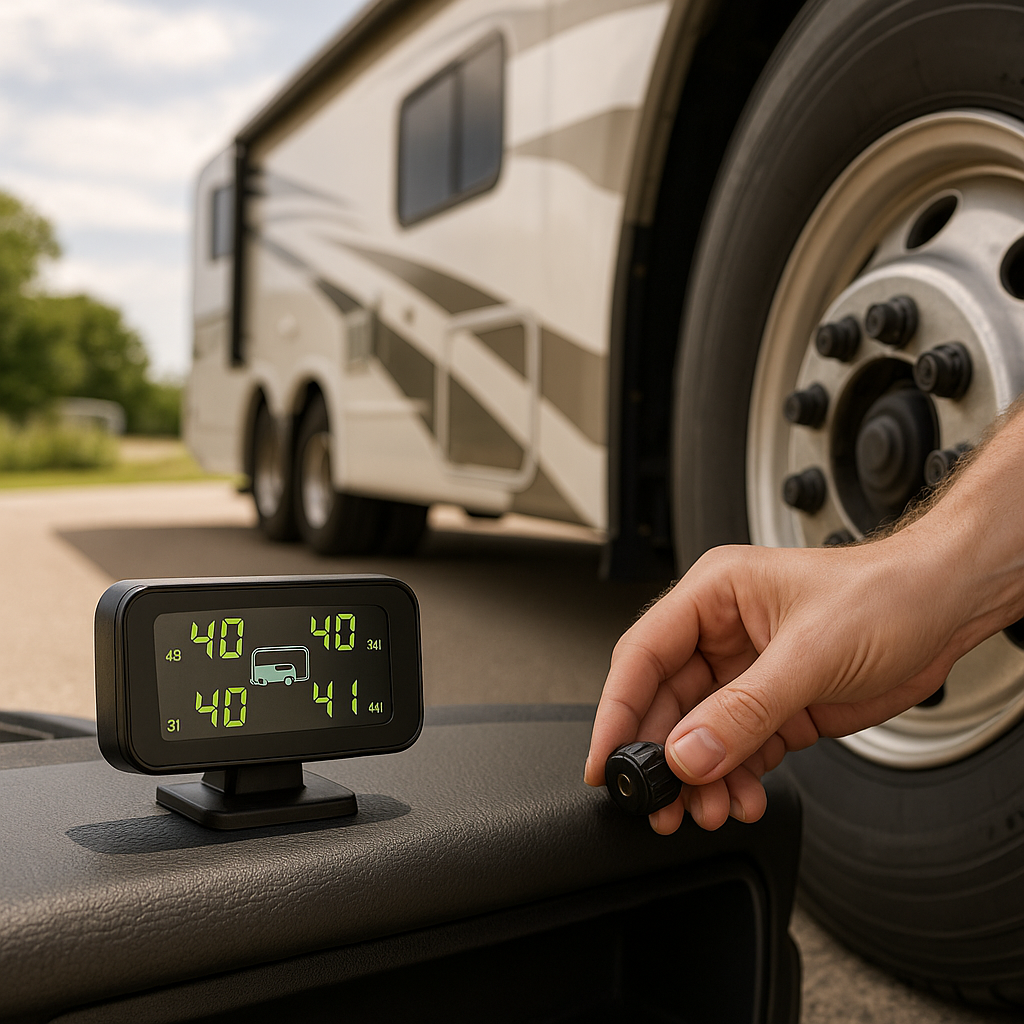
Wait for pressure and temperature readings to appear. Some systems populate quickly, while others may take a few minutes.
Set alert thresholds if the system allows it. Make sure high and low pressure alerts align with your actual tire specs.
Test the system before travel. Confirm all tires are reporting and that the monitor can cycle through each position.
Safety Notes
- Never rely on TPMS alone as a substitute for manual tire inspections.
- Always verify tire pressure when tires are cold.
- Replace damaged valve stems before installing sensors.
- Use metal valve stems when recommended, especially with heavier flow-through sensors.
- If a TPMS alarm sounds while driving, reduce speed safely and pull over as soon as conditions allow.
How to Use a TPMS to Prevent Blowouts
A TPMS helps most when paired with good tire habits.
Best Practices We Recommend
Check Baseline Pressures Before Every Trip
Start with correct cold inflation. A TPMS is an early warning system, not a cure for already underinflated tires.
Watch Temperature Trends
A single tire running hotter than the others can signal a developing issue, even before pressure drops dramatically.
Don’t Ignore Small Pressure Losses
A tire that repeatedly loses a few PSI may have a puncture, valve leak, or bead problem.
React Quickly to Alerts
Rapid air loss warnings deserve immediate attention. Even a few extra minutes at highway speed can destroy a tire.
Common RV TPMS Mistakes to Avoid
Skipping the Repeater
On a long rig, this is one of the biggest causes of dropped sensor readings.
Setting Incorrect Pressure Baselines
If the baseline is wrong, your alerts may be too sensitive or not sensitive enough.
Using Old or Weak Valve Stems
Added sensor weight can stress worn components.
Forgetting Sensor Batteries
A dead sensor battery can leave one tire unmonitored just when you need it most.
Our Recommendation by RV Type
Best for Class A and Class C Motorhomes
We recommend the TireMinder i10 for most owners who want a polished all-around system.
Best for Fifth Wheels and Long Travel Trailers
We recommend the EEZTire-TPMS Real Time System because of its strong long-range performance.
Best for Large Multi-Axle Setups
We recommend the TST 507 for its expansion potential and sensor options.
Best Budget Choice
We recommend the Tymate RV TPMS for shorter rigs and cost-conscious buyers.
FAQ
1. Is an RV TPMS really necessary?
Yes. We consider it one of the most valuable safety upgrades for any RV. It can alert you to pressure loss and overheating before a tire fails catastrophically.
2. Do I need a repeater for my RV TPMS?
If you have a long travel trailer, fifth wheel, Class A motorhome, or a towed vehicle, usually yes. A repeater greatly improves signal reliability.
3. Are flow-through sensors better than cap sensors?
Not always. Flow-through sensors are more convenient for adding air, but cap sensors are lighter and often simpler. For many RV owners, cap sensors are the better fit.
4. Can a TPMS replace manual tire checks?
No. We still recommend checking tire condition, tread, sidewalls, and cold inflation manually before trips.
5. How many tires should I monitor?
Ideally all road-going tires on the RV, and often the towed vehicle as well. Some RVers also monitor the spare.
Get your free Get Our Free Full-Timer's Gear Guide
The no-fluff gear list trusted by full-time RVers — tested in real conditions across North America.
Final Verdict
The best RV TPMS system for most owners is the TireMinder i10 because it delivers the best mix of reliability, readability, and RV-focused features. If you have a particularly long rig, the EEZTire-TPMS Real Time System is a close contender with excellent range. If you want maximum flexibility and expansion, the TST 507 remains one of the strongest choices on the market.
No matter which system you choose, we recommend installing it before your next major trip. A good RV TPMS does more than display tire pressure. It gives you time to react, helps prevent expensive damage, and can make the difference between a routine stop and a dangerous blowout.