RV Gas and CO Detector Safety: Standards, Placement, and When to Replace

Salem Hassan founded Travelcamp RV and brings 30+ years of hands-on RV, marine, and powersports experience to every review.
✎ Reviewed by Salem Hassan — Founder, Travelcamp · 30+ years in RV, marine, and powersports
Why trust us
RVGearInsider articles are researched by the Searchshop Editorial team with a full-timer's lens — evaluating gear for year-round use, not weekend trips. We assess every recommendation against the demands of full-time living: sustained power draw, weight budget, water system integration, and long-term durability. We may earn a commission on qualifying purchases; it does not change what we recommend.



RV Gas and CO Detector Safety: Standards, Placement, and When to Replace
RV life depends on compact systems working safely in a confined space. That is especially true for propane leak detectors and carbon monoxide alarms. If either device is missing, expired, poorly located, disconnected, or ignored, the margin for error gets very small.
In this guide, we researched the core standards, practical placement principles, replacement timing, and maintenance habits that support rv lpg propane detector carbon monoxide safety. While every RV model is different, the safety fundamentals are consistent: use listed equipment, follow the manufacturer’s instructions, verify operation regularly, and replace detectors before they age out.
Why This Matters

Propane and carbon monoxide create different hazards, but both can become dangerous quickly in an RV.
Propane is highly flammable. A leak from an appliance connection, regulator issue, damaged line, or partially open burner can allow gas to collect in low areas. In an enclosed RV, that can create fire or explosion risk.
Carbon monoxide, by contrast, is colorless and odorless. It is produced by incomplete combustion from fuel-burning appliances and engines. Common RV sources include generators, furnaces, water heaters, cooktops, and vehicle exhaust entering the coach. Because you cannot see or smell it, occupants may not recognize exposure until symptoms begin.
The real consequences of ignoring detector safety include:
- Missed warning of a propane leak before ignition
- Delayed response to dangerous carbon monoxide buildup
- False confidence from an expired detector that no longer performs as intended
- Nuisance alarms that owners silence or disconnect instead of correcting the cause
- Increased risk while sleeping, when occupants are least likely to notice symptoms or odors
We recommend treating RV gas and CO detectors as essential life-safety equipment, not optional accessories.
Relevant Standards & Regulations
The RV industry, code bodies, and testing organizations all play a role in setting expectations for detector use and installation.
NFPA 1192: Standard on Recreational Vehicles. Addresses fire and life safety provisions for RV design and systems, including requirements related to fuel systems and life-safety equipment installed by manufacturers.
NFPA 70 (National Electrical Code): Governs electrical practices relevant to powering and wiring permanently installed RV safety devices where applicable.
UL 1484: Standard for safety for residential gas detectors. Commonly referenced for propane/LP-gas detection devices intended for occupancy spaces.
UL 2034: Standard for single and multiple station carbon monoxide alarms. RV carbon monoxide alarms are commonly listed to this standard or a related certification path recognized by the manufacturer.
ANSI/RVIA construction requirements: RV manufacturers that participate in RVIA compliance programs build to recognized safety requirements derived from applicable standards such as NFPA 1192.
Manufacturer installation instructions: These are not optional guidance. Listed detectors are evaluated for performance under specific mounting, wiring, and replacement conditions, and the manufacturer’s instructions are part of compliant installation.
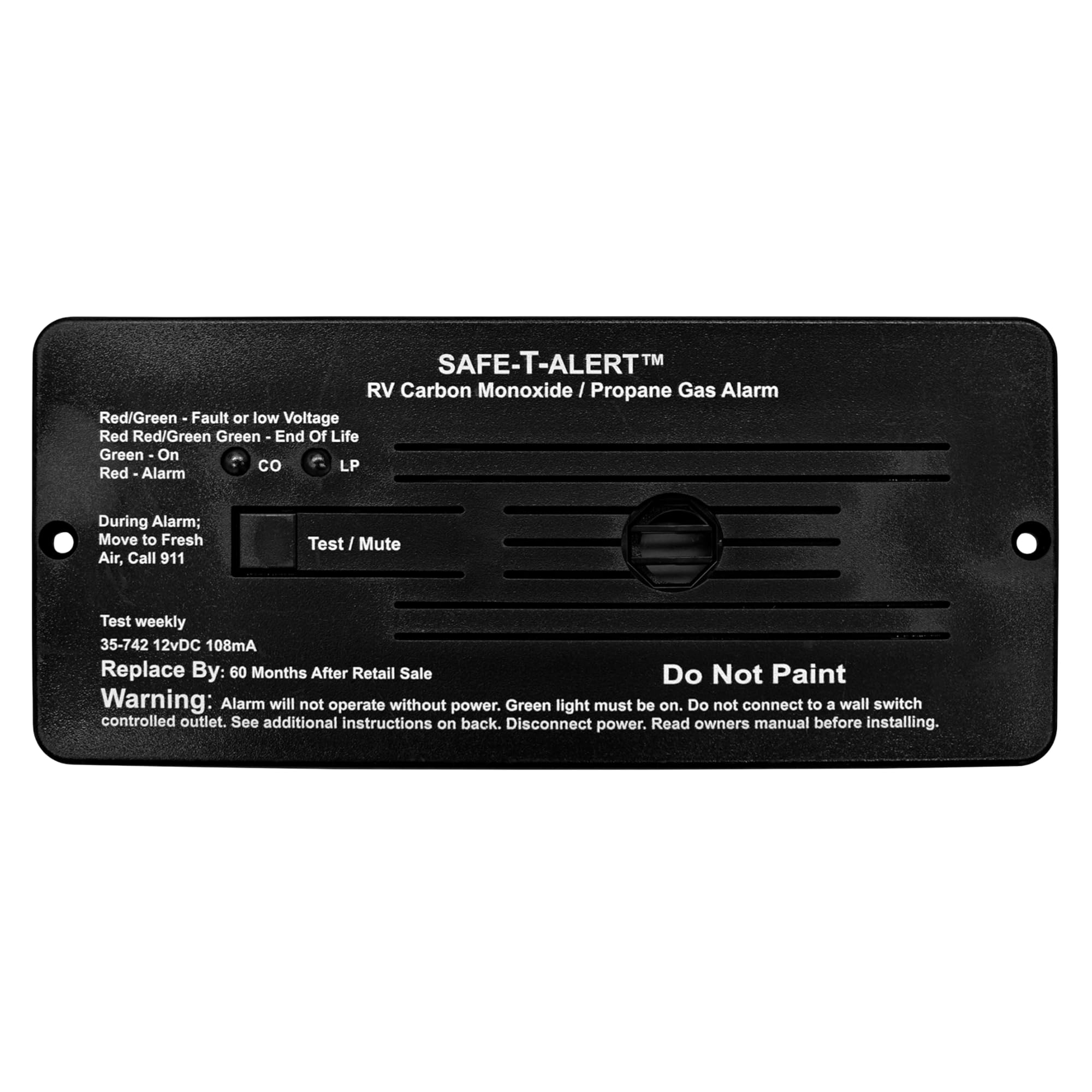
A practical note: owners should always check the label on the installed detector itself. The unit will typically identify its listing, operating voltage, manufacturing date, replacement date, and alarm type.
Key Safety Principles

Use the right detector for the right hazard
A propane detector is not a carbon monoxide alarm, and a carbon monoxide alarm is not a propane detector unless the device is specifically a combination unit. We recommend confirming exactly what your installed device monitors before assuming you are protected.
Practical application: read the front label and model documentation. If the device says LP gas only, it does not replace a CO alarm.
Follow manufacturer placement instructions exactly
Detector performance depends heavily on placement. Propane detectors are often mounted low because LP gas is heavier than air, while CO alarm placement can vary by product design and instructions. There is no safe shortcut here.
Practical application: if replacing a detector, do not assume the old mounting position is correct for the new model. Verify the new unit’s required location and orientation.
Respect service life limits
Most RV detectors have a finite sensor life. Even if the unit still powers on, the sensing element may be beyond its reliable service window.
Practical application: check for a replace-by date or manufacturing date on the label. If the unit is expired, replace it rather than relying on a passing self-test.
Never disable an alarm to stop nuisance alerts
An alarm that sounds repeatedly is telling you something important: there may be a real hazard, a low-voltage condition, contamination, end-of-life status, or improper installation.
Practical application: investigate the cause, ventilate if needed, shut down suspected fuel-burning equipment, and troubleshoot according to the manual.
Keep detectors powered and unobstructed
Many RV propane detectors are hardwired to the 12V DC system and may draw a small continuous current. If the house battery is disconnected or deeply discharged, the detector may stop protecting the coach.
Practical application: include detector operation in your battery and storage routine. Also keep vents and sensing openings free of dust, pet hair, and blockage.
Step-by-Step Safe Practices
- Identify every installed detector in the RV. Confirm whether each unit detects LP gas, carbon monoxide, smoke, or multiple hazards.
- Read the label on each device. Record the model, listing standard, voltage, manufacture date, and replacement date.
- Check the owner’s manual and detector manual. Verify approved mounting location, height, and spacing for that exact model.
- Test each detector using the built-in test function. Follow the manufacturer’s instructions and note that a self-test does not replace end-of-life replacement.
- Inspect power supply conditions. For hardwired units, verify the RV battery is charged and the circuit is active. For battery-powered alarms, replace batteries as directed.
- Inspect for contamination or obstruction. Gently clean the exterior openings if the manufacturer permits it. Do not spray cleaners, solvents, or aerosols into the unit.
- Review nearby hazard sources. Check propane appliances, the furnace, water heater, cooktop, refrigerator, generator, and exhaust pathways for obvious issues.
- Replace expired detectors immediately. Match the replacement unit to the hazard type and installation requirements.
- Test after replacement or battery service. Confirm the new or serviced unit powers up and passes the manufacturer’s test procedure.
- Create a recurring inspection schedule. We recommend checking detector status before each trip and reviewing replacement dates at least seasonally.
Common Hazards & How to Avoid Them
Expired detectors still left in service
This is one of the most common RV safety gaps. Owners often assume a detector is fine because a light is on or the test button works.
How to avoid it: check the date label, not just the indicator light. Replace units at the manufacturer’s stated end-of-life interval.
Incorrect replacement units
A detector may fit the same opening or use the same wiring plug, but still not be the correct certified replacement for the application.
How to avoid it: confirm the hazard type, voltage, listing, and mounting instructions before purchase. When in doubt, use the RV manufacturer or detector manufacturer cross-reference.
Low battery voltage disabling LP detection
Hardwired RV propane detectors often depend on the coach 12V system. During storage or battery neglect, the detector may lose power.
How to avoid it: maintain battery charge, verify detector operation after reconnecting power, and do not store the RV under the assumption that the detector remains active if DC power is off.
Generator or engine exhaust entering the RV
CO incidents in RVs are frequently associated with exhaust intrusion, especially when parked near other vehicles, buildings, or with open windows in the wrong location.
How to avoid it: inspect exhaust systems, avoid idling near openings, be cautious with neighboring generators, and never ignore a CO alarm during generator use.
Cooking fumes and aerosols causing nuisance alarms
Some detectors may react to heavy fumes, vapors, or contaminants. Repeated nuisance alarms can lead owners to disconnect the unit.
How to avoid it: improve ventilation when cooking, avoid spraying chemicals near detectors, and replace contaminated or aging units if false alarms persist.
Improper mounting height or location
A poorly placed detector may delay alarm response or fail to perform as intended.
How to avoid it: follow the exact mounting instructions for the model. Do not relocate a detector based on general advice alone.
Authoritative Resources
For current requirements and product-specific guidance, we recommend starting with official and standards-based sources:
- National Fire Protection Association (NFPA): https://www.nfpa.org
- UL Standards & Engagement: https://www.ulstandardsenagement.com
- UL Solutions product certifications directory: https://productiq.ulprospector.com
- RV Industry Association (RVIA): https://www.rvia.org
- National Highway Traffic Safety Administration (NHTSA): https://www.nhtsa.gov
- U.S. Consumer Product Safety Commission (CPSC): https://www.cpsc.gov
- Propane Education & Research Council (PERC): https://propane.com
When researching a replacement detector, we also recommend reviewing the detector manufacturer’s installation manual and the RV owner’s manual before ordering.
Frequently Asked Questions
How often should we replace an RV propane detector?
It depends on the model. Many RV propane detectors have a service life in the 5- to 7-year range, but the only reliable answer is the manufacturer’s label and manual. Replace the unit at its stated end-of-life date.
How often should we replace an RV carbon monoxide alarm?
Again, follow the specific product instructions. Many CO alarms are rated for several years of service, often around 5 to 10 years depending on design. The replace-by date on the device is the controlling reference.
Can we use a household detector in an RV?
Only if the product is specifically suitable for the RV application and installation conditions. RVs involve vibration, 12V systems on some devices, temperature swings, and compact layouts. We recommend using a listed detector intended for the application and installed according to its instructions.
Where should an RV propane detector be mounted?
Generally, LP gas detectors are installed low in the RV because propane is heavier than air, but exact placement depends on the listed device instructions. Always follow the detector manufacturer’s mounting requirements.
Where should an RV carbon monoxide alarm be mounted?
Placement varies by the product design and instructions. Do not assume all CO alarms mount the same way. Check the exact manual for approved wall, ceiling, or other mounting guidance.
If the test button works, is the detector still good?
Not necessarily. The test function usually checks electronics and alarm operation, but it does not override the sensor’s expiration date. An expired detector should still be replaced.
What should we do if the CO alarm sounds?
Move occupants to fresh air immediately, call emergency services if anyone has symptoms, shut down suspected combustion sources if it is safe to do so, and do not re-enter until the situation is understood and resolved.
What should we do if the propane alarm sounds?
Extinguish flames and ignition sources, avoid operating electrical switches if a leak is suspected, shut off the propane supply if it is safe to do so, ventilate the RV, evacuate if needed, and inspect the system before reuse.
Get your free Get Our Free Full-Timer's Gear Guide
The no-fluff gear list trusted by full-time RVers — tested in real conditions across North America.
Final Takeaway
Good detector safety comes down to a few disciplined habits: install the correct device, place it where the manufacturer requires, keep it powered, test it regularly, and replace it on time. In a small living space with fuel-burning appliances, those steps are not minor maintenance details. They are foundational to rv lpg propane detector carbon monoxide safety.
At RVGearInsider, we researched the standards and practical guidance with one conclusion in mind: the safest detector is the one that is correctly selected, correctly installed, and not kept past its service life.