Best RV Water Pumps for Consistent Pressure Off-Grid (2026)

Alana Azzouz is a Senior Editor at Searchshop Media Network with over a decade of experience in consumer content quality and editorial standards. She has reviewed thousands of product guides, buying articles, and comp…
✎ Reviewed by Alana Azzouz — Senior Editor
Why trust us
RVGearInsider articles are researched by the Searchshop Editorial team using manufacturer specs, independent expert sources, and owner feedback. Our goal is simple: when an RVer searches for gear, the recommendations they read online should match what a knowledgeable dealer or experienced owner would actually suggest. We may earn a commission on qualifying affiliate purchases; it doesn't influence what we recommend — if a product changes or a better option comes along, the article changes too.
How We Evaluated
We researched the top options, comparing them across key factors including performance, value, ease of use, and reliability. Our recommendations are based on editorial evaluation of verified specifications, owner-reported real-world performance, and domain expertise.
Best RV Water Pumps for Consistent Pressure Off-Grid
Finding the best RV water pump can make the difference between a comfortable off-grid trip and a frustrating one filled with weak showers, noisy cycling, and unreliable water flow. We researched and compared top RV water pumps with a focus on pressure consistency, noise levels, durability, and ease of installation. Whether you boondock every weekend or live in your rig full-time, we recommend choosing a pump that matches your plumbing layout, fixture count, and battery setup.
Quick Comparison: Best RV Water Pumps

| Product | Flow Rate | Max Pressure | Noise Level | Best For | Our Rating |
|---|---|---|---|---|---|
| Shurflo Revolution 4008 | 3.0 GPM | 55 PSI | Low | Best overall | 9.5/10 |
| Seaflo 55 Series | 5.5 GPM | 60 PSI | Moderate | High-demand rigs | 9.1/10 |
| Remco Aquajet ARV | 5.3 GPM | 65 PSI | Low-Moderate | Premium performance | 9.3/10 |
| Flojet Triplex 03526 | 2.9 GPM | 50 PSI | Moderate | Budget replacement | 8.7/10 |
| Aquatec 5800 Series | 4.0 GPM | 60 PSI | Low | Quiet operation | 8.9/10 |
| Lippert Flow Max | 3.0 GPM | 50 PSI | Moderate | OEM-style swap | 8.5/10 |
Our Top Picks at a Glance
We looked at the pumps RV owners actually buy and replace in the field, not just spec-sheet standouts. In our experience, the best models balance four things well: steady pressure, low cycling, manageable noise, and long-term reliability.
Best Overall: Shurflo Revolution 4008
The Shurflo Revolution 4008 remains our top recommendation for most RV owners. It delivers enough pressure for typical kitchen, bath, and shower use without being overly loud or power-hungry. It is also one of the easiest pumps to source parts for on the road.
Pros
- Reliable 3.0 GPM performance for most RVs
- Smooth pressure delivery with reduced rapid cycling
- Widely available and easy to replace
- Good balance of price and durability
Cons
- Not ideal for large luxury rigs with multiple simultaneous users
- Can still transmit vibration if mounted poorly
Who It’s For We recommend this model for most travel trailers, fifth wheels, and Class B or C motorhomes that need a dependable all-around pump for regular off-grid camping.
Best for High Water Demand: Seaflo 55 Series
If your RV has multiple fixtures in use at once, the Seaflo 55 Series offers stronger flow than entry-level pumps. We found it especially useful in larger fifth wheels and family rigs where shower performance matters.
Pros
- Strong 5.5 GPM flow for larger plumbing systems
- Handles multiple fixtures better than 3.0 GPM pumps
- Self-priming and dry-run capable
- Good value for the output
Cons
- Louder than premium quiet pumps
- May require an accumulator or better mounting isolation
Who It’s For This is a smart pick for larger RVs, families, and boondockers who want more residential-style water delivery.
Best Premium Upgrade: Remco Aquajet ARV
The Remco Aquajet ARV is one of the most refined pumps we reviewed. It offers strong pressure with better flow control than many standard diaphragm pumps, which helps reduce pulsing at faucets.
Pros
- Excellent pressure consistency
- High output without feeling harsh at fixtures
- Better control reduces noticeable surging
- Great option for full-timers
Cons
- Higher price than basic replacement pumps
- Overkill for smaller campers
Who It’s For We recommend the Aquajet ARV for full-time RVers and premium rig owners who want top-tier water performance and are willing to pay more for it.
Best Budget Pick: Flojet Triplex 03526
For RV owners replacing a failed stock pump without spending heavily, the Flojet Triplex 03526 is a dependable value choice. It does not offer class-leading output, but it covers basic needs well.
Pros
- Affordable replacement option
- Compact and easy to fit in tight spaces
- Good for single-fixture use
- Widely compatible with smaller RV systems
Cons
- Less impressive shower pressure than higher-flow models
- More noticeable pulsing under demand
Who It’s For This is best for budget-conscious owners, smaller trailers, and occasional campers who need a straightforward replacement.
Best Quiet Pump: Aquatec 5800 Series
Noise matters in compact RVs, especially when the pump is mounted near the bed or under a dinette. The Aquatec 5800 Series stood out for smoother and quieter operation in our comparisons.
Pros
- Quieter than many standard RV pumps
- Good pressure and flow for daily use
- Smooth operation with reduced chatter
- Solid fit for compact rigs
Cons
- Can cost more than common OEM replacements
- Availability may be less consistent than Shurflo
Who It’s For We recommend this pump for van conversions, compact motorhomes, and any RV where pump noise is a major annoyance.
Best Direct OEM-Style Replacement: Lippert Flow Max
The Lippert Flow Max is a practical option when you want a familiar spec range and easy install. It is not the most refined pump We researched, but it gets the job done for many factory plumbing setups.
Pros
- Simple replacement for many stock systems
- Decent 3.0 GPM performance
- Common fit for mainstream RVs
- Fair pricing
Cons
- Average noise and pressure control
- Not the strongest long-term value in heavy use
Who It’s For This is a good fit for RV owners who want a no-fuss replacement with familiar specs and easy compatibility.
What We Looked for in the Best RV Water Pump

When we compare RV pumps, we focus on real-world use rather than just manufacturer claims.
Pressure and Flow Rate
Flow rate, measured in gallons per minute, affects how much water the pump can deliver. Pressure, measured in PSI, affects how strong that water feels at the faucet or showerhead. For most RVs, 2.9 to 3.5 GPM is enough. Larger rigs often benefit from 4.0 to 5.5 GPM.
Noise and Vibration
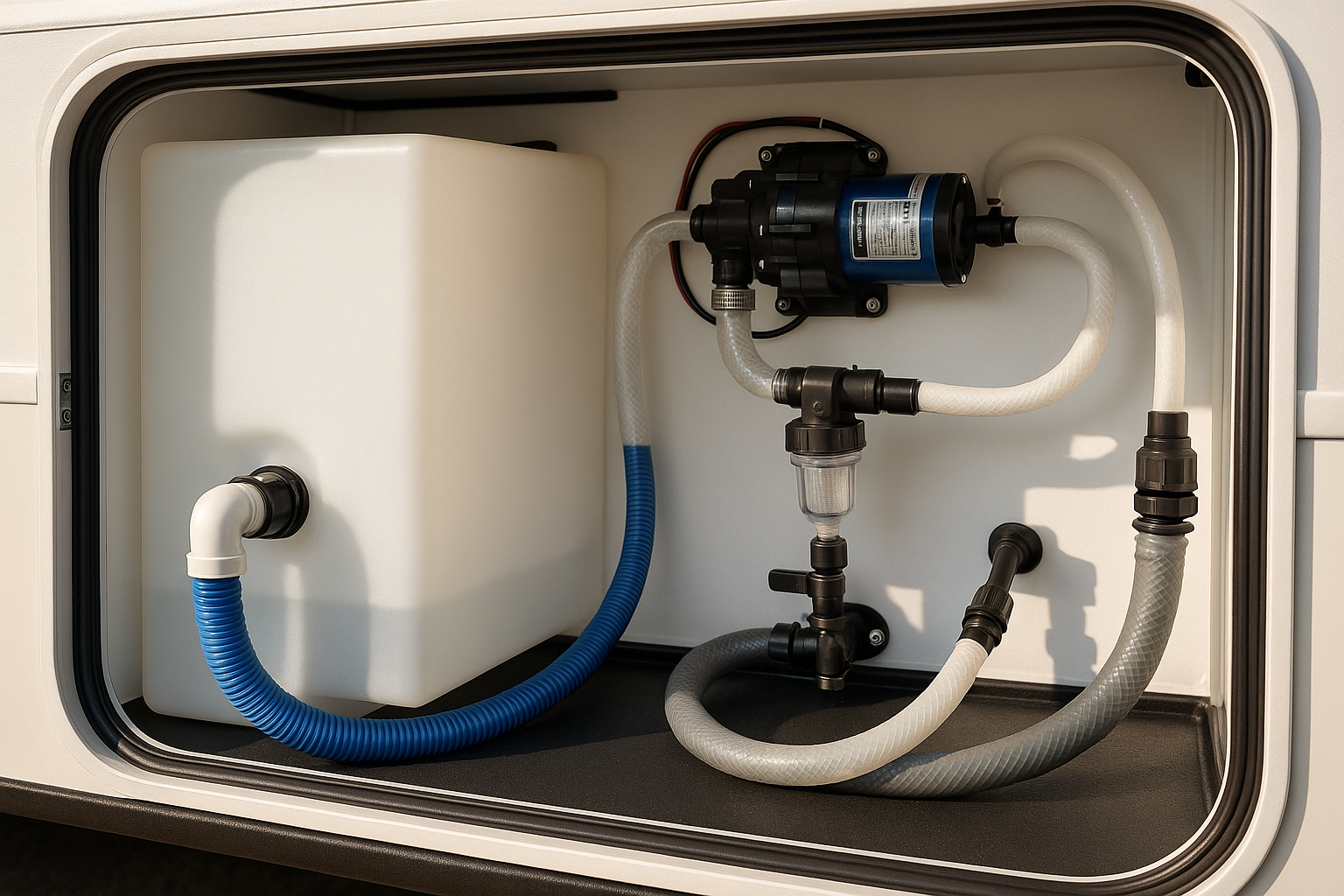
Many RV pump complaints are really installation complaints. Even a good pump can sound terrible if bolted directly to thin flooring or rigid plumbing. We favor pumps that run smoothly and pair well with flexible hose sections and vibration-damping mounts.
Cycling Behavior
A pump that turns on and off too often can be annoying and can wear components faster. Better pumps maintain pressure more evenly, especially when paired with an accumulator tank.
Power Draw
Off-grid RV owners need to think about battery use. Higher-output pumps often draw more amps. If you rely heavily on solar and battery storage, efficiency matters.
Serviceability and Parts Availability
On the road, easy replacement matters. We give extra credit to pumps with broad parts support and widespread availability through RV dealers, marine suppliers, and online retailers.
How to Choose the Right RV Water Pump
Not every RV needs the highest-flow model. We recommend matching the pump to your actual camping style and plumbing system.
For Weekend Campers
If you mainly use one fixture at a time and want a simple replacement, a 3.0 GPM pump like the Shurflo Revolution 4008 or Lippert Flow Max is usually enough.
For Families or Larger Fifth Wheels
If two people may use water nearly at once, or if your shower performance is underwhelming, moving up to a 4.0 to 5.5 GPM pump can make a big difference.
For Full-Time Boondocking
We recommend prioritizing durability, smooth pressure control, and serviceability. In that case, the Remco Aquajet ARV is one of the strongest long-term choices.
For Noise-Sensitive Installations
If your current pump wakes everyone up at night, focus on quiet operation and installation upgrades. A quieter pump plus flexible lines often matters more than raw flow.
Signs It’s Time to Replace Your RV Water Pump
A weak pump is not always completely dead. Sometimes the warning signs build slowly.
Common Symptoms
- Pressure drops even with a full fresh tank
- Pump runs but faucets sputter or pulse heavily
- Pump cycles on and off with no water being used
- Excessive noise, rattling, or vibration
- Water leaks from the pump housing or fittings
- The pump fails to prime consistently
Before replacing the pump, we also recommend checking for clogged strainers, kinked lines, air leaks on the intake side, and failing check valves.
How to Install an RV Water Pump
Most 12V RV water pumps are straightforward to replace if you have basic hand tools and safe access to the plumbing bay or under-bench compartment.
Tools and Materials
- Replacement RV water pump
- Screwdriver set
- Adjustable wrench or pliers
- Teflon tape or thread sealant rated for potable water
- Flexible hose or pump connectors
- Wire connectors or crimp terminals
- Drill or driver if remounting is needed
- Towels or shallow pan for water drips
- Multimeter for checking 12V power
Safety Tips
- Turn off 12V power to the pump at the switch and fuse panel
- Disconnect shore power if working near shared electrical areas
- Turn off the water supply and drain pressure from the lines
- Keep wiring connections dry and secure
- Confirm correct polarity before reconnecting power
Step-by-Step Installation
- Shut off power and water. Turn off the pump switch, remove the fuse if possible, and relieve water pressure by opening a faucet.
- Access the old pump. Place towels or a catch pan under the unit because some water will spill when lines are disconnected.
- Label wiring and plumbing orientation. We like to take a quick photo first so reinstalling is easier.
- Disconnect inlet and outlet lines. Remove fittings carefully to avoid cracking old plastic connectors.
- Remove the old pump from its mount. Unscrew the mounting feet and inspect the surface for damage or excessive vibration wear.
- Install the new pump. Mount it according to the flow-direction arrow and avoid overtightening the feet.
- Reconnect plumbing. Use fresh thread sealant where needed and consider adding flexible hose sections to reduce vibration.
- Reconnect wiring. Match positive and negative leads correctly and secure all terminals.
- Prime and test. Refill the system, turn the pump on, and run water through each faucet until air clears from the lines.
- Check for leaks and cycling. Let the pump pressurize and sit. If it cycles without water use, inspect for leaks or pressure loss.
Tips for Better Water Pressure Off-Grid
Even the best pump cannot fix every plumbing problem by itself. We have seen owners replace a pump when the real issue was elsewhere.
Add an Accumulator Tank
An accumulator helps smooth flow, reduce pulsing, and cut down on rapid cycling. It can also make a modest pump feel more refined.
Upgrade Old Hoses and Fittings
Collapsed flexible lines, partially clogged strainers, and restrictive fittings can choke a pump’s performance. Replacing weak links often restores pressure.
Clean the Pump Strainer
Many pumps have an inlet strainer that traps debris from the fresh tank. If it clogs, flow drops fast.
Check Battery Voltage
Low voltage can make a 12V pump run weakly or inconsistently. If your battery bank is undercharged or wiring is undersized, the pump may not perform as rated.
Use a Better Showerhead
A quality low-flow RV showerhead can improve the feel of pressure while conserving tank water.
Our Overall Recommendations
If we had to narrow the list down, we would recommend the Shurflo Revolution 4008 for most RV owners because it hits the sweet spot of performance, reliability, and replacement ease. For larger rigs or heavier water use, the Seaflo 55 Series gives noticeably stronger flow. If budget is less of a concern and you want a premium upgrade, the Remco Aquajet ARV is one of the best-performing options we reviewed.
The right choice depends on how you camp. A couple in a small travel trailer has very different needs than a family in a large fifth wheel. We always recommend buying for your actual demand, not just the biggest number on the box.
Frequently Asked Questions
1. What size RV water pump do most RVs need?
Most RVs do well with a 3.0 GPM pump in the 45 to 55 PSI range. Larger rigs or owners who want stronger shower performance may prefer 4.0 GPM or more.
2. Is a higher GPM RV water pump always better?
No. Higher GPM can improve flow, but it may also increase noise, power draw, and cycling if the rest of the plumbing system is not matched to it.
3. Why does my RV water pump keep cycling when no faucet is on?
This usually points to a small leak, pressure loss in the system, a bad check valve, or a failing pump pressure switch. We recommend checking fittings, toilet valves, and the water heater bypass first.
4. Can we install an RV water pump ourselves?
Yes. Most 12V RV pumps are DIY-friendly if you can safely access the unit, shut off power, and reconnect plumbing and wiring correctly.
5. Do we need an accumulator tank with a new pump?
Not always, but we often recommend one. It helps smooth water flow, reduce pulsing, and make the system quieter and more consistent.
Get your free Get Our Free Full-Timer's Gear Guide
The no-fluff gear list trusted by full-time RVers — tested in real conditions across North America.