Best LED Interior Lights for RVs: Brighter and Lower Draw (2026)

Alana Azzouz is a Senior Editor at Searchshop Media Network with over a decade of experience in consumer content quality and editorial standards. She has reviewed thousands of product guides, buying articles, and comp…
✎ Reviewed by Alana Azzouz — Senior Editor
Why trust us
RVGearInsider articles are researched by the Searchshop Editorial team using manufacturer specs, independent expert sources, and owner feedback. Our goal is simple: when an RVer searches for gear, the recommendations they read online should match what a knowledgeable dealer or experienced owner would actually suggest. We may earn a commission on qualifying affiliate purchases; it doesn't influence what we recommend — if a product changes or a better option comes along, the article changes too.
How We Evaluated
We researched the top options, comparing them across key factors including performance, value, ease of use, and reliability. Our recommendations are based on editorial evaluation of verified specifications, owner-reported real-world performance, and domain expertise.
Best LED Interior Lights for RVs: Brighter and Lower Draw
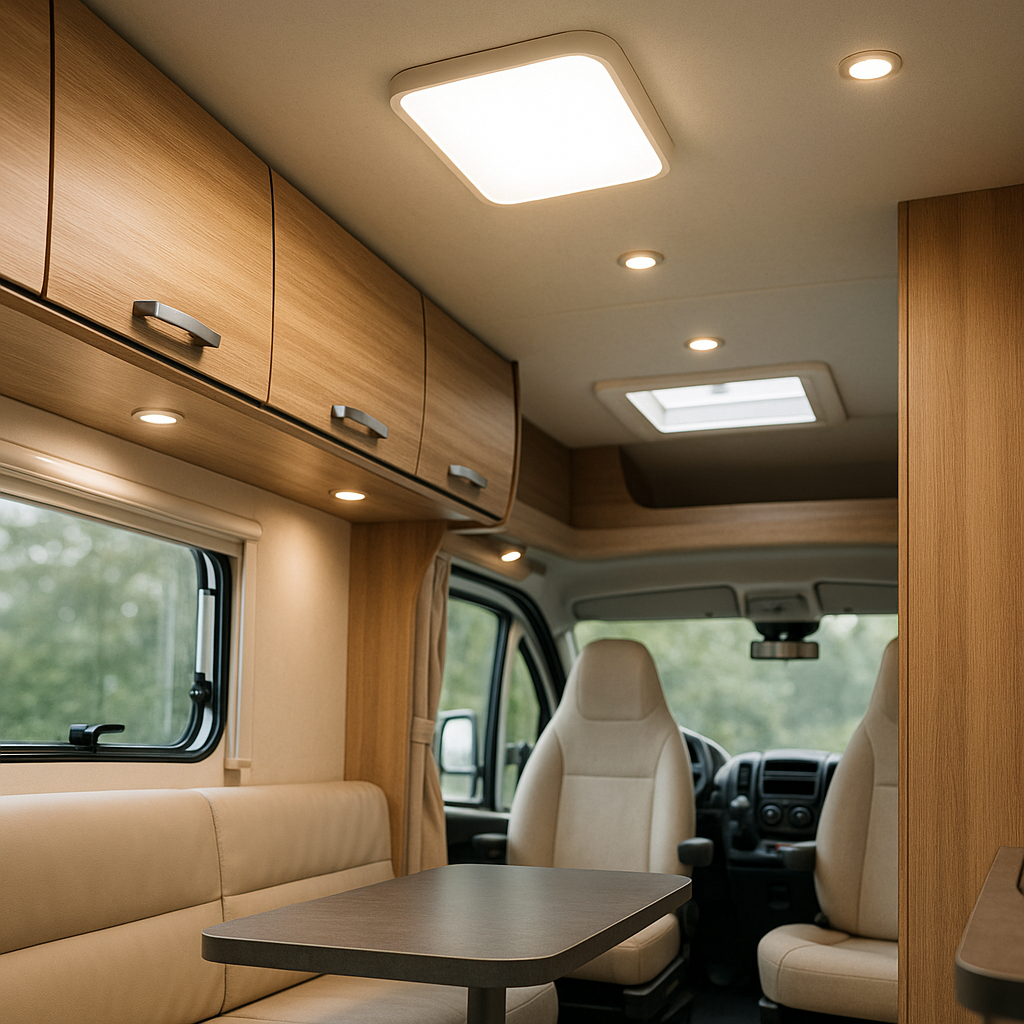
If we are searching for the best rv led interior lights, we usually want three things at once: more brightness, less battery drain, and a cleaner, more comfortable light inside the rig. Stock RV bulbs are often dim, yellow, hot-running, or power-hungry. A smart LED upgrade can make the cabin feel newer, improve visibility for cooking and reading, and help us stretch battery capacity longer when we are off-grid.
In this buyers guide, we compare the top types of RV interior LED lights, explain what really matters before we buy, and show how to match the right light to each space in the RV.
Quick Comparison: Best RV LED Interior Lights

| Product Type | Best For | Brightness | Color Temp | Power Source | Key Advantage | Possible Drawback |
|---|---|---|---|---|---|---|
| LED Replacement Bulbs (921/194/1141 style) | Fast upgrades using existing fixtures | Moderate to high | Warm, natural, cool | 12V fixture socket | Cheapest and easiest upgrade | Light quality depends on old fixture |
| LED Pancake Panels | Dome light conversions | High | Usually natural/cool options | 12V adapter board | Strong output in compact fixtures | Can look utilitarian |
| Double Dome LED Fixtures | Full fixture replacement | High | Warm to cool depending on model | Hardwired 12V | Big brightness gain and fresh look | More install work |
| Dimmable LED Ceiling Lights | Main living areas | Moderate to high | Warm or natural white | Hardwired 12V | Better ambiance and control | Not all dimmers are compatible |
| Under-Cabinet LED Light Bars | Kitchen and work surfaces | Focused high output | Natural or cool white | Hardwired or stick-on 12V | Excellent task lighting | Some adhesive kits are less durable |
| LED Reading Lights with Switch/USB | Bedside and bunks | Focused | Warm or natural white | Hardwired 12V | Directional beam and convenience | Narrow beam is not for full-room lighting |
| Motion-Sensor LED Lights | Night use, closets, bath | Low to moderate | Warm or cool | Battery or 12V | Great for nighttime navigation | Battery models need recharging |
Why Upgrade to LED Interior Lights in an RV?
Interior LED lighting is one of the easiest and most noticeable RV upgrades we can make. Compared with older incandescent or halogen bulbs, quality LEDs offer several practical advantages:
- Lower power draw: Ideal for boondocking and battery conservation
- Higher brightness per watt: More usable light without overloading 12V systems
- Less heat: Safer and more comfortable in small interior spaces
- Longer lifespan: Fewer bulb changes over time
- Better color options: Warm white for relaxing, cool white for task lighting
- Cleaner appearance: Many fixtures modernize the cabin instantly
For many of us, lighting upgrades are not just about aesthetics. They directly affect battery runtime, comfort, and everyday usability.
Our Picks for the Best RV LED Interior Lights

Because RVs use different fixture styles, there is no single best light for every location. Instead, we recommend choosing by use case.
1. Best Overall for Easy Upgrades: LED Replacement Bulbs
If we want the fastest path to the best rv led interior lights, replacement bulbs are usually the starting point. They slide into many factory fixtures and instantly reduce power draw.
Pros
- Lowest-cost upgrade path
- Usually plug-and-play
- Major reduction in amp draw
- Available in multiple socket types and color temperatures
Cons
- Old fixture lenses can limit performance
- Some cheap bulbs flicker or have poor color rendering
- Beam pattern may be uneven in certain housings
Who It’s For
This option is best for RV owners who want a quick, budget-friendly conversion without replacing entire fixtures.
2. Best for Dome Fixtures: LED Pancake Panels
Pancake-style LED boards are popular in RV dome lights because they produce a lot of light in a compact shape. Many kits include adapters for common bulb bases, making them easy to retrofit.
Pros
- Bright output for the size
- Good for older dome housings
- Efficient and widely available
- Often inexpensive per fixture
Cons
- Appearance is hidden but still somewhat basic
- Adhesive mounting quality varies
- Some models run too cool-blue for cozy interiors
Who It’s For
We like these for owners who want strong overhead lighting in existing fixtures, especially in kitchens, hallways, and living areas.
3. Best Full Replacement Option: Double Dome LED Fixtures
When the old fixture is cracked, yellowed, or inefficient, a full replacement often makes more sense than swapping bulbs. Double dome LED fixtures are common in RVs and can provide broad, even light.
Pros
- Complete refresh of look and performance
- Broad coverage for general cabin lighting
- Often includes separate side switches
- Better lens clarity than old fixtures
Cons
- Requires removing and rewiring the old fixture
- Fixture dimensions must match available space
- Budget models may use harsh cool-white LEDs
Who It’s For
This is the best fit for us when we want a clean factory-like upgrade in the main cabin, bedroom, or hallway.
4. Best for Ambiance: Dimmable LED Ceiling Lights
Not every RV needs maximum brightness all the time. Dimmable LED ceiling lights let us soften the cabin in the evening and brighten it for chores or meal prep.
Pros
- Adjustable brightness improves comfort
- Great for multipurpose spaces
- Can reduce glare at night
- Often looks more residential and modern
Cons
- Need compatible switches or dimmers
- Usually cost more than basic fixtures
- Installation can be more involved
Who It’s For
We recommend dimmable options for living rooms, dinettes, and bedrooms where mood and flexibility matter.
5. Best for Task Lighting: Under-Cabinet LED Light Bars
Task lighting is often missing in RV kitchens. Under-cabinet LED bars solve that by putting bright light exactly where we prep food, wash dishes, or use a laptop.
Pros
- Excellent illumination on counters
- Efficient and space-saving
- Can be hidden for a clean look
- Useful in kitchens, desks, and wardrobes
Cons
- Adhesive-only installs may fail in heat
- Wiring can take planning
- Some bars create visible hotspots
Who It’s For
These are ideal for RVers who cook often, work remotely, or want more practical light in specific work zones.
6. Best for Bedside Use: Adjustable LED Reading Lights
A focused reading light is one of the most underrated RV upgrades. It keeps us from flooding the whole bedroom with light when only one person wants to read.
Pros
- Directional beam reduces disturbance
- Compact and easy to mount
- Many include built-in switches or USB ports
- Great for bunks and headboards
Cons
- Not meant for broad room lighting
- Some necks loosen over time
- USB-equipped models may cost more
Who It’s For
We like these for couples, bunkhouses, and anyone who reads in bed or wants more focused personal lighting.
7. Best for Night Use: Motion-Sensor LEDs
For bathrooms, entry steps, and nighttime paths, motion-sensor lights add safety without forcing us to turn on a bright overhead fixture.
Pros
- Convenient at night
- Helps prevent trips and stumbles
- Low power use
- Easy to add in dark corners
Cons
- Battery versions need charging or replacement
- Sensors can be inconsistent in some layouts
- Usually supplemental, not primary, lighting
Who It’s For
This is a smart add-on for families, older RVers, and anyone who wants easier navigation after dark.
How to Choose the Best RV LED Interior Lights
Not all LEDs are created equal. Here is what we should look at before buying.
Brightness: Lumens Matter More Than “Watts”
LEDs use far less power than incandescent bulbs, so wattage is not the best comparison point. Instead, we should check lumens, which measure light output.
General guidelines:
- Reading light: 150–300 lumens
- Small dome or accent light: 200–400 lumens
- Main ceiling fixture: 400–800+ lumens
- Task light for kitchen or desk: 300–700 lumens
If we boondock often, it helps to balance brightness with battery draw rather than just choosing the highest lumen number.
Color Temperature: Warm vs Natural vs Cool
Color temperature changes how the RV feels inside.
- Warm white (2700K–3200K): Cozy, softer, more home-like
- Natural white (3500K–4500K): Balanced, clean, versatile
- Cool white (5000K–6500K): Crisp and bright, better for task areas
For most RV interiors, we find natural white gives the best mix of comfort and visibility. Warm white is excellent in bedrooms and lounges, while cool white works best in kitchens, bathrooms, and workstations.
Power Draw and Battery Use
One of the main reasons to switch to LED is lower amp draw. Even a modest conversion across several fixtures can save meaningful battery capacity over an evening.
When comparing products, look for:
- Wattage or amperage per fixture
- Number of lights used at once
- Whether the light is intended for 12V DC systems
- Efficiency relative to lumen output
Cheap high-output LEDs sometimes use more power than expected, so we should compare both brightness and consumption.
Voltage Compatibility
Most RV interior lights run on 12V DC, but voltage in real-world RV systems can fluctuate above 12V when charging. Better LED lights are designed to handle a wider voltage range, often something like 10V–30V DC.
That matters because poor-quality LEDs may flicker, overheat, or fail early when converter or charging voltage rises.
CRI: Better Color Rendering Looks Better Inside
CRI stands for Color Rendering Index. Higher CRI means colors look more natural under the light.
- 80 CRI: Acceptable in many budget lights
- 90+ CRI: Better for interiors, cooking, and overall visual comfort
If we care about a more residential look and less washed-out skin tones or cabinetry, higher CRI is worth seeking out.
Fixture Size and Mounting Style
Before ordering, we should verify:
- Existing bulb base or socket type
- Fixture dimensions
- Surface-mount vs recessed fit
- Lens clearance for replacement boards or bulbs
- Screw hole spacing for replacement fixtures
This step prevents one of the most common upgrade mistakes: buying lights that are electrically compatible but physically awkward.
Best Light Types by RV Area
Different spaces need different lighting. Here is how we usually break it down.
Living Area
Best choices:
- Double dome LED fixtures
- Dimmable ceiling fixtures
- Replacement bulbs for quick upgrades
We want broad, even lighting here, ideally with the option to dim in the evening.
Kitchen
Best choices:
- Under-cabinet LED bars
- Bright dome fixtures
- Natural or cool white LEDs
Task visibility matters most in the kitchen, so focused light often helps more than simply making the whole room brighter.
Bedroom
Best choices:
- Warm white ceiling lights
- Adjustable reading lights
- Dimmable fixtures
Bedrooms benefit from softer light and more control.
Bathroom
Best choices:
- Bright natural/cool white LEDs
- Moisture-resistant fixtures
- Motion-sensor night lights
We usually want clear, shadow-reducing light in this small space.
Hallway, Entry, and Steps
Best choices:
- Motion-sensor LEDs
- Low-draw accent lights
- Compact dome fixtures
These areas benefit from convenience and safety more than raw brightness.
Common Mistakes to Avoid
A lighting upgrade is simple, but a few mistakes can ruin the result.
Buying the Cheapest LEDs Available
Ultra-cheap LEDs often suffer from:
- Flicker
- Blue-tinted light
- Short lifespan
- Weak adhesive
- Poor voltage tolerance
We usually save more in the long run by buying quality lights once.
Choosing Only Cool White Everywhere
Cool white can feel bright at first, but too much of it makes an RV interior feel sterile. Mixing color temperatures by zone usually creates a more comfortable space.
Ignoring Lens and Fixture Condition
If the old fixture lens is cloudy, brittle, or yellowed, a replacement bulb may not deliver the improvement we expect. In those cases, a full fixture replacement is often smarter.
Overlooking Dimming Compatibility
Not all LEDs dim well, and not all dimmers work with every LED. If dimming matters, we should confirm compatibility before buying.
How We Install RV LED Interior Lights
The exact process depends on whether we are replacing a bulb or a whole fixture, but the basic workflow is straightforward.
1. Turn Off 12V Power
We disconnect the battery or switch off the relevant 12V circuit to avoid shorts.
2. Remove the Lens or Old Fixture
For bulb swaps, we remove the lens and old bulb. For fixture replacements, we unscrew the old housing and expose the wiring.
3. Confirm Socket Type or Wire Polarity
We verify the bulb base, adapter, or positive/negative wire orientation before installing the new light.
4. Test Fit the LED
We make sure the replacement bulb, panel, or fixture physically fits without pinching wires or interfering with the lens.
5. Connect and Test Before Final Assembly
We restore power briefly to confirm the light works. If a polarity-sensitive LED does not light, we reverse the connection if the design allows.
6. Secure the Light and Reinstall the Lens
Once tested, we mount everything firmly and reinstall any covers or lenses.
7. Check for Heat, Flicker, and Glare
After a few minutes of use, we confirm the light is stable, comfortable, and not producing excessive glare.
Our Final Buying Advice
The best rv led interior lights are the ones that match how we actually use the coach. For a fast and inexpensive improvement, replacement bulbs or LED panels are hard to beat. For a more polished upgrade, new double dome or dimmable fixtures can transform the cabin. And for everyday convenience, task lights and reading lights often deliver the biggest real-world benefit.
If we had to prioritize, we would usually upgrade in this order:
- Main living area ceiling lights
- Kitchen task lighting
- Bedroom reading lights
- Bathroom and hallway lights
- Motion-sensor nighttime lighting
That sequence gives us the biggest jump in comfort and efficiency right away while keeping battery draw under control.
FAQ
What color LED is best for RV interior lights?
For most RVs, natural white around 3500K to 4500K is the best all-around choice. We like warm white in bedrooms and cool white in kitchens or bathrooms.
Do LED lights really save that much battery power in an RV?
Yes. LED lights use much less power than incandescent bulbs, especially when multiple fixtures are on for several hours. This can make a noticeable difference when boondocking.
Can we just replace RV bulbs with LED, or should we replace the whole fixture?
If the existing fixture is in good shape, replacing bulbs is often enough. If the lens is yellowed, cracked, or poorly designed, replacing the whole fixture usually gives better results.
Are RV LED interior lights hard to install?
Most are easy to moderate in difficulty. Bulb swaps are simple, while full fixture replacements require basic 12V wiring knowledge and careful polarity checks.
What should we avoid when buying RV LED lights?
We should avoid unknown ultra-cheap lights with poor voltage tolerance, harsh blue color, low CRI, or inconsistent build quality. It is better to choose lights designed specifically for RV 12V use.
Get your free Get Our Free Full-Timer's Gear Guide
The no-fluff gear list trusted by full-time RVers — tested in real conditions across North America.