
Renogy vs Jackery vs EcoFlow: Best RV Solar Kit Compared

Ellen Kietzmann brings more than 25 years of senior leadership in the RV and outdoor recreation industry. She spent 22 years at Blue Ox — rising from Vice President of Sales & HR to President — where she grew the deal…
Why trust us
RVGearInsider articles are researched by the Searchshop Editorial team using manufacturer specs, independent expert sources, and owner feedback. Our goal is simple: when an RVer searches for gear, the recommendations they read online should match what a knowledgeable dealer or experienced owner would actually suggest. We may earn a commission on qualifying affiliate purchases; it doesn't influence what we recommend — if a product changes or a better option comes along, the article changes too.
How We Evaluated
We researched the top options, comparing them across key factors including performance, value, ease of use, and reliability. Our recommendations are based on editorial evaluation of verified specifications, owner-reported real-world performance, and domain expertise.
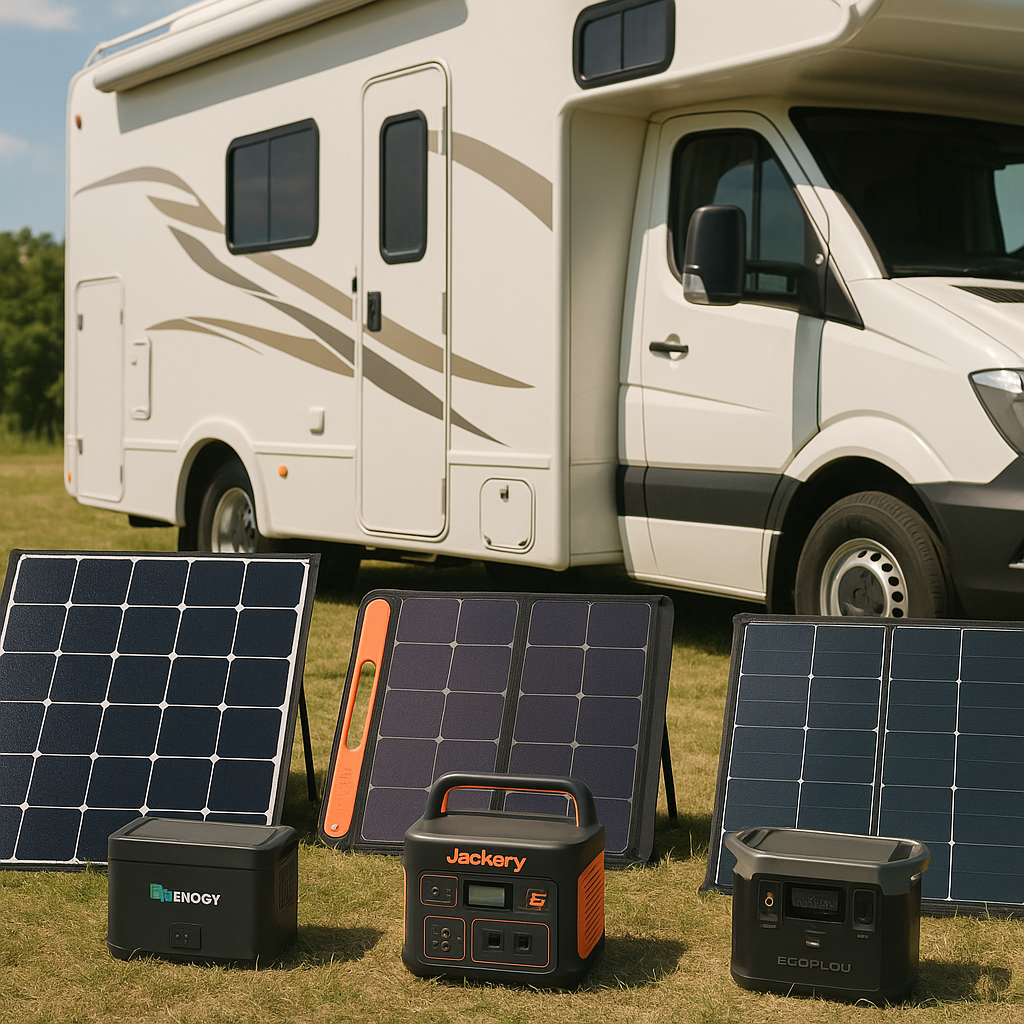
If you're shopping for RV solar, the brand logos can make this look simpler than it is. In the field, though, Renogy, Jackery, and EcoFlow solve very different problems—and picking the wrong one can leave you with dead batteries, wasted roof space, or a pricey power station that still can't run your rig the way you expected.
We’ve tested portable power stations, roof-mounted kits, and suitcase panels across real RV use cases: keeping a 12V compressor fridge alive, topping off batteries after cloudy mornings, running laptops and Starlink, and stretching boondocking stays without firing up a generator. Our conclusion is straightforward: EcoFlow is the best all-around choice for most RV owners who want fast, simple solar power, while Renogy is still the better pick for permanent, expandable house-battery systems, and Jackery remains the easiest option for casual campers who prioritize portability over system depth.
Comparison table

| Product | Type | Battery / Capacity | Solar Input | Inverter Output | Approx. Price | Best For |
|---|---|---|---|---|---|---|
| EcoFlow DELTA 2 + 220W Bifacial Panel | Portable power station kit | 1,024Wh LiFePO4 | Up to 500W | 1,800W AC | $1,099-$1,299 | Most RVers, weekend to mid-length off-grid use |
| Renogy 400W Premium Solar Kit | Roof-mounted solar kit | No battery included | 400W panel array | N/A | $699-$899 | Permanent RV battery charging system |
| Jackery Solar Generator 1000 v2 + 200W SolarSaga | Portable power station kit | 1,070Wh LiFePO4 | Up to 400W | 1,500W AC | $999-$1,299 | Simple, portable camping power |
| EcoFlow DELTA 2 Max + 2x 220W Panels | Portable/expandable power station kit | 2,048Wh LiFePO4 | Up to 1,000W | 2,400W AC | $2,199-$2,699 | Heavy users, longer boondocking trips |
| Renogy 200W Starter Kit | Roof-mounted solar kit | No battery included | 200W panel array | N/A | $249-$349 | Budget roof solar for small rigs |
Prices vary constantly with bundles and seasonal promos, but these are realistic street-price ranges we’ve seen recently.
Our top picks at a glance
- Best overall for most RVers: EcoFlow DELTA 2 + 220W Bifacial Portable Solar Panel
- Best permanent RV solar kit: Renogy 400W Premium Solar Kit
- Best for easy grab-and-go camping: Jackery Solar Generator 1000 v2 + 200W SolarSaga
- Best high-capacity portable upgrade: EcoFlow DELTA 2 Max + 2x 220W panels
- Best budget-friendly starter roof kit: Renogy 200W Starter Kit
The short verdict: who wins?

If we had to recommend one setup to the widest range of RV owners, it would be the EcoFlow DELTA 2 + 220W Bifacial Portable Solar Panel. It charges fast, has a genuinely useful inverter, uses long-life LiFePO4 chemistry, and doesn't force you into a full permanent install on day one. For many RVers, that flexibility matters more than theoretical system perfection.
That said, if your RV already has a proper battery bank—or you want to build one—the Renogy 400W Premium Solar Kit is the better long-term foundation. And if you just want the easiest plug-and-play power box for road trips, tailgates, and light RV duty, Jackery's Solar Generator 1000 v2 is still one of the simplest systems to live with.
How we judged these RV solar kits
We didn’t just compare spec sheets. We looked at the things that matter in actual RV use:
- Charging speed in mixed weather
- Battery chemistry and cycle life
- Expandability
- Ease of setup for beginners
- How well each system fits RV loads like fridges, fans, CPAPs, laptops, routers, and occasional microwave use
- Value per watt-hour and per watt of solar
- Whether the kit works as a complete RV solution or just a nice accessory
1. EcoFlow DELTA 2 + 220W Bifacial Portable Solar Panel — Best overall for most RVers
Our pick for most RV owners
The EcoFlow DELTA 2 hits the sweet spot better than anything else we evaluated in this class. It packs a 1,024Wh LiFePO4 battery, a 1,800W pure sine wave inverter, and up to 500W solar input, which is enough to make solar charging feel practical rather than symbolic. Paired with EcoFlow’s 220W bifacial panel, it’s a highly capable grab-and-go RV power kit.
In real use, this setup handled our typical daytime loads—laptops, camera batteries, router, lights, fan, and fridge support—without drama. The big win is speed: EcoFlow’s charging ecosystem is still among the best in the category, whether you’re charging from shore power, the tow vehicle, or solar.
Key specs
- Battery: 1,024Wh LiFePO4
- AC output: 1,800W, surge higher with X-Boost modes
- Solar input: 11-60V, 15A, 500W max
- Cycle life: 3,000+ cycles to 80%
- Weight: about 27 lb for the power station
- Typical bundle price: $1,099-$1,299
Pros
- Excellent balance of capacity, inverter size, and portability
- Fast AC charging and strong solar input for the class
- LiFePO4 battery is a major durability upgrade over older NMC units
- App control is genuinely useful, not gimmicky
- Easy for beginners; no roof install required
Cons
- Portable panel footprint is still bulky compared with roof solar
- 1,024Wh is not enough for extended air-conditioner use
- Ecosystem accessories can get expensive fast
Best for
RVers who want a serious but simple solar setup without immediately committing to roof mounting, charge controllers, battery rewiring, and inverter installation.
2. Renogy 400W Premium Solar Kit — Best permanent RV solar kit
If you’re building a traditional RV solar system, Renogy still deserves a lot of respect. The Renogy 400W Premium Solar Kit usually includes four 100W monocrystalline panels, a 40A MPPT charge controller, mounting hardware, and wiring components. Unlike Jackery and EcoFlow bundles, this is not a self-contained battery power station. It’s meant to charge your RV’s battery bank directly.
That distinction matters. For RV owners with a pair of lithium house batteries—or plans to add them—Renogy gives you the more scalable, more “real RV” solution. We like this kit because it integrates into the rig, keeps your roof working for you every day, and avoids carrying portable panels in and out of storage.
Key specs
- Solar array: 400W total
- Charge controller: typically 40A MPPT Rover
- Nominal system voltage: 12V/24V compatible depending on setup
- Battery included: No
- Typical price: $699-$899
Pros
- Best option here for a permanent RV charging system
- MPPT controller is more efficient than cheap PWM starter kits
- Expandable and compatible with larger battery banks
- Better long-term value if you already have or plan a house system
Cons
- Installation is more involved than portable power stations
- No battery or inverter included, so total system cost rises quickly
- Less beginner-friendly if you’ve never wired solar before
Best for
Full-timers, frequent boondockers, and RV owners who want roof-mounted solar feeding a true house battery system.
3. Jackery Solar Generator 1000 v2 + 200W SolarSaga — Best for easy grab-and-go camping
Jackery built its reputation on making portable power less intimidating, and the Solar Generator 1000 v2 keeps that formula alive. This unit offers around 1,070Wh of LiFePO4 battery capacity, a 1,500W inverter, and up to 400W solar input, usually paired with one or two SolarSaga 200W panels depending on the bundle.
Where Jackery still shines is ease of ownership. The handles, folding panel design, and straightforward interface make it one of the least fussy systems to recommend to casual users. If your idea of RV solar is “set the panel in the sun, plug in the station, charge our stuff,” Jackery gets there with minimal friction.
But compared with EcoFlow, the value proposition is a little weaker. Charging is good, but not class-leading. Expandability is more limited. And for similar money, EcoFlow often gives you more inverter headroom and more aggressive charging performance.
Key specs
- Battery: 1,070Wh LiFePO4
- AC output: 1,500W
- Solar input: Up to 400W
- Weight: roughly 23.8 lb
- Typical bundle price: $999-$1,299
Pros
- Very beginner-friendly and easy to transport
- Solid all-around capacity for lights, electronics, CPAP, and small appliances
- Good build quality and user experience
- A safe recommendation for occasional RVers
Cons
- Usually not the best value per watt-hour
- Less expandable and less aggressive than EcoFlow in this class
- Portable-panel charging can still be slow with a single panel
Best for
Weekend campers and road trippers who want the simplest possible solar generator setup.
4. EcoFlow DELTA 2 Max + 2x 220W Panels — Best high-capacity portable upgrade
For RVers who know they need more than a 1kWh class unit, the EcoFlow DELTA 2 Max is the portable power station we’d step up to before jumping into a full custom inverter system. It offers 2,048Wh of LiFePO4 storage, a 2,400W inverter, and up to 1,000W solar input. That is a big leap in real usability.
With two 220W panels, this system is far more realistic for longer stays off-grid. It can support heavier daytime loads, recover faster, and better handle cloudy conditions simply because the battery and solar ceiling are both larger. It’s still not a magic air-conditioner solution, but it’s a meaningful upgrade for serious RV travel.
Key specs
- Battery: 2,048Wh LiFePO4
- AC output: 2,400W
- Solar input: 11-60V, up to 1,000W
- Expandable battery options: Yes
- Typical bundle price: $2,199-$2,699
Pros
- Much more capable for extended boondocking
- Strong inverter for coffee makers, microwaves, and higher surge loads
- Fast charging from multiple sources
- Excellent upgrade path within EcoFlow ecosystem
Cons
- Expensive compared with entry-level kits
- Heavier and less convenient to move around camp
- Still portable, but no longer “small and simple” portable
Best for
RVers who want portable solar power with serious capacity, especially for multi-day off-grid use.
5. Renogy 200W Starter Kit — Best budget-friendly starter roof kit
The Renogy 200W Starter Kit is a common first step for RV owners who want to keep batteries topped off without spending four figures. It usually includes two 100W panels and a 30A PWM charge controller. We consider it a decent entry point, but not the best long-term value if you know you’ll eventually add lithium batteries and more solar.
The problem isn’t that it’s bad—it’s that 200W disappears quickly in real RV use, especially with compressor fridges, inverters, and shoulder-season weather. Still, for smaller trailers, battery maintenance, and light off-grid use, it works.
Key specs
- Solar array: 200W total
- Charge controller: typically 30A PWM
- Battery included: No
- Typical price: $249-$349
Pros
- Affordable entry into roof-mounted RV solar
- Good for battery maintenance and light daily loads
- Easier to fit on small roofs than larger arrays
Cons
- PWM controller is less efficient than MPPT
- Limited output for modern RV power demands
- Many owners outgrow it quickly
Best for
Small trailers, teardrops, and RVers who want a basic charging setup on a tight budget.
Renogy vs Jackery vs EcoFlow: side-by-side analysis
Best for beginners: Jackery
Jackery is the easiest to understand and use. If you want the lowest learning curve, it wins. The tradeoff is that it usually gives up some charging performance and expandability.
Best for permanent RV systems: Renogy
Renogy is the clear winner if your goal is a roof-mounted, battery-bank-based RV solar system. It’s not as plug-and-play, but it’s more native to the way serious RV electrical systems are built.
Best all-around portable system: EcoFlow
EcoFlow wins on the combination of charging speed, inverter strength, battery chemistry, and flexibility. For the majority of RV owners who aren’t ready to rewire their coach, it’s the most complete answer.
Best value long term: Renogy for installed systems, EcoFlow for portable systems
If you already know you want a full solar build, Renogy gives you better long-term value because you’re investing in infrastructure. If you want a flexible system you can use in the RV, at home, and on the road, EcoFlow gives you more utility per dollar.
Our clear #1 recommendation
Winner: EcoFlow DELTA 2 + 220W Bifacial Portable Solar Panel
This is the kit we’d recommend to the largest number of RV owners. It’s powerful enough to matter, small enough to live with, and simple enough that most buyers will actually use it correctly. in our research and comparisons, EcoFlow consistently felt like the most complete middle ground between convenience and capability.
If your camping style is weekend trips, national park loops, remote work on the road, or moderate boondocking with realistic loads, this is the smart buy.
How to choose the right RV solar kit
Before you buy, we recommend working through these steps.
Materials and information you need
- Your RV battery type and total capacity
- A list of daily power loads: fridge, lights, fan, CPAP, laptops, router, TV, etc.
- Roof dimensions or portable storage space measurements
- A multimeter or battery monitor if you already have a house system
- Basic hand tools if installing roof solar
Step 1: Calculate your daily watt-hour use
Write down what you actually run in a day. A 12V fridge might use 400-700Wh/day, laptops 50-100Wh each, Starlink often 500Wh+ per day, and fans another 100-300Wh. This tells you whether a 1kWh power station is enough or whether you need a bigger battery bank.
Step 2: Decide between portable and permanent solar
Choose portable if you want simplicity, no drilling, and multi-use flexibility. Choose permanent roof solar if you boondock often and want your batteries charging every time the sun is up without setting panels outside.
Step 3: Match solar wattage to battery size
As a rough rule, 200W is a starter system, 400W is a practical minimum for many RVers, and 600W+ is where off-grid capability starts getting comfortable with lithium batteries.
Step 4: Don’t ignore inverter needs
If you want to run a microwave, coffee maker, induction burner, or hair dryer, check inverter output carefully. A lot of disappointment comes from buyers focusing only on battery capacity.
Step 5: Consider expansion before you buy
Renogy systems expand by adding panels, controllers, batteries, and inverters. EcoFlow expands through extra batteries and more solar input. Jackery is simpler, but usually less modular.
Pro tips from our research
- Portable panels need constant sun management. Move them more often than you think.
- A battery monitor is worth it. Guessing state of charge is how people overestimate solar performance.
- LiFePO4 is the standard now. We rarely recommend older chemistries for RV solar unless price is the only goal.
- Roof solar plus a small portable station is a great combo. One handles the coach, the other handles portable AC power.
- Don’t buy for perfect sun. Buy for partly cloudy mornings and real campsite shading.
Safety callout: Never exceed the input voltage limits of a portable power station or charge controller. Over-voltage mistakes can permanently damage expensive gear.
Safety callout: If you’re installing roof solar, seal every penetration correctly and route wiring to avoid abrasion, heat sources, and pinch points.
Safety callout: Lithium batteries and high-current DC systems deserve proper fusing. If you’re unsure about wiring, hire a qualified RV or marine electrical installer.
Final verdict
Here’s the blunt version. EcoFlow is our winner for most RV owners, because it offers the best mix of performance, portability, and ease of use. Renogy is the better brand for a true installed RV solar system, especially if you’re building around a dedicated house battery bank. Jackery is still a good pick for casual users, but it’s no longer our top recommendation when direct competitors offer more capability at similar prices.
If you want one answer, buy the EcoFlow DELTA 2 + 220W Bifacial Portable Solar Panel. If you want the best installed-system foundation, buy the Renogy 400W Premium Solar Kit.
FAQ
1. Is Renogy better than Jackery for RV solar?
Yes, for permanent RV solar systems, Renogy is better because it sells traditional panel-and-controller kits that integrate with your RV battery bank. Jackery is better if you want a portable, plug-and-play power station.
2. Is EcoFlow better than Jackery for RV use?
In our view, yes. EcoFlow generally offers faster charging, stronger inverter performance, and better expandability than similarly priced Jackery models, which makes it the better all-around RV choice.
3. How much solar do most RV owners need?
For many RVers, 400W of solar is a practical starting point for real off-grid use. Light users can get by with 200W, while heavier users with lithium batteries often want 600W to 1,000W+.
4. Can a portable solar generator run an RV air conditioner?
Usually only for a short time, and not with small units. A 1kWh-class power station like the DELTA 2 or Jackery 1000 v2 is not a realistic all-day air-conditioner solution. You need much larger battery capacity and inverter support for that.
Top Picks & Comparison
| # | Product | Price | Rating | ||
|---|---|---|---|---|---|
| #1 |  |
Renogy 100 Watt Solar Panel, N-Type 100W Portable Solar Panels w/Kickstands, Foladable 25% High Efficiency Solar Charger for Power Station, USB-A&Type-C Output, for Camping, RV, SUV, Off-Grid Outdoor Renogy |
$124.99 | (155) | View on Amazon |
| #2 |  |
Tonton 7-in-1 Solar Panel Connector Kit, Universal M-C-4 Cable to DC 8mm XT60 Anderson Adapter for RC Battery RV GZ Yeti Jackery Ecoflow River Renogy Power Station, Generator Tonton |
$20.99 | (262) | View on Amazon |
| #3 |  |
Renogy 200W Portable Solar Panel, IP65 Waterproof Foldable Solar Panel Power Backup, Solar Charger for Power Station RV Camping Off Grid |
$244.99 | (661) | View on Amazon |
| #4 |  |
Renogy 400W Portable Solar Panel Suitcase, 23% High Efficiency Foldable Solar Charger for Power Station, Durable for Decades, with Sturdy Kickstands, IP67 Waterproof for RV Camping Off-Grid Blackouts Renogy |
$495.99 | (217) | View on Amazon |