
Garmin RV 1095 vs Rand McNally OverDryve: GPS Showdown for RV Owners
 By Salem Hassan — Co-Founder, Searchshop · 30+ years in RV & marine dealerships· December 24, 2025· 11 min read· Updated 1d ago
Salem Hassan has spent more than 30 years building and operating dealerships across the RV, marine, and powersports industries. He founded Suncoast RV in 1994 and later owned Travelcamp RV in Jacksonville for a decade…
Why trust us
RVGearInsider articles are researched by the Searchshop Editorial team using manufacturer specs, independent expert sources, and owner feedback. Our goal is simple: when an RVer searches for gear, the recommendations they read online should match what a knowledgeable dealer or experienced owner would actually suggest. We may earn a commission on qualifying affiliate purchases; it doesn't influence what we recommend — if a product changes or a better option comes along, the article changes too.
How We Evaluated
We researched the top options, comparing them across key factors including performance, value, ease of use, and reliability. Our recommendations are based on editorial evaluation of verified specifications, owner-reported real-world performance, and domain expertise.
If you’ve ever been routed under a low bridge, onto a weight-restricted county road, or through a downtown fuel-stop nightmare, you already know why RV-specific navigation matters. We’ve tested enough dash-mounted GPS units to say this plainly: not all “RV GPS” devices are equally smart, equally stable, or equally worth your money.
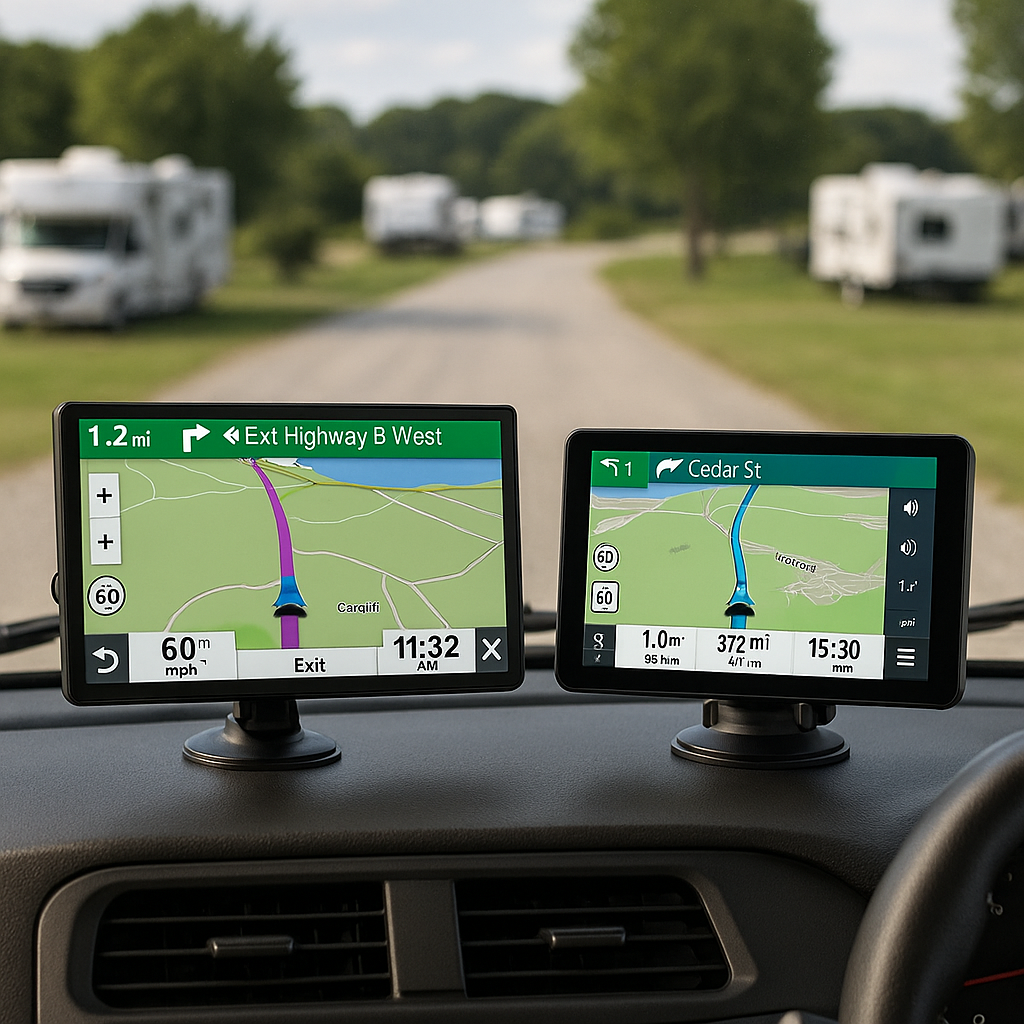
In this showdown, we’re putting the Garmin RV 1095 head-to-head with Rand McNally OverDryve models, then widening the lens to include a few of the best alternatives RV owners are actually cross-shopping. Our short verdict: Garmin is the safer bet for most RVers, especially if route reliability is your top priority. But there are a few important caveats depending on your rig, budget, and whether you want a pure GPS or an Android-powered all-in-one.
Comparison table

| Model | Screen Size | Key RV/Truck Routing | Voice Assistant / Smart Features | Approx. Price | Best For |
|---|---|---|---|---|---|
 Garmin RV 1095 Garmin RV 1095 |
10" | Custom RV routing by size/weight, road warnings, campground data | Voice assist, hands-free calling, live traffic/weather via app | $899.99 | Best overall for most RV owners |
| Rand McNally OverDryve 8 Pro II | 8" | RV/truck routing, mileage/log tools, Rand route database | Android tablet features, built-in dash cam, SiriusXM-ready | $499-$699 | Drivers wanting GPS + Android device |
| Garmin RV 895 | 8" | Custom RV routing, BirdsEye imagery, campground directories | Voice assist, live services via app | $699.99 | Best value if 10" is too big |
 Rand McNally TND 750 Rand McNally TND 750 |
7" | Truck/RV-style routing, fuel/rest tools, route planning | Voice assistant, connected services | $349-$399 | Budget-minded Rand fans |
| Garmin dēzl OTR1010 | 10" | Truck custom routing, arrival planning, load-to-dock guidance | Voice assist, live traffic via app | $799.99 | Big-rig and Super C users |
Price note: Street pricing changes often. We’ve listed typical current retail/MSRP ranges seen at major sellers.
Our quick verdict
Our #1 recommendation: Garmin RV 1095
For most Class A, Class C, fifth-wheel, and travel trailer owners, the Garmin RV 1095 is the best overall choice because it combines a huge 10-inch display, dependable custom RV routing, strong map support, campground directories, and a cleaner user experience than the OverDryve lineup. Rand McNally still has fans—especially drivers who like truck-style routing and Android app flexibility—but in our field use, Garmin has been more polished and more consistent.
Best RV GPS units we recommend

We’re focusing on real products RV owners can buy now or still commonly find through major retailers and marketplaces.
- Garmin RV 1095 — Best overall
- Rand McNally OverDryve 8 Pro II — Best for Android app integration
- Garmin RV 895 — Best value premium Garmin
- Rand McNally TND 750 — Best Rand option if you don’t need OverDryve features
- Garmin dēzl OTR1010 — Best for large-rig drivers who want truck-grade routing flexibility
Garmin RV 1095 vs Rand McNally OverDryve: side-by-side analysis
1. Routing accuracy and RV safety
This is the category that matters most, and it’s where Garmin wins.
The Garmin RV 1095 supports custom RV routing based on your rig’s dimensions and weight. You can input height, length, width, and weight, and the unit attempts to avoid roads with relevant restrictions. It also layers in warnings for steep grades, sharp curves, speed changes, and state border notices. in our research, Garmin’s route logic generally felt more conservative—in a good way. It was less likely to gamble on awkward local shortcuts that looked fine on a car GPS but made no sense in a motorhome.
The Rand McNally OverDryve 8 Pro II also offers RV and truck-aware routing, and Rand has long had a loyal following among commercial drivers. In broad terms, it’s capable. But compared with Garmin, we found the interface less intuitive and route recalculations a little less confidence-inspiring, especially when deviating from the planned route in suburban areas.
Winner: Garmin RV 1095
2. Screen size and readability
The Garmin RV 1095’s 10-inch edge-to-edge display is one of its biggest selling points. In a large coach, that extra screen real estate is not a luxury—it’s a usability upgrade. Junction views are easier to parse, lane guidance is clearer, and campground search results are easier to read from the driver’s seat.
The OverDryve 8 Pro II’s 8-inch display is still respectable, but once you’ve lived with a 10-inch RV-specific unit, it’s hard to go back. If you travel long days or share driving duties, the larger Garmin screen reduces eye strain and “what exit is that?” moments.
Winner: Garmin RV 1095
3. Smart features and app flexibility
This is where Rand McNally fights back.
The OverDryve line was designed as more than a GPS. The OverDryve 8 Pro II runs on Android and can act like a connected infotainment hub. Depending on the exact trim and setup, you may get access to apps, media, hands-free features, and in some versions a built-in dash cam. For drivers who want one device to handle navigation, entertainment, and connected tools, that flexibility is appealing.
The Garmin RV 1095 is more focused. It offers voice assist, Bluetooth hands-free calling, live traffic and weather when paired to the Garmin Drive app, and a polished RV travel feature set. But it is not trying to be a general-purpose Android tablet.
If your goal is best GPS, Garmin wins. If your goal is most gadget versatility, Rand has the edge.
Winner: Rand McNally OverDryve 8 Pro II
4. Ease of use and stability
We’re opinionated here: in day-to-day use, Garmin feels more finished.
The RV 1095 boots quickly, menus are cleaner, and route planning is easier to understand without a learning curve. Garmin’s campground directories, trip planning tools, and warning prompts feel integrated rather than bolted on.
The OverDryve experience can be powerful, but Android-based all-in-one devices often come with more setup, more menu layers, and more opportunities for lag or inconsistency. Some owners love that flexibility. We think many RVers just want a navigator that works every time they hit the ignition.
Winner: Garmin RV 1095
5. Value for money
At around $899.99, the Garmin RV 1095 is expensive. There’s no sugarcoating that. The OverDryve 8 Pro II usually lands much lower depending on retailer and condition, often in the $499 to $699 range. If your budget is tight, Rand looks tempting.
But value is not just purchase price. If a GPS saves you one ugly reroute, one difficult fuel-stop approach, or one white-knuckle downtown detour, the better device pays for itself quickly. For us, Garmin earns its premium because we trust it more.
Winner: Garmin RV 1095
Product-by-product picks
1) Garmin RV 1095 — Best overall RV GPS
Specs at a glance
- Screen: 10-inch high-resolution display
- Routing: Custom RV routing by rig size and weight
- Maps: North America, map updates included
- Features: RV parks and services, road warnings, BirdsEye Direct satellite imagery, voice assist, live traffic/weather via app
- Typical price: $899.99
What we liked
- Huge, easy-to-read screen
- Best overall route confidence for RV travel
- Strong campground and RV service databases
- Clean interface and fast recalculation
- Excellent lane guidance and junction views
What we didn’t
- Expensive
- Large footprint on the dash or windshield
- Live features depend on smartphone pairing
Bottom line: If you want the least compromised RV GPS we’ve tested in this class, this is it. It’s our top pick because it gets the fundamentals right.
2) Rand McNally OverDryve 8 Pro II — Best for all-in-one Android features
Specs at a glance
- Screen: 8-inch tablet-style display
- Routing: RV/truck-aware navigation
- Features: Android-based apps, Bluetooth, voice features, SiriusXM compatibility, built-in dash cam on some configurations
- Typical price: $499-$699
What we liked
- More versatile than a standard GPS
- Good option for drivers who want apps on the device
- Useful for truck-style trip tools and connected features
- Better value upfront than Garmin RV 1095
What we didn’t
- Interface feels busier and less polished
- Routing confidence not quite at Garmin’s level in our use
- Smaller screen than the RV 1095
- Long-term software experience can vary
Bottom line: If you specifically want an Android-powered navigation hub and are comfortable with a more complex device, the OverDryve still makes sense.
3) Garmin RV 895 — Best value premium Garmin
Specs at a glance
- Screen: 8-inch display
- Routing: Custom RV routing
- Features: RV parks and services, BirdsEye Direct imagery, Garmin Drive app integration, voice assist
- Typical price: $699.99
What we liked
- Nearly all the Garmin RV advantages in a smaller package
- Easier to mount than the 1095
- Better price-to-performance balance for many RVers
- Excellent route planning and travel tools
What we didn’t
- Not as immersive or readable as the 10-inch 1095
- Still expensive compared with budget options
Bottom line: For many buyers, this is the smartest buy in Garmin’s RV lineup. If the 1095 feels too pricey or too large, the 895 is the one we’d buy next.
4) Rand McNally TND 750 — Best Rand option for simpler navigation
Specs at a glance
- Screen: 7-inch display
- Routing: Truck-focused custom routing often used by RV owners with large rigs
- Features: Fuel/rest stop tools, route planning, connected services
- Typical price: $349-$399
What we liked
- Lower price than OverDryve and Garmin premium models
- Strong POI tools for long-haul style travel
- Better if you want Rand routing without full Android complexity
What we didn’t
- Smaller screen is a real downgrade in an RV cockpit
- Less RV-specific polish than Garmin RV series
- Interface still not our favorite
Bottom line: A reasonable budget-conscious pick for big-rig travelers who already like Rand McNally’s ecosystem.
5) Garmin dēzl OTR1010 — Best for truck-based RV platforms
Specs at a glance
- Screen: 10-inch display
- Routing: Custom truck routing, arrival planning, load-to-dock style guidance
- Features: High-resolution satellite imagery, route planning tools, live services via app
- Typical price: $799.99
What we liked
- Excellent for Super C owners and heavier, commercial-style rigs
- Big, sharp display
- Strong route awareness and arrival planning
- Often cheaper than the RV 1095
What we didn’t
- Less RV lifestyle content than Garmin’s RV series
- Better for truck logic than campground-first travel planning
Bottom line: If your RV use overlaps heavily with commercial truck routing needs, this is a very strong alternative.
How we choose the right RV GPS: our field checklist
If you’re shopping this category, here’s the process we recommend.
Materials / information to have before you buy
- Your RV’s exact height, length, width, and weight
- Tow vehicle and trailer dimensions if applicable
- Your preferred mounting location
- A smartphone for connected traffic/weather features
- Typical travel style: interstate, backroads, boondocking, or resort hopping
1. Measure your rig accurately
Do not guess your height. Measure to the tallest fixed point, including AC units, antennas, or satellite domes. A wrong height setting defeats the entire point of RV routing.
2. Decide whether you want a pure GPS or a smart device
If you want a dedicated navigator that stays focused on routing, choose Garmin. If you want app support and broader infotainment features on the same screen, OverDryve may fit better.
3. Pick the screen size for your cockpit
For Class A motorhomes and larger Super C rigs, we strongly prefer 10-inch displays. For smaller Class C rigs, vans, or tighter dashboards, 7- to 8-inch units are easier to mount cleanly.
4. Check map and update support
A GPS is only as good as its map ecosystem. Garmin has been stronger here in our experience, with more consistent update support and a smoother companion-app experience.
5. Compare POI databases that match your travel style
If you rely heavily on campgrounds, RV parks, and services, Garmin’s RV-focused content is excellent. If you think more like a trucker—fuel chains, rest areas, logistics-style stops—Rand can still be appealing.
6. Test the mount before a long trip
A giant 10-inch GPS is great until it blocks sightlines or vibrates on rough roads. Dry-fit the mount, run the power cable cleanly, and confirm the screen is visible without forcing you to look too far off the road.
Safety callout: Never enter destinations or edit route settings while driving. Have a passenger handle changes, or pull over safely before touching the device.
Safety callout: RV GPS routing is a tool, not a guarantee. Always obey posted road signs, bridge clearances, and local restrictions even if the GPS says otherwise.
Pro tips from our research
- Create vehicle profiles for different setups, especially if you sometimes tow and sometimes don’t.
- Preview the final miles to every campground. GPS units are most likely to make awkward decisions near the destination.
- Use satellite imagery when available to inspect campground entrances and fuel stations.
- Keep a backup nav option on your phone, but do not rely on a car-navigation app as your primary RV routing tool.
- Update maps before every major trip, not in the campground parking lot on departure morning.
Head-to-head verdict: which one should you buy?
If you’re choosing strictly between Garmin RV 1095 vs Rand McNally OverDryve, our answer is straightforward: buy the Garmin RV 1095.
It has the better screen, the cleaner interface, the more confidence-inspiring RV routing, and the more polished overall ownership experience. The OverDryve is not a bad device, and some tech-forward drivers will absolutely prefer its Android flexibility. But for the average RVer—and especially for the average RVer trying to avoid bad routing decisions in a large, expensive rig—Garmin is the one we trust more.
If the RV 1095 is too expensive, our fallback recommendation is the Garmin RV 895. If you’re committed to Rand McNally, we’d actually tell many buyers to look hard at the TND 750 unless they truly want the OverDryve’s extra smart-device features.
Final recommendation
Best overall: Garmin RV 1095
We recommend the Garmin RV 1095 for most RV owners because it delivers the best combination of route quality, screen size, RV-specific tools, and day-to-day usability. It’s pricey, but it’s the one we’d mount in our own coach for a cross-country trip.
Best alternative: Garmin RV 895
If you want to save some money without giving up the Garmin experience, the RV 895 is the sweet spot.
Best Rand McNally pick: OverDryve 8 Pro II
If you want a more connected, Android-style navigation device and you’re comfortable with a bit more complexity, the OverDryve 8 Pro II is the Rand model we’d consider first.
FAQ
1. Is the Garmin RV 1095 worth the extra money over Rand McNally OverDryve?
Yes, for most RV owners. We think the RV 1095 justifies its higher price with better routing confidence, a larger 10-inch display, and a more polished interface.
2. Can we use Google Maps or Apple Maps instead of an RV GPS?
You can use them as a backup, but we do not recommend them as your primary navigation in a large RV. Standard car-navigation apps usually do not account for your rig’s height, weight, or length restrictions.
3. What is the best screen size for an RV GPS?
For larger motorhomes, we prefer 10 inches because it’s easier to read lane guidance and junction views. For smaller cabs and vans, 7 to 8 inches may fit better.
4. Does Rand McNally OverDryve still make sense in 2026?
Yes, but mostly for buyers who specifically want Android-style features in the GPS itself. If your top priority is dependable RV navigation, we still lean Garmin.
Top Picks & Comparison
| # | Product | Price | Rating | ||
|---|---|---|---|---|---|
| #1 |  |
Garmin RV 795 GPS Navigator 7” High-Resolution Display, Custom RV Routing, Birdseye Satellite Imagery, Live Traffic & Weather, Parks Directory Bundle with 64GB Memory Card + More Garmin |
$475.95 | (17) | View on Amazon |
| #2 | |
Rand McNally TND 750 7-inch GPS Truck Navigator with Built-in Dash Cam, Easy-to-Read Display and Custom Truck Routing (Renewed) |
$207.99 | (478) | View on Amazon |
| #3 | |
Garmin RV 1095, Extra-Large, Easy-to-Read 10” GPS Navigator, Custom Routing, High-Resolution Birdseye Satellite Imagery, Directory of Parks and Services, Landscape or Portrait View Display Garmin |
$828.59 | (887) | View on Amazon |
| #4 |  |
Garmin RV 1095 GPS RV Navigator 10”Extra-Large, Easy-to-Read Custom Routing, High-Resolution Birdseye Satellite Imagery, Directory of Parks and Services, Landscape/Portrait View Display Bundle Garmin |
$864.95 | (17) | View on Amazon |