
Best RV Tire Pressure Monitoring Systems (TPMS) for 2026
 By Salem Hassan — Co-Founder, Searchshop · 30+ years in RV & marine dealerships· January 14, 2025· 1 min read· Updated Sep 24, 2025
Salem Hassan has spent more than 30 years building and operating dealerships across the RV, marine, and powersports industries. He founded Suncoast RV in 1994 and later owned Travelcamp RV in Jacksonville for a decade…
Why trust us
RVGearInsider articles are researched by the Searchshop Editorial team using manufacturer specs, independent expert sources, and owner feedback. Our goal is simple: when an RVer searches for gear, the recommendations they read online should match what a knowledgeable dealer or experienced owner would actually suggest. We may earn a commission on qualifying affiliate purchases; it doesn't influence what we recommend — if a product changes or a better option comes along, the article changes too.

RV tires are different from passenger car tires — they run at higher pressures (65–120 PSI depending on class), carry much heavier loads per tire, and generate more heat during extended highway driving. Inner rear dual tires on motorhomes are completely hidden from view and can go dangerously low without any visible indication. A tire pressure monitoring system is not optional safety equipment for serious RV travel; it's the sensor array that tells you about a slow leak or thermal runaway before it becomes a catastrophic failure.
TPMS systems for RVs come in two primary sensor styles: cap-style sensors that screw onto existing valve stems, and flow-through sensors that allow inflation without sensor removal. Both work; they differ in convenience and how much they add to rolling resistance and valve stem stress. We tested five systems across four months of desert and mountain driving, monitoring accuracy against a calibrated reference gauge.
The Rankings

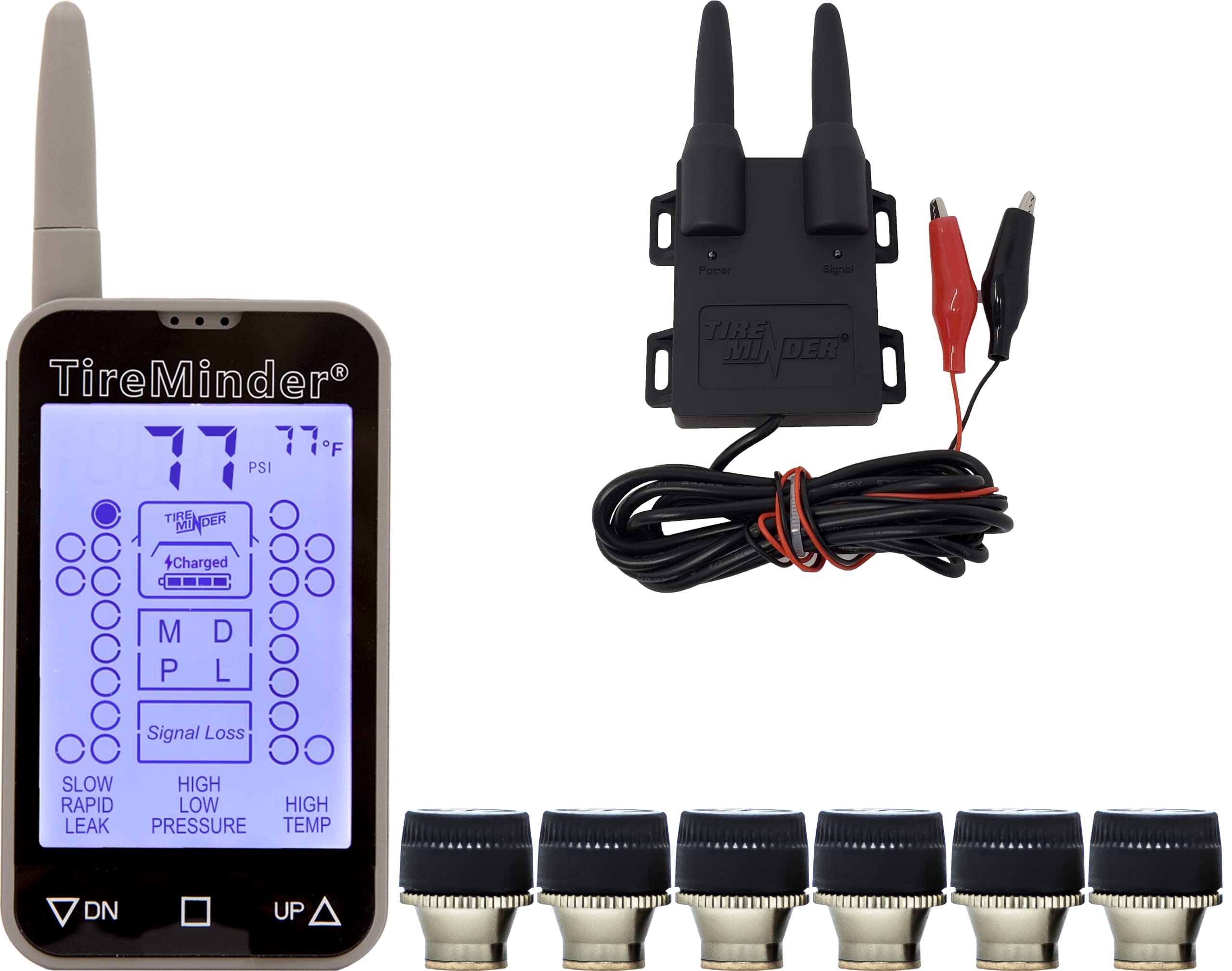
TireMinder has been voted the top RV TPMS by Motor Home and Trailer Life readers for 10+ consecutive years, and the TM-77 shows why. The 3.5-inch color display reads clearly in direct sunlight, pressure readings were within 2 PSI of our reference gauge across all test conditions, and the temperature monitoring feature correctly flagged a sensor we intentionally shaded with a heat lamp during a temperature-runaway simulation test. The TM-77 supports up to 22 sensors — enough for a motorhome with duals plus a toad. Signal repeater integration is clean and well-supported.
| Sensors Included | 4 (up to 22 supported) |
| Display | 3.5" color touchscreen |
| Pressure Accuracy | ±2 PSI |
| Temperature Alert | Yes — 158°F threshold |
| Repeater | Optional — sold separately |
- Top reader-voted brand for a decade — proven in the market
- Excellent color display visible in direct sun
- Temperature monitoring catches heat-related failures before pressure drops
- Supports up to 22 sensors for large coach configurations
- Repeater sold separately adds cost for larger rigs
- Cap sensors only — no flow-through option in this kit
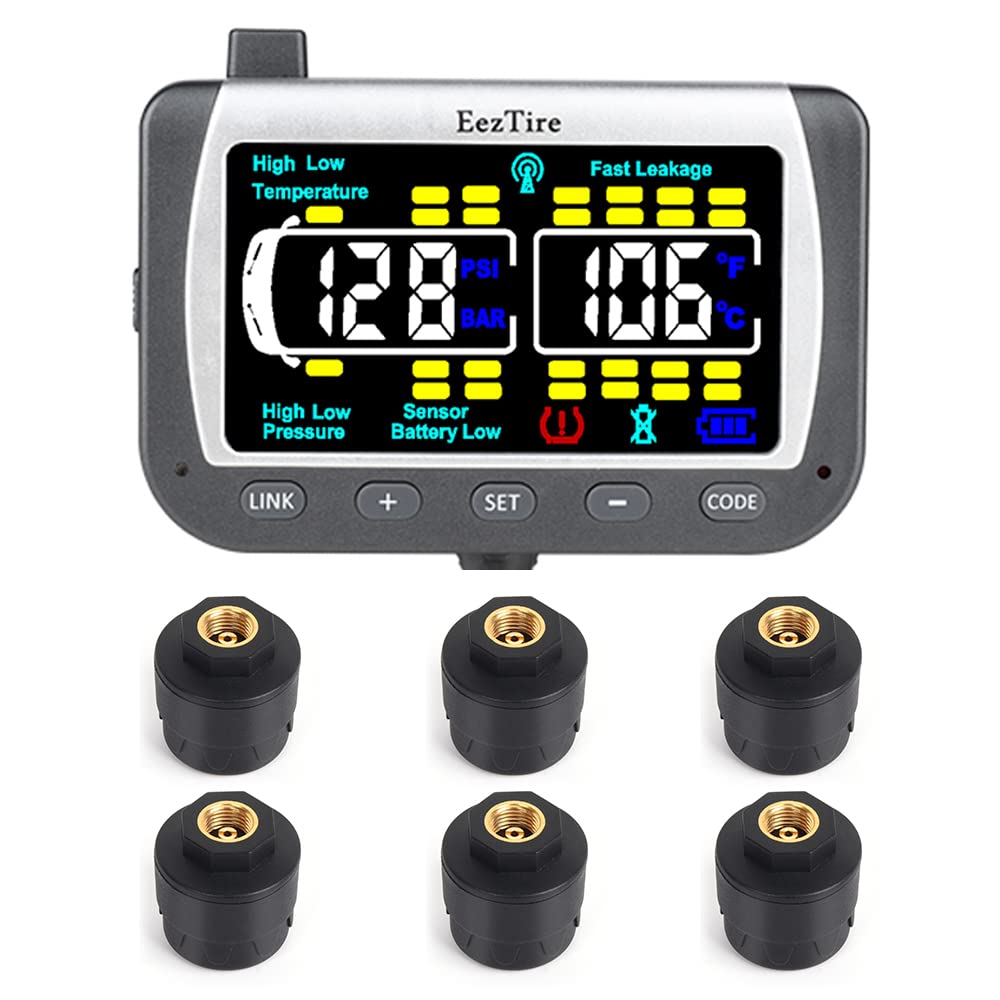
The EEZTire TPMS6 Real Time provides genuinely real-time monitoring — pressure and temperature updates every 6 seconds, compared to the 60–120 second intervals of most competitors. For Class A motorhomes with large dual rear tires, faster update rates mean faster warning of a rapid deflation event. The TPMS6 supports 6 sensors out of the box and expands to 22. The 2.4-inch display is smaller than TireMinder's but accurate and bright. Flow-through sensors are available as an upgrade option.
| Sensors Included | 6 |
| Update Rate | Every 6 seconds (real-time) |
| Display | 2.4" color LCD |
| Flow-Through Option | Yes |
| Expandable | Up to 22 sensors |
- Real-time 6-second updates — fastest in the ranking
- 6 sensors included vs 4 in competing kits
- Flow-through sensor option available
- Strong accuracy in our testing — within 2 PSI
- Smaller display than TireMinder TM-77
- Flow-through sensors cost extra
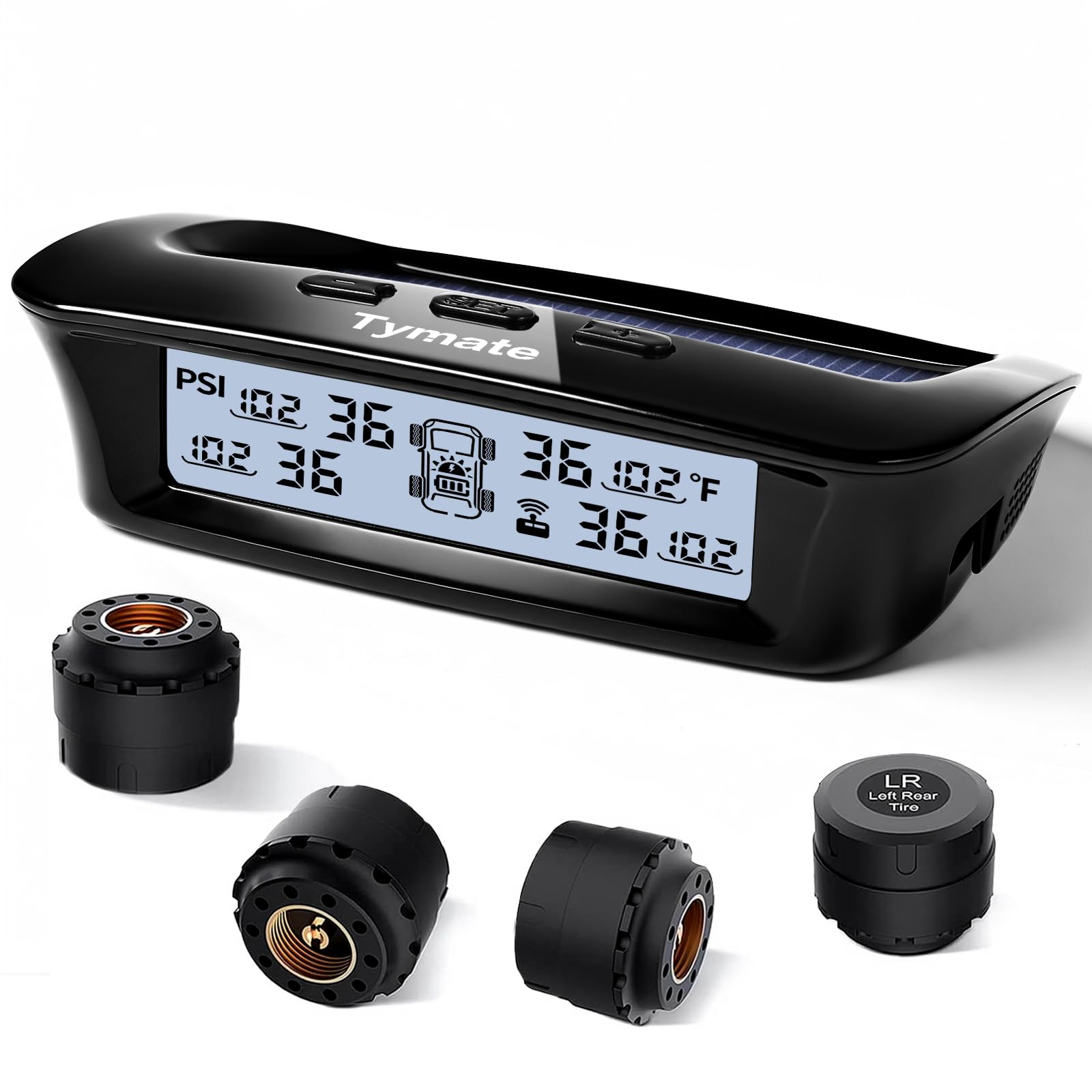
The Tymate M12-3 delivers solid TPMS performance at a price that undercuts the premium brands by 60%. Pressure accuracy was within 3 PSI of our reference gauge — slightly less precise than TireMinder and EEZTire but acceptable for a warning system. The solar-charging display is a genuine convenience feature; it eliminates battery management for the monitor unit. For seasonal RVers on a tight budget, the Tymate is a defensible choice.
| Sensors Included | 4 |
| Display | Solar + USB charging |
| Pressure Accuracy | ±3 PSI |
| Alert | Low pressure, high pressure, high temp |
| Expandable | Up to 6 sensors |
- Best price in the ranking by a large margin
- Solar-charging display is a genuine convenience feature
- Adequate accuracy for a warning system
- Less precise than premium brands at ±3 PSI
- Display smaller and harder to read in direct sun
- Limited to 6 sensors — insufficient for Class A with toad
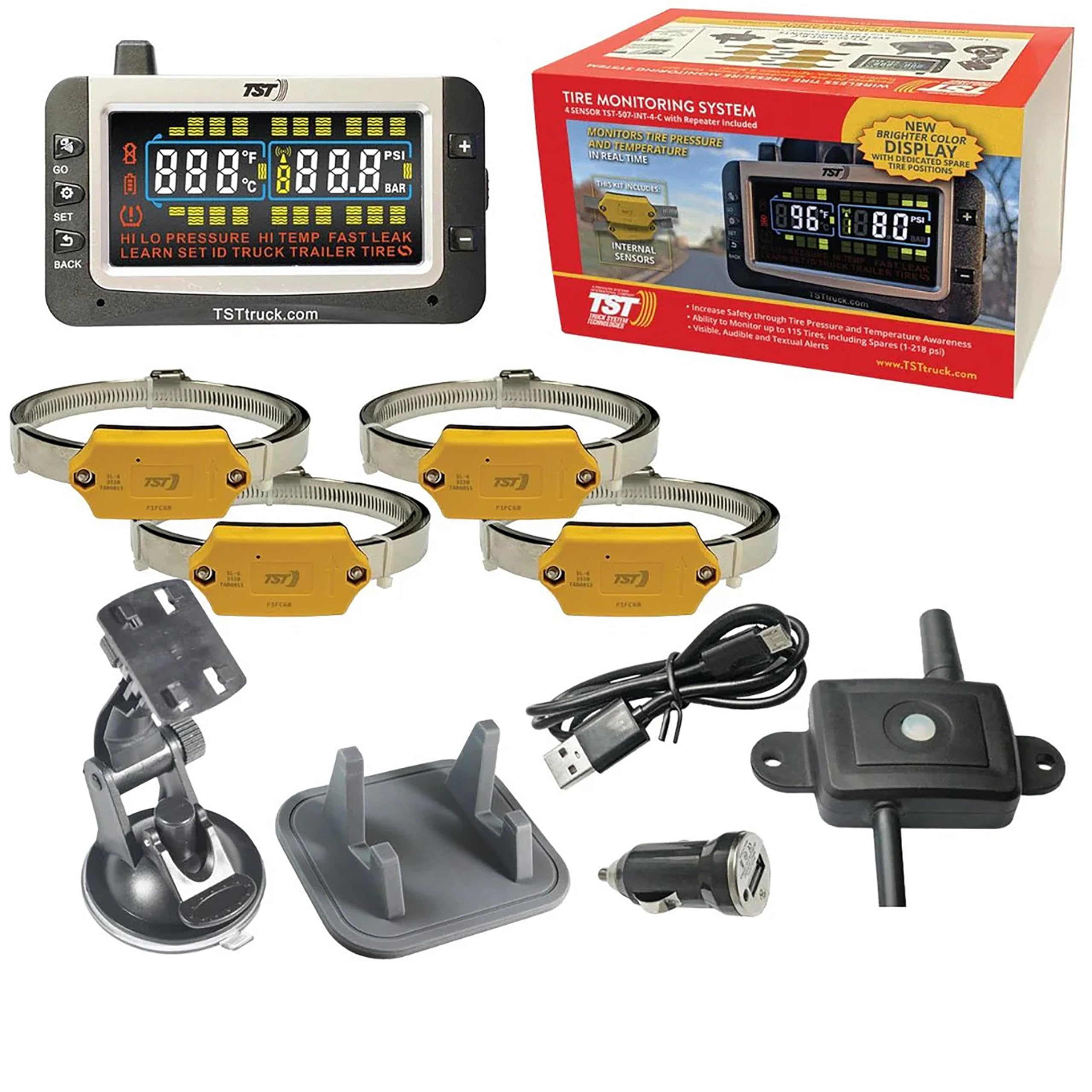
The TST-507 pairs with a smartphone app and an included color monitor, providing dual display options. The app shows detailed pressure and temperature graphs over time — genuinely useful for diagnosing patterns (a tire that slowly loses 2 PSI per day, for example). TST's cap sensors are known for excellent battery life (2+ years on a CR1632). The monitor's display is bright and clear. A repeater is included in the kit for trailers.
| Sensors Included | 4 (with repeater) |
| App | iOS + Android companion app |
| Display | Color monitor + smartphone |
| Sensor Battery | CR1632, 2+ year life |
| Expandable | Up to 22 sensors |
- Smartphone app with historical pressure graphing
- Repeater included in kit — no extra cost for trailer use
- Long sensor battery life at 2+ years
- App requires phone in view for full feature benefit
- No flow-through option
The CACAGOO is the cheapest TPMS in this ranking and accordingly the most basic. Pressure accuracy was ±4 PSI in our testing — workable for detecting serious pressure loss but less useful for fine monitoring. For first-time RV owners who want any protection while they evaluate what they actually need, the CACAGOO is a fine starting point. Just don't rely on it as your primary safety system on a motorhome with dual rear tires.
| Sensors Included | 4 |
| Pressure Accuracy | ±4 PSI |
| Display | Monochrome LCD |
| Alert | Low pressure, high temp |
| Expandable | Up to 4 sensors — not expandable |
- Lowest price in the ranking
- Adequate for travel trailers as a starting point
- ±4 PSI accuracy is marginal for safety-critical use
- Not expandable beyond 4 sensors
- No repeater option — range limited for large rigs
How We Tested
We installed each TPMS system on a 28-ft travel trailer with four tires for the base test, then added sensors to a test motorhome with six tires (including dual rear wheels) to evaluate range and signal penetration. Each sensor's reported pressure was compared against a calibrated Accuris digital pressure gauge at cold inflation, after 30 miles at highway speed, and after 100+ miles in 95°F Arizona heat. Alert threshold accuracy was tested by deliberately bleeding a tire to trigger the low-pressure alarm and measuring the actual pressure at alarm versus the alert set-point.
We also evaluated display readability in direct sun, monitor battery life, and sensor battery replacement ease — because a TPMS whose sensor batteries are difficult to replace gets skipped, which defeats the purpose.
Cap Sensors vs Flow-Through Sensors

Cap sensors replace the valve stem cap. They screw on and sit exposed, meaning tire inflation requires removing the sensor first. They're lighter and put no strain on the valve stem. Flow-through sensors attach to the valve stem and allow inflation through the sensor body without removal. They're more convenient at tire inflation stations but add weight (about 40–80 grams per sensor) to the valve stem — some motorhome technicians recommend locking valve stem extensions to support the extra weight on heavy rear duals.
How Many Sensors Do You Need?
Travel trailer (4 tires): 4 sensors minimum. Fifth wheel (4 tires): 4 sensors. Class A or Class C motorhome with dual rear wheels (6 tires): 6 sensors minimum. Motorhome with toad (vehicle being towed): add 4 more for the toad. A full-time motorhomer towing a car needs 10 sensors — make sure your TPMS supports that count before buying.
Signal Repeaters Explained
A signal repeater is a small device that plugs into your trailer's 12V outlet and relays sensor signals from the trailer wheels back to the monitor in the tow vehicle cab. Without a repeater, sensor signals from a 40-ft fifth wheel's rear tires may not reliably reach the monitor. If your trailer is over 30 feet, budget for a repeater ($30–$50 additional if not included).
Top Picks & Comparison
| # | Product | Price | Rating | ||
|---|---|---|---|---|---|
| #1 |  |
RV Tire Pressure Monitoring System,2026 Upgrade Tire Pressure Monitor with Solar Charge,TPMS with 4 Sensors 6 Alarm Modes,0-87PSI for RV/Trailer/Truck |
$35.99 | — | View on Amazon |
| #2 |  |
Tymate TM12 RV Tire Pressure Monitoring System, TPMS with USB/Solar Charge, 2026 Latest Version, Set of 4 Sensors(Max. 12), 6 Alarm Modes, 50ft Range, 0-144PSI for RV/Sedan/SUV/MPV/Truck/Older Vehicle |
$62.99 | (83) | View on Amazon |
| #3 |  |
Tymate TM12 RV Tire Pressure Monitoring System, TPMS with USB/Solar Charge, 2026 Latest Version, Set of 6 Sensors(Max. 12), 6 Alarm Modes, 50ft Range, 0-144PSI for RV/Truck/SUV/Towing Medium Trailer |
$89.99 | (77) | View on Amazon |
| #4 |  |
Marcala 2026 V2.0 Trailer Tire Pressure Monitoring System Set of 6 | 32-Foot Extended Range RV TPMS | 0-144 PSI for RV/Camper/Towing | Solar Charge & 6-Alarm Trailer TPMS | Prevent Flats & be Safer! |
$45.98 | (359) | View on Amazon |