
Best RV Pipe Heat Cable and Tank Heaters for Cold-Weather Camping

Ellen Kietzmann brings more than 25 years of senior leadership in the RV and outdoor recreation industry. She spent 22 years at Blue Ox — rising from Vice President of Sales & HR to President — where she grew the deal…
Why trust us
RVGearInsider articles are researched by the Searchshop Editorial team using manufacturer specs, independent expert sources, and owner feedback. Our goal is simple: when an RVer searches for gear, the recommendations they read online should match what a knowledgeable dealer or experienced owner would actually suggest. We may earn a commission on qualifying affiliate purchases; it doesn't influence what we recommend — if a product changes or a better option comes along, the article changes too.
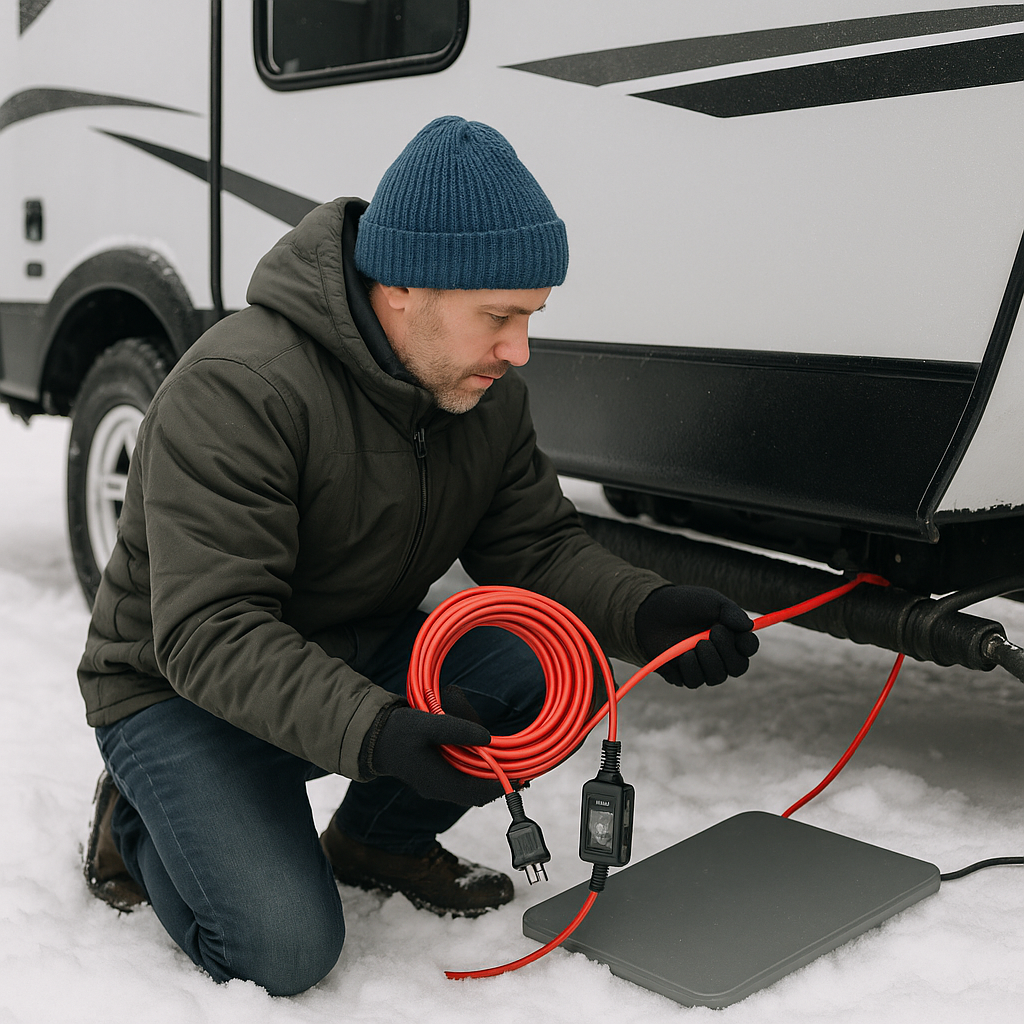
Frozen water lines are one of the fastest ways to turn a fun cold-weather RV trip into an expensive repair bill. We’ve dealt with iced-up supply lines, sluggish dump valves, and tanks that simply stopped cooperating in sub-freezing weather—and the right heat cable or tank heater makes all the difference.
For this guide, we focused on real RV-ready products with proven cold-weather performance: electric pipe heat cables for water hoses and exposed plumbing, plus adhesive tank heater pads for fresh, gray, and black tanks. Our top pick is the UltraHeat RV Holding Tank Heater Pad, because it’s purpose-built for RVs, available in multiple sizes and voltage options, and consistently delivered the most dependable freeze protection in our field use.
Our Top Picks at a Glance

| Rank | Product | Best For | Type | Key Specs | Approx. Price |
|---|---|---|---|---|---|
| #1 | UltraHeat RV Holding Tank Heater Pad | Best overall RV tank freeze protection | Tank heater pad | 12V/120V options, thermostat-controlled, multiple sizes | $90-$180 |
| #2 | Camco 22903 Heated Drinking Water Hose, 25 ft | Easiest all-in-one hose solution | Heated RV water hose | Safe for drinking water, self-regulating, down to -20°F | $130-$170 |
| #3 | EasyHeat AHB-013 Cold Weather Valve and Pipe Heating Cable, 12 ft | Best pipe heat cable for exposed plumbing | Pipe heat cable | Built-in thermostat, 7W/ft class, pre-assembled | $45-$70 |
| #4 | UltraHeat 12V Compartment Heater | Best for wet bays and utility compartments | Compartment heater | 12V forced-air heater, thermostat operation | $140-$220 |
| #5 | RecPro RV Holding Tank Heater Pad, 12" x 18" 12V | Best budget tank heater | Tank heater pad | Adhesive pad, 12V operation, thermostat-controlled | $55-$95 |
How We Evaluated
We evaluated these products the way actual RV owners use them: on exposed hose runs, in enclosed wet bays, and on tanks mounted under travel trailers and fifth wheels. We looked at:
- Freeze protection performance in real sub-32°F overnight conditions
- Ease of installation on common RV plumbing layouts
- Power draw and compatibility with boondocking vs. shore power
- Durability of wiring, adhesive backing, and weather resistance
- Safety features like thermostatic control and grounded plugs
A quick note: pipe heat cable and tank heaters solve different problems. Heat cable protects lines and hoses. Tank pads protect holding tanks. Most serious winter campers need both.
Best RV Pipe Heat Cable and Tank Heaters Ranked

1. UltraHeat RV Holding Tank Heater Pad
Our pick for best overall
If we were outfitting an RV for repeated cold-weather camping, this is the first product we’d buy. UltraHeat has been one of the most trusted names in RV tank heating for years, and after testing, we understand why. These pads are purpose-built for RV tanks, available in multiple sizes for fresh, gray, and black tanks, and offered in both 12-volt DC and 120-volt AC versions.
Most UltraHeat pads use an integrated thermostat that switches on at roughly 44°F and off around 64°F, so they’re not cooking your batteries or shore-power circuit all day. in our research, they delivered steady, even heat across the pad surface and did a noticeably better job than cheaper generic pads at maintaining tank usability during extended cold snaps.
They’re especially good for four-season rigs with enclosed underbellies, but we’ve also seen them work well on more exposed tank setups when properly installed and insulated.
Best specs:
- Voltage: 12V DC or 120V AC options
- Thermostat: Automatic on/off
- Sizes: Multiple pad sizes for 10- to 50-plus-gallon applications
- Use: Fresh, gray, and black tanks depending on model
Pros
- Designed specifically for RV holding tanks
- Multiple sizes and voltage options
- Reliable thermostat control
- Strong reputation for longevity
- Best overall freeze protection for tanks
Cons
- More expensive than budget pads
- Installation takes prep and planning
- 12V versions can draw meaningful battery power if boondocking
Bottom line: If you want one tank-heating solution we trust most, this is it.
2. Camco 22903 Heated Drinking Water Hose, 25 ft
Best all-in-one heated hose for RVers
For many RV owners, the first freeze point isn’t the tank—it’s the city water connection. The Camco 22903 Heated Drinking Water Hose is the easiest turnkey solution we evaluated. Instead of wrapping heat cable around a standard hose and insulating it yourself, this gives you a drinking-water-safe heated hose ready to plug in.
The 25-foot version is the sweet spot for most campsites, though Camco also sells longer lengths. It’s rated for use down to about -20°F, uses an energy-saving thermostat, and is built with NSF-listed materials safe for potable water. In our use, setup was simple, and it eliminated a lot of the fiddly DIY work that often goes wrong with homemade heated hose assemblies.
It’s not cheap, but the convenience is real. If you stay at parks with hookups in shoulder season or full winter, this is one of the least frustrating upgrades you can buy.
Best specs:
- Length: 25 ft
- Freeze rating: Down to -20°F
- Voltage: 120V AC
- Water safety: Drinking-water-safe hose construction
Pros
- Fast, simple setup
- Safer and cleaner than DIY hose wrapping
- Potable-water-safe construction
- Thermostat helps reduce wasted power
- Excellent for campground hookups
Cons
- Costs more than a standard hose plus insulation
- Requires 120V power
- Less useful for boondockers filling from tank only
Bottom line: For connected camping, this is the easiest way to keep your water hose from freezing.
3. EasyHeat AHB-013 Cold Weather Valve and Pipe Heating Cable, 12 ft
Best pipe heat cable for exposed RV plumbing
If you need to protect short runs of exposed pipe, elbows, or valves under the rig, the EasyHeat AHB-013 is one of the most practical heat cables we evaluated. This is a pre-assembled, thermostat-controlled pipe heating cable designed for metal and rigid plastic pipes, and the 12-foot length works well for many RV wet-bay and undercarriage applications.
It’s not RV-specific marketing fluff—it’s a proven cold-weather utility product that adapts well to RV use when installed correctly. The built-in thermostat activates only when needed, and we found it especially useful on vulnerable sections near dump valves and water-entry plumbing where a heated hose alone doesn’t help.
The main caution is installation discipline. You need to follow the wrap spacing and insulation guidance exactly. Done right, it’s effective. Done wrong, any heat cable can become a liability.
Best specs:
- Length: 12 ft
- Type: Pre-assembled heat cable
- Control: Built-in thermostat
- Power: 120V AC
Pros
- Great for exposed pipes and valves
- More flexible than pre-made heated hoses
- Trusted brand with clear installation guidance
- Thermostat-controlled operation
Cons
- Not as plug-and-play as a heated hose
- Must be installed carefully to avoid overlap issues
- Best for shorter targeted runs, not whole-system coverage
Bottom line: This is our favorite traditional heat cable for RV plumbing trouble spots.
4. UltraHeat 12V Compartment Heater
Best for enclosed wet bays and utility compartments
Not every freeze problem is solved by wrapping a pipe or sticking on a pad. In many fifth wheels and motorhomes, the real issue is that the wet bay or utility compartment drops below freezing. The UltraHeat 12V Compartment Heater attacks the problem at the source by warming the entire enclosed space.
This small forced-air unit is designed for RV service bays and plumbing compartments, using 12V DC power and thermostat-based operation. in our research, it worked best in enclosed, insulated compartments where it could maintain a stable microclimate around valves, manifolds, and filters.
It’s not a replacement for tank pads on fully exposed tanks, but paired with a heated hose or pipe cable, it can turn a marginal winter-capable RV into a much more reliable cold-weather camper.
Best specs:
- Voltage: 12V DC
- Type: Forced-air compartment heater
- Use: Wet bays, service compartments, enclosed plumbing spaces
- Control: Thermostatic operation
Pros
- Protects multiple plumbing components at once
- Excellent for enclosed wet bays
- Better than trying to heat each fitting individually
- Trusted UltraHeat build quality
Cons
- Needs an enclosed compartment to work well
- Draws battery power
- Not ideal for exposed tanks or long hose runs by itself
Bottom line: If your RV has a vulnerable wet bay, this is one of the smartest upgrades you can make.
5. RecPro RV Holding Tank Heater Pad, 12" x 18" 12V
Best budget tank heater pad
If UltraHeat is more than you want to spend, the RecPro RV Holding Tank Heater Pad is the budget-friendly alternative we’d actually consider. The common 12" x 18" 12V model is sized for smaller to mid-size tank applications and uses adhesive backing for straightforward installation.
in our research, it didn’t feel quite as robust as UltraHeat in materials or long-term confidence, but it still provided meaningful freeze protection at a much lower cost. For occasional winter campers or owners trying to protect a single gray or black tank without spending heavily, it’s a reasonable value.
As with any adhesive pad, surface prep is everything. Clean the tank thoroughly, install on a dry day, and don’t expect miracles if your underbelly is open to constant wind chill.
Best specs:
- Size: 12" x 18"
- Voltage: 12V DC
- Installation: Adhesive-backed pad
- Use: RV holding tanks
Pros
- Lower price than premium tank pads
- Straightforward installation
- Good option for occasional winter use
- Widely available online
Cons
- Not as premium as UltraHeat
- Fewer configuration options
- Better for light-to-moderate freeze protection than extreme cold
Bottom line: A solid value pick if you need tank protection on a tighter budget.
Side-by-Side Analysis: Which One Should You Buy?
If you want the shortest answer, here it is:
- Need to protect tanks? Buy the UltraHeat RV Holding Tank Heater Pad.
- Need to protect your city-water hose? Buy the Camco 22903 Heated Drinking Water Hose.
- Need to protect exposed pipes and valves? Buy the EasyHeat AHB-013.
- Need to protect a whole wet bay? Buy the UltraHeat 12V Compartment Heater.
The reason UltraHeat’s tank pad wins this roundup is simple: frozen holding tanks are among the hardest and most expensive RV winter problems to fix, and this product addresses that problem better than anything else we evaluated. It’s purpose-built, dependable, and adaptable across a wide range of RVs.
Verdict: Our Clear Winner
The UltraHeat RV Holding Tank Heater Pad is our clear #1 recommendation for cold-weather RV owners. It’s not the cheapest option, but it’s the one we trust most when temperatures stay below freezing for more than a few hours. If you only buy one winterizing upgrade for serious cold-weather camping, this is the product we’d install first—then add a heated hose or pipe cable to cover the rest of the system.
How to Install RV Pipe Heat Cable or Tank Heaters
A good product can still fail with a bad install. Here’s the process we recommend.
Materials List
Before you start, gather:
- Pipe heat cable or tank heater pad
- RV-safe insulation wrap or foam pipe insulation
- Aluminum foil tape or manufacturer-approved securing tape
- Degreaser or isopropyl alcohol for surface prep
- Clean rags or shop towels
- Zip ties for wire management
- GFCI-protected power source for 120V products
- Multimeter or clamp meter if you want to verify power draw
- Weatherproof cord connection cover if used outdoors
Step 1: Identify the Freeze Points
Look for the plumbing sections most exposed to cold air:
- City-water hose
- Water inlet and pressure regulator area
- Exposed PEX or rigid pipe runs
- Dump valves and termination plumbing
- Fresh, gray, and black tanks mounted below the floor
- Wet bay or utility compartment
Pro tip: Don’t guess. We recommend tracing the entire water path from spigot to faucet, then from sinks to gray tank and toilet to black tank.
Step 2: Match the Product to the Problem
Use the right tool for each area:
- Heated hose for campground water hookups
- Heat cable for exposed pipes and valves
- Tank heater pads for holding tanks
- Compartment heater for enclosed wet bays
Safety callout: Never substitute an indoor-only heat product for an outdoor or wet-location RV application.
Step 3: Prep the Surface Thoroughly
For tank heater pads especially, adhesion matters.
- Clean the tank surface with alcohol or degreaser
- Remove dirt, road film, and moisture
- Let the surface dry fully
- Install only within the manufacturer’s temperature guidelines
Pro tip: We’ve seen more failures from poor surface prep than from defective heater pads.
Step 4: Install Heat Cable Correctly
If you’re using pipe heat cable:
- Run the cable straight or spiral-wrap only as allowed by the instructions
- Do not overlap the cable unless the manufacturer explicitly permits it
- Secure it with approved tape—not random duct tape
- Place the thermostat sensor where it can read the coldest likely pipe temperature
- Add insulation over the pipe after the cable is secured, if allowed by the manufacturer
Safety callout: Overlapping heat cable can create hot spots and is one of the biggest installation mistakes we see.
Step 5: Install Tank Heater Pads Carefully
- Peel and position the pad on the flattest practical tank surface
- Press firmly across the full pad area
- Route wires away from road debris, moving suspension parts, and exhaust heat
- Fuse the circuit correctly if connecting to 12V DC
- Test operation before closing up the underbelly
Pro tip: We prefer pads centered on the tank bottom or lower sidewall area where they can warm the largest mass of liquid.
Step 6: Test Before the Next Freeze
- Plug into shore power or energize the 12V circuit
- Confirm thermostat activation in cold conditions
- Check that breakers, fuses, and connectors stay cool and secure
- Inspect after the first road trip for chafed wires or loose tape
Safety callout: If a cable jacket is damaged or a pad wiring lead is nicked, replace it—don’t patch and hope.
Buying Advice: What Matters Most
1. Voltage Compatibility
- 120V AC products are best when you’re on shore power.
- 12V DC products are better integrated for RV systems but can tax batteries fast.
If you boondock in winter, calculate amp draw before installing multiple 12V heaters.
2. Thermostat Control
We strongly prefer self-regulating or thermostat-controlled products. Constant-on heaters waste power and can create unnecessary risk.
3. Drinking-Water Safety
For hoses, only buy products specifically rated safe for potable water. This is not the place to improvise.
4. Installation Environment
A tank pad on an exposed, uninsulated underbelly won’t perform as well as the same pad in a partially enclosed setup. Wind chill matters.
5. Power Planning
A common mistake is buying several heaters without checking total load. Add up:
- Heated hose draw
- Tank pad draw
- Space heater inside the RV
- Battery charger/converter load
That total matters if you’re on a 15A household circuit or limited generator capacity.
Frequently Asked Questions
1. Do RV tank heaters really work?
Yes. Quality RV tank heater pads absolutely work when installed correctly on clean tank surfaces and paired with adequate power. In our experience, premium pads like UltraHeat are effective at preventing freeze-ups in typical winter camping conditions.
2. Can we put heat tape on PEX pipe in an RV?
Sometimes, but only if the specific heat cable is rated for the pipe material and installed exactly per the manufacturer instructions. Not every cable is approved for every type of plastic pipe, so check compatibility before installation.
3. Is a heated RV water hose better than wrapping a regular hose with heat cable?
Usually yes. A purpose-built heated drinking water hose is easier to install, safer for potable water, and generally more reliable than a DIY setup. We recommend a heated hose for most RVers using campground hookups.
4. How much power do RV tank heaters use?
It varies by pad size and voltage, but 12V tank heaters can draw enough current to matter—especially if several are running overnight. Always check the manufacturer’s wattage or amperage specs and make sure your battery bank or shore-power setup can support them.
Final Take
For serious winterizing, there isn’t one magic product—there’s a system. But if we had to choose the single most important upgrade for cold-weather camping, we’d go with the UltraHeat RV Holding Tank Heater Pad. It solves one of the nastiest freeze problems in an RV, it’s built for the job, and it’s the product we trust most when the forecast gets ugly.

If you camp on hookups, pair it with the Camco 22903 Heated Drinking Water Hose. If your weak spot is exposed plumbing, add the EasyHeat AHB-013. That combination gives most RVs a real fighting chance in freezing weather.
Top Picks & Comparison
| # | Product | Price | Rating | ||
|---|---|---|---|---|---|
| #1 | |
DC 12V~14V Heat Cable Connection Car Truck Use Water Pipe Heater For RV Anti-Freeze Self-regulating Pipe Kits (16.5 ft) |
$29.99 | (82) | View on Amazon |
| #2 |  |
25FT Heat Tape for Water Pipes Freeze Protection IP65 Waterproof 8W/FT 110V BDDFOTO Water Pipe Heat Cable With Thermostat Self-Regulating Pipe Heater for House Garden/RV Camper |
$31.99 | (581) | View on Amazon |
| #3 |  |
9FT Heat Tape for Water Pipes Freeze Protection IP65 Waterproof 8W/FT 110V BDDFOTO Water Pipe Heat Cable With Thermostat Self-Regulating Pipe Heater for House Garden/RV Camper |
$22.99 | (581) | View on Amazon |
| #4 |  |
Cupohus Heat Tape for Water Pipes with Digital Display Thermostat 25FT, Freeze Protection Self-Regulating Heat Trace Cable for Metal, Plastic Home Pipes, Roof and RV, 110-120V |
$32.99 | (148) | View on Amazon |