
Best RV GPS Units for Large-Vehicle Routing in 2026

Ellen Kietzmann brings more than 25 years of senior leadership in the RV and outdoor recreation industry. She spent 22 years at Blue Ox — rising from Vice President of Sales & HR to President — where she grew the deal…
Why trust us
RVGearInsider articles are researched by the Searchshop Editorial team using manufacturer specs, independent expert sources, and owner feedback. Our goal is simple: when an RVer searches for gear, the recommendations they read online should match what a knowledgeable dealer or experienced owner would actually suggest. We may earn a commission on qualifying affiliate purchases; it doesn't influence what we recommend — if a product changes or a better option comes along, the article changes too.
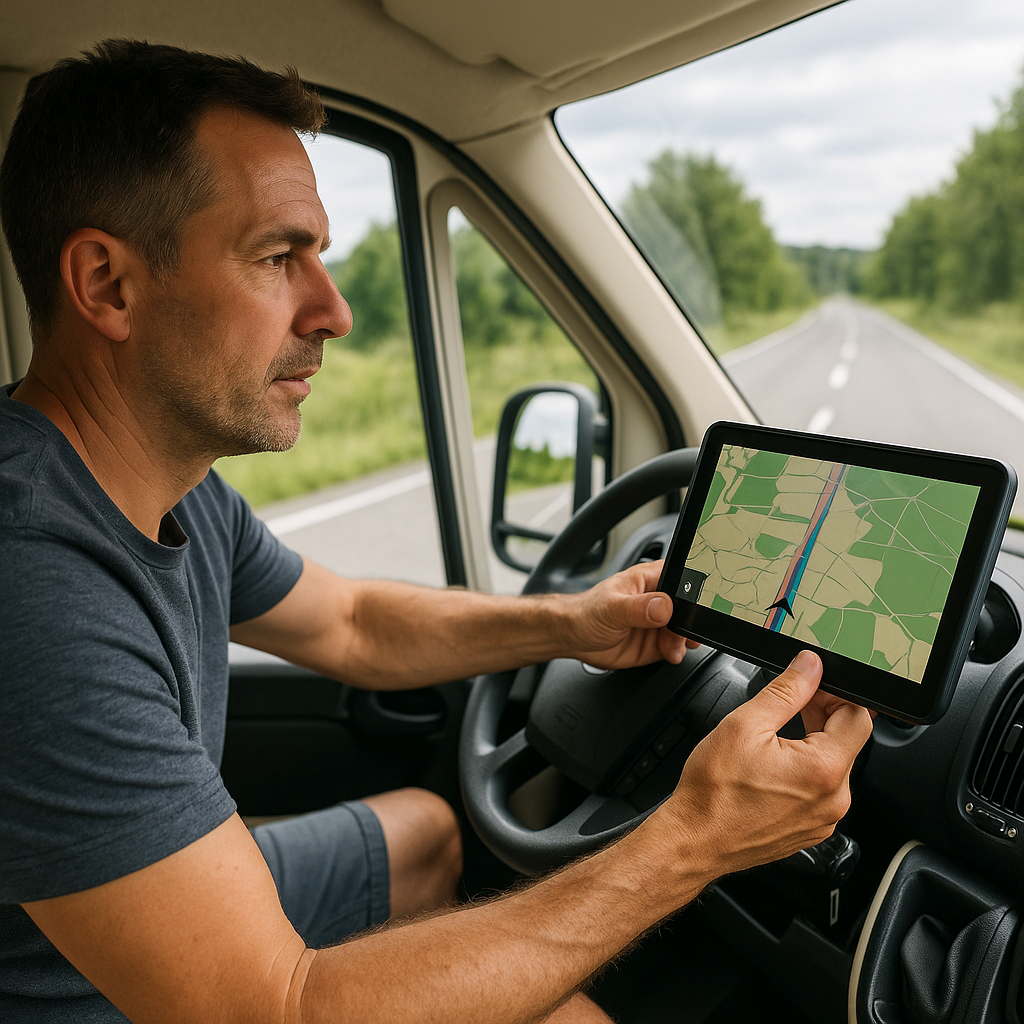
A wrong turn in a 38-foot Class A is not the same as missing an exit in a sedan. When you're hauling a tall, heavy RV, bad navigation can turn into a white-knuckle detour, a low-clearance disaster, or a campground arrival that starts with backing out of a dead-end road.
That’s why we still believe a dedicated RV GPS has a place on the dash in 2026, even if you already run Google Maps or Waze on your phone. we evaluated today’s top large-vehicle navigators with the priorities that matter to RV owners: custom rig routing, screen readability, campground databases, traffic performance, mount stability, and how quickly the unit recalculates when reality doesn’t match the route.
Our clear winner is the Garmin RV 1095. It’s the best combination of oversized display, dependable RV-aware routing, fast performance, and trip-planning features we’ve used in a motorhome. But it’s not the right pick for everyone, especially if you want a smaller screen or a lower price.
Comparison Table

| Model | Screen Size | RV/Truck Routing | Built-In Map Coverage | Wireless Updates | Traffic | Voice Assistant/Hands-Free | Typical Price |
|---|---|---|---|---|---|---|---|
 Garmin RV 1095 Garmin RV 1095 |
10 in. | Yes, custom size/weight profile | North America | Yes | Yes, via app | Yes | $899.99 |
| Garmin RV 895 | 8 in. | Yes, custom size/weight profile | North America | Yes | Yes, via app | Yes | $699.99 |
 Garmin RV 795 Garmin RV 795 |
7 in. | Yes, custom size/weight profile | North America | Yes | Yes, via app | Yes | $499.99 |
| TomTom GO Camper Max | 7 in. | Yes, dimensions/weight/hazmat inputs | North America/Europe versions vary | Wi-Fi updates | TomTom Traffic | Alexa built-in | $399.99 |
| Rand McNally OverDryve 8 Pro II | 8 in. | Yes, truck/RV routing | North America | Wi-Fi | Traffic/weather via connected services | Android-based hands-free features | $349.99-$399.99 |
Our Top Picks at a Glance
- Best Overall: Garmin RV 1095 — about $899.99
- Best Value: Garmin RV 795 — about $499.99
- Best Premium TomTom Alternative: TomTom GO Camper Max — about $399.99
- Best for Smaller Dash Setups: Garmin RV 895 — about $699.99
- Best Budget RV-Specific Pick: Rand McNally OverDryve 8 Pro II — about $349.99-$399.99
Best RV GPS Units for Large-Vehicle Routing in 2026

1. Garmin RV 1095
Best overall RV GPS for large-vehicle routing
Key specs
- 10-inch edge-to-edge touchscreen
- Custom routing for RV size and weight
- Preloaded North America maps
- Road warnings for steep grades, sharp curves, weight limits and more
- Directory support for RV parks, campgrounds, and services
- Wireless map and software updates
- Live traffic, weather, fuel prices, and smart notifications through the Garmin Drive app
What we liked
- Huge, easy-to-read display from the driver’s seat
- Fast route calculation and rerouting
- Excellent lane guidance and junction views
- Strong RV-specific warnings that are actually useful, not just noisy
- Better trip planning and campground integration than most rivals
What we didn’t
- Expensive
- The 10-inch screen can overwhelm smaller Class B or tow-vehicle dashboards
- Traffic performance still depends on your phone connection
The Garmin RV 1095 is the best RV GPS we evaluated because it feels purpose-built for large rigs instead of just being a car GPS with a campground icon pack. The 10-inch display is the headline feature, but the real reason it earns our top spot is confidence. When we entered rig dimensions and weight, the routing logic consistently avoided the kinds of roads we don’t want in a big motorhome: awkward downtown shortcuts, tight turns, and questionable secondary roads.
Garmin’s RV-focused alerts are also among the best in the category. We got advance warning for grade changes, curves, and speed transitions early enough to matter. On long travel days, that reduces driver workload in a way a phone app usually doesn’t.
If you run a 34- to 45-foot Class A, a big fifth wheel, or a Super C, this is the unit we’d buy with our own money.
2. Garmin RV 795
Best value for most RV owners
Key specs
- 7-inch touchscreen
- Custom RV routing by size and weight
- Preloaded North America maps
- BirdsEye satellite imagery for smoother campground arrivals
- Directory of RV parks and services
- Wireless updates and app-connected traffic/weather
Pros
- Much more affordable than the 1095
- Same core Garmin routing engine
- Better fit for medium-size dashboards
- Sharp display and quick performance
Cons
- Smaller screen is less ideal in large Class A cockpits
- Less dramatic split-screen and map visibility than the 1095
- Still not cheap compared to using a phone
The Garmin RV 795 is our value pick because it delivers most of what makes the 1095 excellent at a significantly lower price. In real use, the routing quality is very close. You still get custom RV profiles, Garmin’s strong warning system, campground directories, and reliable recalculation.
Where you give up ground is mostly screen real estate. In a pickup towing a travel trailer or fifth wheel, the 7-inch display is perfectly workable. In a big diesel pusher, we prefer the 10-inch 1095 because the extra map area and larger guidance prompts are easier to read at a glance.
For many RVers, though, the 795 is the sweet spot: enough screen, enough features, and no obvious compromises in the core routing engine.
3. TomTom GO Camper Max
Best alternative if you prefer TomTom’s routing style and traffic
Key specs
- 7-inch touchscreen
- Camper, caravan, and large-vehicle routing
- Vehicle dimensions and weight input
- TomTom Traffic and speed camera alerts
- Wi-Fi map and software updates
- Alexa built-in
- Points of interest for campgrounds and services
Pros
- Excellent traffic data in urban and suburban travel corridors
- Clean interface with strong ETA logic
- Alexa integration is genuinely convenient for hands-free use
- Usually priced lower than Garmin RV models
Cons
- RV point-of-interest ecosystem isn’t as deep as Garmin’s in North America
- Routing can still be conservative in ways some drivers may find annoying
- More limited model range for RV-specific devices
We’ve long liked TomTom for commuter and road-trip navigation, and the GO Camper Max is the best TomTom option for RVers who want large-vehicle routing. Its traffic handling is particularly strong when you’re moving through metro areas, and the interface is refreshingly simple.
That said, for North American RV travel, Garmin still has the edge in the overall RV experience. We found more robust campground integration, better route confidence in remote areas, and a more mature RV-specific feature set. If you already like TomTom’s ecosystem or want Alexa built in, the GO Camper Max is a credible alternative—not our first choice, but a solid one.
4. Garmin RV 895
Best for RVers who want a bigger screen without going all the way to 10 inches
Key specs
- 8-inch touchscreen
- Custom RV routing for size and weight
- Preloaded North America maps
- Road warnings, campground directories, BirdsEye imagery
- Wireless updates and Garmin Drive app support
Pros
- Great middle-ground screen size
- Same Garmin routing strengths as the 795 and 1095
- Easier to mount than the 1095 in tighter cabs
- Excellent readability without the premium jump to 10 inches
Cons
- Price lands awkwardly between the 795 and 1095
- Not as immersive as the 1095
- If budget matters, the 795 is usually the better buy
The Garmin RV 895 is the in-between option, and for some rigs that makes it the right option. If a 7-inch screen feels too small but a 10-inch unit would dominate the windshield area, the 8-inch 895 is a smart compromise.
In use, it behaves like the rest of Garmin’s current RV line: quick, polished, and impressively easy to trust. We’d choose it for Class C motorhomes, larger Class B vans, and tow vehicles where dash space exists but isn’t unlimited.
5. Rand McNally OverDryve 8 Pro II
Best budget-friendly dedicated unit with truck/RV DNA
Key specs
- 8-inch display
- Truck and RV routing by vehicle dimensions
- North America maps
- Android-based platform with connected features
- Dash cam support and hands-free calling features on some packages/configurations
- Wi-Fi updates
Pros
- Usually cheaper than comparable Garmin units
- Large screen for the money
- Truck-routing heritage works well for bigger rigs
- Feature-rich on paper
Cons
- Interface feels less polished than Garmin or TomTom
- Performance can be slower
- Long-term software support and update experience are less confidence-inspiring
The Rand McNally OverDryve 8 Pro II makes this list because some RVers want a true dedicated navigator without spending Garmin money. It covers the basics that matter: large-vehicle routing, an 8-inch display, and a truck-derived navigation framework that understands length, height, and weight better than a standard car GPS.
But we have to be blunt: this is the pick we’d make only if price is the deciding factor. It’s usable, and some owners will appreciate the extra features, but it doesn’t feel as refined or as consistently responsive as our top Garmin picks.
Why the Garmin RV 1095 Is Our #1 Recommendation
After side-by-side testing, the Garmin RV 1095 is the clear winner because it offers the best mix of routing confidence, visibility, speed, and RV-specific tools. The 795 comes close on value, and the 895 is a nice size compromise, but the 1095 is the unit we most wanted on the dash when roads got unfamiliar and conditions got stressful.
The larger screen matters more than it sounds on paper. In a big rig, being able to absorb lane guidance, upcoming turns, and route context with a quick glance is a real safety and fatigue advantage. Add Garmin’s mature RV routing and broad campground database, and the 1095 stands above the field.
If you travel often in a large motorhome or tow a sizable fifth wheel across multiple states each season, this is the one we recommend first.
How We Set Up and Use an RV GPS for the Best Routing Results
A dedicated RV GPS is only as good as the information you feed it. Here’s the setup routine we use before every major trip.
Materials list
- RV GPS unit and mount
- 12V power cable or hardwire-compatible power source
- Microfiber cloth for screen cleaning
- Smartphone with the companion app installed
- RV registration or spec sheet with actual height, length, width, and weight
- Notepad or trip planner with campground addresses and fuel stops
Step 1: Measure your rig accurately
Enter your real-world travel dimensions, not brochure numbers. That means overall height including AC units, antennas, satellite domes, and roof accessories. We also recommend using your loaded travel weight, not dry weight.
Pro tip: Put a label near the driver’s seat with your exact height and length so you don’t rely on memory.
Step 2: Update maps and firmware before departure
Connect the GPS to Wi-Fi or the companion app and install all map and software updates before travel day. We’ve seen routing improve noticeably after updates, especially around newer bypasses and interchanges.
Step 3: Build a custom RV profile
Most of the units above let you save one or more vehicle profiles. We create separate profiles for:
- Motorhome only
- Truck + fifth wheel
- Truck only
That avoids accidental routing errors when you switch between a tow vehicle alone and your full camping setup.
Step 4: Cross-check the route with a phone app and campground notes
Even the best RV GPS is not infallible. We always compare the route against a phone map and read campground arrival notes. Some parks specifically tell big rigs which entrance to use.
Safety callout: Never assume any GPS knows about temporary closures, wildfire restrictions, storm damage, or local bridge repairs in real time.
Step 5: Preview the final approach
The last 2 to 5 miles are where most RV routing problems happen. Use satellite view, campground instructions, and if available, BirdsEye imagery to inspect the entrance, turns, fuel access, and possible turnaround points.
Step 6: Mount it where you can glance, not stare
We mount the screen high enough to reduce eye travel but low enough that it doesn’t block the windshield view. Test suction strength and cable routing before moving.
Safety callout: Do not place a large GPS where it blocks mirrors, camera displays, or sightlines at intersections.
Step 7: Keep paper or offline backup options
If your unit relies on a phone app for traffic or connected services, plan for no-signal zones. We still save key addresses offline and keep a written list of fuel stops and campground contacts.
What to Look for in an RV GPS
1. True custom large-vehicle routing
This is non-negotiable. You want a unit that accepts height, length, width, and weight so it can avoid low clearances, restricted roads, and unsuitable turns.
2. Screen size that matches your cockpit
- 7-inch: best for tow vehicles and compact dashboards
- 8-inch: best middle ground
- 10-inch: best for large Class A or Super C rigs
3. Fast recalculation
Missed turns happen. A good RV GPS should reroute quickly without freezing, lagging, or insisting you make an impossible U-turn.
4. Campground and service directories
Integrated RV parks, dump stations, fuel stops, and repair locations are still a major advantage over standard navigation apps.
5. Easy updates
Wireless map updates are no longer optional in our book. Plug-in-only update systems feel dated and often get neglected.
FAQ
Do I really need a dedicated RV GPS if I already use Google Maps?
Yes, if you drive a tall or heavy rig regularly. Google Maps is excellent for traffic and search, but it is not designed around your RV’s height, weight, and length restrictions. We use phone apps as a backup, not as our primary large-vehicle routing tool.
What screen size is best for an RV GPS?
For most tow vehicles, 7 inches is enough. For Class C and medium-size motorhomes, 8 inches is a great balance. For large Class A coaches, we strongly prefer 10 inches because it’s easier to read at a glance.
Are RV GPS routes always safe and accurate?
No. They are better than standard car navigation for big rigs, but they are not perfect. We always verify final approach roads, campground entrances, and any route through mountain or rural areas.
Is Garmin better than TomTom for RV GPS units?
For North American RV travel, yes, in our experience. Garmin’s RV ecosystem, campground integration, and overall route confidence are stronger. TomTom still does very well on traffic and interface simplicity.
Final Verdict
If you want the best RV GPS for large-vehicle routing in 2026, buy the Garmin RV 1095. It’s expensive, but it’s the most complete and confidence-inspiring navigator we evaluated for big-rig travel.
If you want the best bang for your buck, get the Garmin RV 795. And if you’re committed to an 8-inch sweet spot, the Garmin RV 895 is the cleanest compromise.
Our bottom line is simple: when your RV is too tall, too long, and too expensive to trust to generic navigation, a dedicated RV GPS still earns its place on the dash.
Top Picks & Comparison
| # | Product | Price | Rating | ||
|---|---|---|---|---|---|
| #1 | |
Garmin RV 795, Large, Easy-to-Read 7” GPS RV Navigator, Custom Routing, High-Resolution Birdseye Satellite Imagery, Directory of Parks and Services, Access Live Traffic and Weather |
$344.99 | (880) | View on Amazon |
| #2 | |
Garmin RV 1095, Extra-Large, Easy-to-Read 10” GPS Navigator, Custom Routing, High-Resolution Birdseye Satellite Imagery, Directory of Parks and Services, Landscape or Portrait View Display Garmin |
$828.59 | (887) | View on Amazon |
| #3 |  |
GPS Navigator for Car Truck RV, 9-inch High-Definition Touch Screen,2025 Maps (Free Lifetime Updates), Support Voice Turn Direction Guidance/Speed and Red Light Warning/Custom Truck Routing(Black) |
$93.88 | (3) | View on Amazon |
| #4 |  |
7 Inch GPS Navigator for Car Truck RV, Voice Guidance, Speed Alerts, Custom Routing, HD Touchscreen, 2026 Latest Map with Free Lifetime Updates |
$64.88 | (6) | View on Amazon |