
Best RV Carbon Monoxide and Propane Detectors for 2026
 By Salem Hassan — Co-Founder, Searchshop · 30+ years in RV & marine dealerships· November 27, 2025· 11 min read· Updated 1d ago
Salem Hassan has spent more than 30 years building and operating dealerships across the RV, marine, and powersports industries. He founded Suncoast RV in 1994 and later owned Travelcamp RV in Jacksonville for a decade…
Why trust us
RVGearInsider articles are researched by the Searchshop Editorial team using manufacturer specs, independent expert sources, and owner feedback. Our goal is simple: when an RVer searches for gear, the recommendations they read online should match what a knowledgeable dealer or experienced owner would actually suggest. We may earn a commission on qualifying affiliate purchases; it doesn't influence what we recommend — if a product changes or a better option comes along, the article changes too.
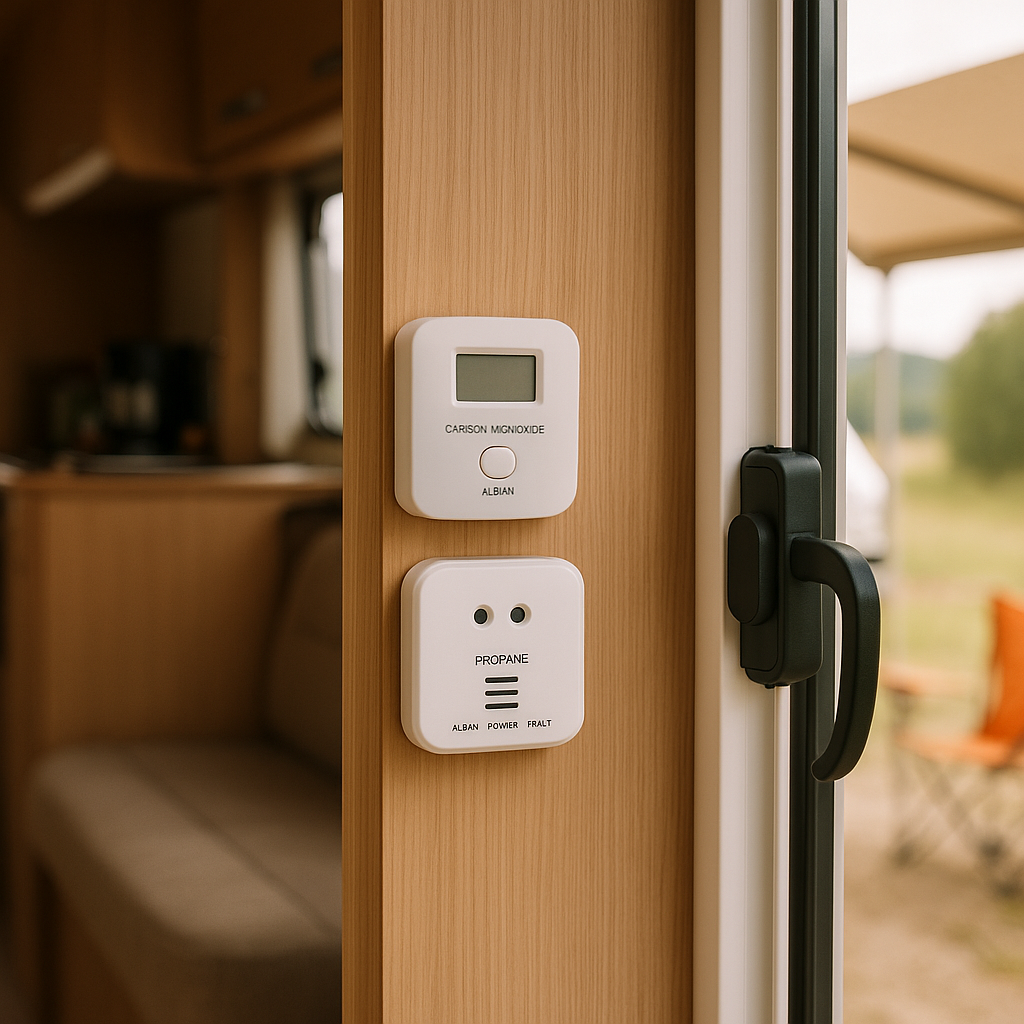
A dead battery can ruin a weekend. A bad gas detector can ruin far more than that. After testing current RV-safe carbon monoxide and propane alarm options, we came away with one strong conclusion: this is not the place to save twenty bucks.
RVs are tight, fast-changing environments. You’ve got propane appliances, generators, furnaces, compact sleeping spaces, and often older wiring. That means your detector needs to do more than chirp eventually — it needs to wake you up fast, survive vibration, and fit the 12-volt reality of RV life. Below are the RV carbon monoxide and propane detectors we recommend for 2026, with our clear #1 pick, side-by-side specs, and practical installation advice.
Our top picks at a glance

| Rank | Product | Detects | Power | End-of-Life Signal | Approx. Price | Best For |
|---|---|---|---|---|---|---|
| #1 | Safe-T-Alert 35-742-BL Dual LP/CO Alarm | Propane + Carbon Monoxide | 12V hardwired | Yes | $95-$120 | Best overall for most RVs |
| #2 | MTI Industries Safe-T-Alert 30-442-P-WT Propane Alarm | Propane only | 12V hardwired | Yes | $55-$75 | Best propane-only replacement |
| #3 | Safe-T-Alert 25-742-WT Mini RV CO Alarm | Carbon Monoxide only | 12V hardwired | Yes | $70-$95 | Best dedicated CO alarm |
| #4 | Kidde 21032065 Nighthawk Plug-In CO Alarm | Carbon Monoxide only | 120V plug-in + battery backup | Yes | $35-$50 | Best for motorhomes on shore power |
| #5 | First Alert MTI SA-740 Marine/RV Propane Alarm | Propane only | 12V hardwired | Yes | $60-$85 | Best compact low-mount LP alarm |
Our #1 recommendation
If you want one detector we’d install in the average modern travel trailer or fifth wheel, it’s the Safe-T-Alert 35-742-BL Dual LP/CO Alarm.
It solves the biggest problem we see in RVs: owners running outdated single-gas alarms or assuming a household detector covers both risks. It doesn’t. The 35-742-BL gives you dedicated monitoring for both propane and carbon monoxide in a single 12-volt RV-specific unit, with a form factor that fits many common OEM cutouts. It’s loud, simple, and built for the low-voltage environment RVs actually use.
Is it the cheapest? No. Is it the one we’d trust in a family bunkhouse trailer, a couples’ fifth wheel, or a Class C with a generator? Yes.
How we judged these detectors

We focused on what matters in actual RV use:
- RV-compatible power: 12V hardwired units got priority because that’s what most trailers and fifth wheels need.
- Correct gas coverage: propane pools low; carbon monoxide mixes through the cabin. Many RVs need protection from both.
- Replacement fit: we favored models commonly used as OEM replacements.
- Alarm clarity: loud signal, distinct fault/end-of-life alerts, and easy-to-read labeling matter at 2 a.m.
- Service life: detectors are consumable safety gear. We looked for clear end-of-life indication and current production support.
- Field practicality: vibration resistance, mounting flexibility, and low false-alarm tendencies all matter on the road.
The best RV carbon monoxide and propane detectors for 2026
1. Safe-T-Alert 35-742-BL Dual LP/CO Alarm — Best overall
Approx. price: $95-$120
Type: Dual-gas RV alarm
Power: 12V DC hardwired
Detects: Propane (LP) and carbon monoxide
Mounting: Wall mount, common RV replacement footprint
This is our top pick because it’s the cleanest all-in-one answer for most RV owners. The Safe-T-Alert 35-742-BL is specifically designed for RV use, not adapted from a household unit. It continuously monitors for propane leaks and carbon monoxide, and it’s meant to stay powered from your coach battery system.
In our view, the biggest strength here is simplicity. One unit, one install location strategy, one replacement cycle to track. It’s especially attractive if your rig already had a combination detector from the factory and you want a straightforward swap.
The alarm pattern is loud enough for a bedroom area in most midsize RVs, and the unit includes self-test and end-of-life signaling. We also like that replacement support is easy to find through RV parts channels.
Pros
- Detects both LP gas and CO in one RV-specific unit
- 12V hardwired for trailers, fifth wheels, and many motorhomes
- Common replacement choice for OEM-installed alarms
- Clear end-of-life indication
- Good value versus buying separate LP and CO units
Cons
- More expensive than single-gas alarms
- Hardwired install may require light wiring work
- Combo placement can be a compromise in some floorplans
Best for: RV owners replacing an aging factory combo detector and anyone who wants the simplest, safest one-unit solution.
2. MTI Industries Safe-T-Alert 30-442-P-WT Propane Alarm — Best propane-only replacement
Approx. price: $55-$75
Type: LP gas alarm
Power: 12V DC hardwired
Detects: Propane only
Mounting: Low wall mount
If your RV already has a separate CO detector and you only need to replace the LP side, the 30-442-P-WT is one of the easiest recommendations we make. This unit is purpose-built for RV propane detection and is designed to be mounted low, where propane vapor is more likely to accumulate.
We’ve seen this model and its close variants used widely in trailers and motorhomes because it’s dependable, compact, and relatively painless to replace. It also avoids the common mistake of using a generic household combustible gas detector that isn’t well suited to RV electrical systems or mounting realities.
Its biggest limitation is obvious: it only handles propane. That’s fine if you already have a fresh, working CO alarm elsewhere. It’s not fine if you think propane detection alone covers generator or furnace exhaust risks.
Pros
- Strong choice for direct LP detector replacement
- 12V RV-compatible design
- Compact and easy to mount near the floor
- Lower cost than combo units
- Widely available through RV parts retailers
Cons
- No carbon monoxide detection
- Requires a separate CO alarm for full protection
- Hardwired install still takes basic electrical care
Best for: Owners replacing a failed propane detector in an RV that already has a separate, current CO alarm.
3. Safe-T-Alert 25-742-WT Mini RV CO Alarm — Best dedicated CO alarm
Approx. price: $70-$95
Type: Carbon monoxide alarm
Power: 12V DC hardwired
Detects: Carbon monoxide only
Mounting: Wall mount
For rigs where we want a dedicated hardwired CO detector, the Safe-T-Alert 25-742-WT Mini RV CO Alarm is our favorite. It’s compact, RV-specific, and easy to add in sleeping areas or main living spaces depending on your layout.
This is the unit we like for older RVs that came with only an LP detector near the floor but never had a proper hardwired CO alarm. It’s also a smart add-on in motorhomes with onboard generators, where carbon monoxide risk deserves its own dedicated sensor.
The main advantage over a household plug-in model is that it works with your RV’s 12V system, including when you’re boondocking. That matters because CO risk often increases when owners are dry camping, running generators, or using furnaces in cold weather.
Pros
- True RV-ready 12V CO protection
- Compact size fits more wall locations
- Great upgrade for older RVs missing CO coverage
- Reliable dedicated sensor without overcomplication
Cons
- No propane detection
- Costs more than some household CO alarms
- Requires hardwiring
Best for: Older RVs lacking proper CO protection and owners who want a dedicated 12V CO alarm rather than a combo unit.
4. Kidde 21032065 Nighthawk Plug-In CO Alarm — Best for motorhomes on shore power
Approx. price: $35-$50
Type: Carbon monoxide alarm
Power: 120V AC plug-in with battery backup
Detects: Carbon monoxide only
Mounting: Standard outlet plug-in
This is the one non-RV-specific pick on our list, and we’re including it carefully. The Kidde Nighthawk 21032065 is a solid household CO alarm with battery backup, and it can make sense in motorhomes or larger rigs with reliable 120V access and residential-style outlets in the cabin.
We do not recommend this as a primary solution for most towables. But as a supplemental CO alarm in a Class A or Class C — especially near the bedroom when plugged in often — it’s a practical and affordable layer of protection.
It’s easy to install, easy to replace, and widely sold. The tradeoff is that it’s not purpose-built for RV vibration, 12V-only use, or LP detection.
Pros
- Inexpensive and easy to find
- Simple plug-in installation
- Battery backup adds protection during power interruption
- Good supplemental CO alarm for motorhomes
Cons
- Not an RV-specific 12V unit
- No propane detection
- Not ideal as primary protection in towables or boondocking setups
Best for: Supplemental CO coverage in motorhomes and RVs that spend most of their time on shore power.
5. First Alert MTI SA-740 Marine/RV Propane Alarm — Best compact low-mount LP alarm
Approx. price: $60-$85
Type: Propane alarm
Power: 12V DC hardwired
Detects: Propane only
Mounting: Low wall mount
The First Alert MTI SA-740 is a useful pick when space is tight and you need a compact 12V propane alarm for an RV or marine-style installation. We like it for smaller trailers, truck campers, and retrofit jobs where a larger faceplate is inconvenient.
Performance-wise, it does what an LP alarm should do: monitor low-mounted airspace for propane leaks and provide a clear audible warning. It’s not flashy, but propane detectors shouldn’t be. They should be reliable and replaceable.
Compared with the Safe-T-Alert propane-only model above, the SA-740 is a bit more niche. We’d choose it when fitment is the deciding factor.
Pros
- Compact footprint for tight installs
- 12V hardwired for RV use
- Good choice for low-wall propane monitoring
- Useful in smaller rigs and retrofit situations
Cons
- Propane only
- Less universal as a replacement than some Safe-T-Alert units
- Not usually the best value unless you need the compact size
Best for: Small RVs, truck campers, and retrofit installations with limited mounting space.
Side-by-side comparison: which one should you buy?
Here’s the practical breakdown.
- If you need one detector to do it all, buy the Safe-T-Alert 35-742-BL.
- If your propane alarm died but your CO protection is current, buy the MTI Safe-T-Alert 30-442-P-WT.
- If your older RV lacks a proper 12V CO alarm, add the Safe-T-Alert 25-742-WT.
- If you own a motorhome and want cheap backup CO coverage near a sleeping area, the Kidde Nighthawk is a solid supplemental unit.
- If installation space is unusually tight, the First Alert MTI SA-740 is the better fit.
Our verdict
The Safe-T-Alert 35-742-BL Dual LP/CO Alarm is the clear winner because it matches how most RV owners actually shop and install safety gear: they want a direct, RV-safe, 12-volt solution that covers the two biggest gas threats in one unit. The other models are good in specific roles, but this is the detector we’d recommend to the broadest number of RV owners without hesitation.
What to check before you buy
Before ordering a detector, verify these points:
- What your current alarm detects — LP, CO, or both.
- Power type — 12V hardwired is standard in many RVs; 120V plug-in is usually supplemental only.
- Cutout and faceplate size — especially if replacing a factory unit.
- Manufacture date and service life — many RV detectors require replacement after about 5 to 7 years.
- Mounting height — propane alarms belong low; CO alarm placement depends on manufacturer guidance and RV layout.
How to replace an RV carbon monoxide or propane detector
Replacing an RV detector is usually straightforward, but it’s still safety equipment. If you’re not comfortable with 12V wiring, use a certified RV technician.
Materials list
- New RV detector compatible with your application
- Phillips screwdriver
- Wire stripper/crimper
- Butt connectors or approved wire connectors
- Multimeter or 12V test light
- Mounting screws
- Owner’s manual for the new detector
- Safety glasses
Step-by-step installation
Turn off RV power
Disconnect shore power and switch off the 12V battery disconnect if equipped.Verify the old detector type
Confirm whether the existing unit is propane-only, CO-only, or combo. Match replacement function exactly unless you’re redesigning protection intentionally.Remove the old detector
Unscrew the mounting plate or faceplate and gently pull the unit free.Test the wiring
Use a multimeter to identify positive and negative 12V leads before connecting the new detector.Connect the new alarm
Use the manufacturer’s wiring diagram. Make tight, vibration-resistant connections with proper connectors.Mount at the correct height
Propane detectors should typically be mounted low to the floor. Follow the exact placement instructions for combo and CO units.Restore power
Reconnect battery and shore power as needed.Run the self-test
Use the test button and confirm the alarm sequence works correctly.Document the install date
Write the replacement date inside your RV maintenance log and set a reminder for end-of-life replacement.
Pro tips from our research
- Replace on schedule, not after failure. Most RV gas detectors are not lifetime devices.
- Don’t paint over or block vents. We’ve seen this more than once on used rigs.
- Vacuum dust around the unit regularly. Dust buildup can affect performance and trigger nuisance alerts.
- Add a second CO alarm near sleeping areas in larger rigs. Especially in motorhomes with generators.
- Check battery voltage health. Low coach voltage can cause trouble signals or erratic detector behavior.
Safety callout: Never disable or unplug a chirping detector just to get through the night. A chirp usually means low voltage, fault, or end-of-life — all of which need immediate attention.
Safety callout: A household smoke detector is not a substitute for an RV propane detector or carbon monoxide alarm. These are different hazards requiring different sensors.
Safety callout: If your propane alarm sounds, shut off propane at the tank if safe to do so, extinguish flames, avoid switches and sparks, ventilate the RV, evacuate, and investigate only after the area is safe.
Why RV-specific detectors matter
This is where many buyers get tripped up. A cheap residential alarm may look similar online, but RVs are harder on electronics and have different power realities. Towables often rely on 12V systems, and propane appliances are far more central to daily use than in a house.
That’s why we generally favor Safe-T-Alert and MTI-style RV units over generic home alarms for primary protection. They’re built for the job, easier to integrate, and more likely to match existing wiring and mounting locations.
FAQ
1. Do we need both a carbon monoxide detector and a propane detector in an RV?
Yes. Carbon monoxide and propane are different hazards. CO comes from incomplete combustion and exhaust sources; propane comes from leaks in fuel systems or appliances. A detector that senses one does not automatically sense the other unless it’s a combo unit.
2. How often should an RV propane or CO detector be replaced?
Most RV detectors need replacement roughly every 5 to 7 years, depending on the model. Check the label and manual. If the unit gives an end-of-life signal, replace it immediately.
3. Can we use a household carbon monoxide detector in an RV?
Sometimes as a supplemental CO alarm, especially in a motorhome with 120V outlets. But we do not recommend a household unit as the primary detector solution in most RVs, especially towables, because it won’t replace a 12V RV propane alarm and may not suit off-grid use.
4. Where should an RV propane detector be installed?
Near the floor, following the manufacturer’s instructions. Propane is heavier than air, so low mounting is important. Avoid guessing — use the placement guidance included with the detector.
Final word
If your RV detector is more than a few years old, yellowed, chirping, or of unknown age, replace it before your next trip. Our top choice for 2026 is still the Safe-T-Alert 35-742-BL Dual LP/CO Alarm because it offers the best blend of coverage, RV compatibility, and real-world value.
For RV safety gear, we’re opinionated on purpose: buy the right detector, install it correctly, test it regularly, and replace it on schedule. This is one upgrade that’s small in cost and huge in consequence.
Top Picks & Comparison
| # | Product | Price | Rating | ||
|---|---|---|---|---|---|
| #1 | 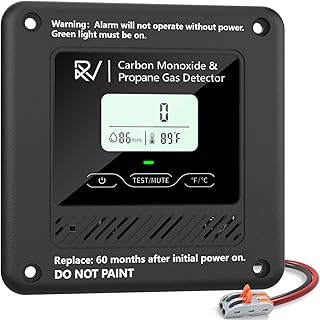 |
4-in-1 Upgraded RV Carbon Monoxide and Propane Detector, Replace The Old RV Gas Detector #31011,2 in 1 Dual CO/LP Gas Alarm with Temperature & Humidity,100dB Loud Alert,12V DC,Flush Mount-Black |
$69.99 | — | View on Amazon |
| #2 |  |
Safe T Alert - Dual LP/CO Alarm - Flush Mount Black - 35-742-BL |
$58.02 | (2,329) | View on Amazon |
| #3 |  |
Safe T Alert - Mini Dual LP/CO Alarm - Flush Mount Black - 25-742-BL |
$75.91 | (97) | View on Amazon |
| #4 |  |
RV CO & Propane LP Gas Detector, 12V DC Hardwired Display, White | Digital wall mount detector for camper, travel trailer, motorhome and truck camper, with CO, propane and LP gas readings |
$49.99 | (3) | View on Amazon |