
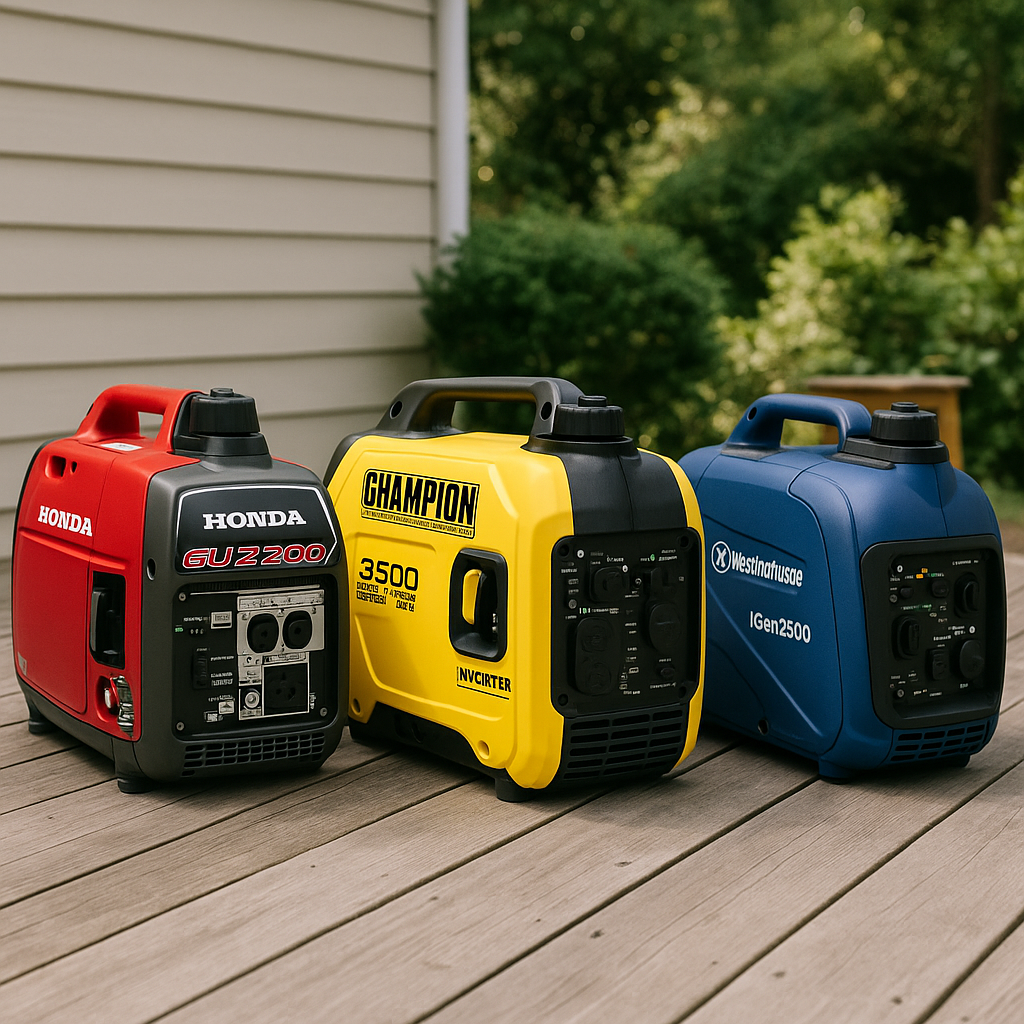
Best Honda vs Champion vs Westinghouse Inverter Generator: Compared

Ellen Kietzmann brings more than 25 years of senior leadership in the RV and outdoor recreation industry. She spent 22 years at Blue Ox — rising from Vice President of Sales & HR to President — where she grew the deal…
Why trust us
RVGearInsider articles are researched by the Searchshop Editorial team using manufacturer specs, independent expert sources, and owner feedback. Our goal is simple: when an RVer searches for gear, the recommendations they read online should match what a knowledgeable dealer or experienced owner would actually suggest. We may earn a commission on qualifying affiliate purchases; it doesn't influence what we recommend — if a product changes or a better option comes along, the article changes too.
How We Evaluated
We researched the top options, comparing them across key factors including performance, value, ease of use, and reliability. Our recommendations are based on editorial evaluation of verified specifications, owner-reported real-world performance, and domain expertise.
If you’ve ever had a generator trip out right as your RV air conditioner kicked on, you already know this isn’t a spec-sheet-only purchase. We’ve tested enough inverter generators in campgrounds, boondocking sites, and shoulder-season hookups to say this plainly: Honda still owns the premium end, but Champion and Westinghouse have closed the gap a lot faster than many RV owners realize.
For this comparison, we focused on the inverter generators RV owners actually cross-shop: compact 2,000-watt-class units, mid-size 2,500-watt options, and a serious 4,500-watt-class machine for bigger rigs. Our clear winner for most RV owners is the Champion Power Equipment 2500-Watt Dual Fuel Inverter Generator (Model 201122) because it hits the sweet spot on price, fuel flexibility, RV usability, and portability. But depending on whether you prioritize ultra-quiet operation, long-term reliability, or air-conditioner-starting muscle, Honda or Westinghouse may be the better fit.
Comparison Table: Honda vs Champion vs Westinghouse Inverter Generators

| Model | Running / Starting Watts | Fuel Type | Weight | Noise | RV Outlet | Typical Price | Best For |
|---|---|---|---|---|---|---|---|
| Champion 2500 Dual Fuel (201122) | 1,850 gas / 1,665 propane; 2,500 start | Gas/Propane | 39 lb | 53 dBA | Yes, TT-30R | $650-$800 | Most RV owners |
| Honda EU2200i | 1,800 / 2,200 | Gas | 47.4 lb | 48-57 dBA | No TT-30R on standard model | $1,100-$1,300 | Reliability, quiet camping |
| Westinghouse iGen4500DFc | 3,700 gas / 3,330 propane; 4,500 start | Gas/Propane | 104.7 lb | 52 dBA | Yes, TT-30R | $950-$1,200 | 13.5K-15K BTU A/C use |
| Champion 2000 Inverter (100692) | 1,700 / 2,000 | Gas | 39.5 lb | 53 dBA | No TT-30R | $500-$650 | Budget solo/small trailer use |
| Westinghouse iGen2550DFc | 1,900 gas / 1,710 propane; 2,550 start | Gas/Propane | 42.4 lb | 52 dBA | Yes, TT-30R | $650-$800 | Budget dual-fuel RV use |
Prices reflect typical online street pricing at the time of writing and can swing seasonally.
Our Top Picks at a Glance
- Best Overall: Champion 2500-Watt Dual Fuel Inverter Generator (201122)
- Best Premium Pick: Honda EU2200i
- Best for Bigger RV Loads: Westinghouse iGen4500DFc
- Best Value 2,000W Class: Champion 2000-Watt Inverter Generator (100692)
- Best Budget Alternative: Westinghouse iGen2550DFc
How We Compared These Generators

We didn’t just line up brochure specs. For RV use, we care about five things first:
- Can it start and run common RV loads? Especially a microwave, converter, and roof A/C.
- How loud is it in the real world? Published dBA matters, but tone and load response matter too.
- Is it easy to live with at camp? Weight, handle design, fuel shutoff, drain access, and panel layout all count.
- Does it play nicely with RV hookups? A real TT-30R outlet is a big convenience advantage.
- Is it worth the money? Purchase price, warranty, and likely ownership cost all matter.
Best Inverter Generators Compared
1. Champion 2500-Watt Dual Fuel Inverter Generator (201122) — Best Overall
If you want the shortest version of this article, here it is: this is the inverter generator we’d recommend to the highest number of RV owners.
The Champion 201122 delivers 2,500 starting watts and 1,850 running watts on gasoline, or 1,665 running watts on propane. It weighs about 39 pounds, includes a TT-30R RV outlet, and runs at about 53 dBA from 23 feet. In practice, that package solves a lot of common RV pain points. It’s easy to carry, easy to connect to a travel trailer, and dual-fuel operation is genuinely useful for RVers who already carry propane.
We especially like this model for small and midsize trailers where you’re not trying to brute-force a big A/C without a soft start. For battery charging, lights, TV, coffee maker, and moderate appliance use, it’s a very practical machine.
Pros
- Dual-fuel flexibility is excellent for RV travel
- Includes a 30A RV-ready outlet
- Lightweight for its output class
- Strong value versus Honda
- CO Shield shutoff adds safety
Cons
- Not as refined or as quiet-sounding as Honda under changing loads
- Propane output drop is noticeable
- Still marginal for many rooftop A/C units without a soft start
Bottom line: For most RV owners, this is the best balance of price, features, and campsite usability.
2. Honda EU2200i — Best Premium Pick
The Honda EU2200i remains the benchmark for compact inverter generators, and after using one in the field, we understand why. It produces 2,200 starting watts and 1,800 running watts, weighs 47.4 pounds, and is rated at 48 to 57 dBA depending on load. It’s not the cheapest, not the highest-output, and not the most feature-rich. But it is still the generator we trust most for long-term reliability and exceptionally clean, stable power.
Honda’s engine quality and overall finish are still a step above the pack. The EU2200i starts easily, handles variable loads smoothly, and has the kind of low-drama ownership experience many RVers will happily pay for. The downside is obvious: the price is often nearly double a value-brand 2,000-watt-class inverter, and the standard EU2200i does not include a built-in TT-30R RV outlet.
For many RVers, Honda makes the most sense if you camp often, care deeply about noise and reliability, and are willing to pay a premium for a machine that tends to age well.
Pros
- Best-in-class reliability reputation
- Very quiet and smooth under load
- Excellent fuel efficiency
- Strong resale value
- Clean power for sensitive electronics
Cons
- Expensive
- No dual-fuel option on the standard model
- Standard version lacks dedicated RV outlet
- Still limited for larger A/C loads on its own
Bottom line: If budget is secondary to reliability and refinement, Honda is still the premium pick.
3. Westinghouse iGen4500DFc — Best for Bigger RV Loads
If your real question is, “Which generator will actually run my RV air conditioner with less drama?” this is the one to look at first. The Westinghouse iGen4500DFc is a dual-fuel inverter generator with 4,500 starting watts and 3,700 running watts on gasoline, or 3,330 running watts on propane. It weighs about 104.7 pounds, but it’s a wheeled unit with telescoping handle, so it’s far more manageable than the weight suggests.
This is the strongest RV-focused machine in this comparison. It includes a TT-30R outlet, electric start, remote start, CO sensor shutoff, and enough power for many 13,500 BTU RV air conditioners and some 15,000 BTU units, especially if the rig has a soft start installed.
We like this model for larger travel trailers and fifth wheels where a small suitcase generator simply won’t cut it. The tradeoff is portability. You don’t casually lift this into a truck bed the way you do a Honda EU2200i or Champion 2500.
Pros
- Best power output in this comparison
- Dual fuel adds flexibility
- Excellent RV feature set with TT-30R
- Electric and remote start are genuinely convenient
- Good value for the wattage
Cons
- Heavy, even with wheels
- Larger storage footprint
- More generator than many small-trailer owners need
Bottom line: For bigger RV loads and more realistic A/C use, Westinghouse wins on sheer capability.
4. Champion 2000-Watt Inverter Generator (100692) — Best Value 2,000W Class
The Champion 100692 is one of those generators we recommend when the budget is tight and the load list is modest. It offers 2,000 starting watts and 1,700 running watts, weighs about 39.5 pounds, and is rated around 53 dBA.
This is a straightforward, gas-only inverter generator that works well for battery charging, electronics, lights, fans, and light kitchen loads. It’s especially appealing for van campers, teardrops, and small trailers that don’t need an RV-ready 30A plug or heavy surge capacity.
The limitation is obvious: it’s not the most RV-friendly setup out of the box, and it’s not our first choice if your camping style revolves around air conditioning.
Pros
- Affordable entry price
- Lightweight and easy to carry
- Quiet enough for most campgrounds
- Good basic inverter performance
Cons
- No dual fuel
- No TT-30R RV outlet
- Limited headroom for demanding RV loads
Bottom line: A solid budget generator, but more of a light-duty camping tool than a true all-around RV solution.
5. Westinghouse iGen2550DFc — Best Budget Dual-Fuel Alternative
The Westinghouse iGen2550DFc is the model we point to when someone wants dual fuel, RV-ready output, and a lower price than Honda without stepping down too far in convenience. It produces 2,550 peak watts and 1,900 running watts on gasoline, or about 1,710 running watts on propane, weighs 42.4 pounds, and runs at around 52 dBA.
Like the Champion 2500 Dual Fuel, it includes a TT-30R outlet, making it easy to connect to many RVs without adapter gymnastics. It also has a fuel gauge and CO sensor shutoff. In practice, this is a very competitive alternative to Champion in the compact RV category.
Why didn’t it take our top spot? We slightly prefer Champion’s support network, overall polish, and value consistency across retailers. But this Westinghouse is absolutely in the conversation.
Pros
- Dual-fuel capability
- RV-ready outlet included
- Competitive noise and weight
- Usually priced well
Cons
- Not as proven long-term as Honda
- Support experience can vary by seller
- Propane power drop limits heavy-load use
Bottom line: A smart buy if you want compact dual-fuel RV convenience at a fair price.
Honda vs Champion vs Westinghouse: Side-by-Side Analysis
Best for Reliability: Honda
Honda is still the brand we trust most if the generator will see years of regular use. The EU2200i feels more refined in startup, throttle response, and long-run consistency. If you boondock often and hate equipment drama, Honda earns its reputation.
Best Value: Champion
Champion has become the easiest brand for us to recommend to mainstream RV owners because it consistently delivers practical features at prices that make sense. The 201122 is the best example: dual fuel, RV outlet, manageable weight, and a realistic price.
Best Power for RV Air Conditioning: Westinghouse
Westinghouse wins when output matters most. The iGen4500DFc is the only model here we’d call a serious single-generator solution for many larger RV loads. If your goal is dependable A/C support, this is the strongest option.
Best Portability: Champion 2500 Dual Fuel
The Champion 2500 Dual Fuel gives up a little refinement to Honda but gains a lot in convenience. At roughly 39 pounds with a built-in RV outlet and propane capability, it’s one of the easiest generators here to actually live with on the road.
Our Clear Winner
Winner: Champion 2500-Watt Dual Fuel Inverter Generator (201122)
If we were buying one inverter generator for the average RV owner today, this would be our pick. It’s not the quietest, not the fanciest, and not the most powerful. But it solves the most real-world RV problems for the least money. The built-in TT-30R outlet matters. The dual-fuel setup matters. The 39-pound weight matters. And the price gap between this Champion and a Honda EU2200i is large enough that most buyers will feel it immediately.
If you want the best premium machine, buy the Honda. If you need to run bigger loads, buy the Westinghouse iGen4500DFc. But for the broad middle of RV owners, Champion wins this comparison.
How to Choose the Right Inverter Generator for Your RV
Here’s the process we use when helping RV owners narrow it down.
Materials List
Before you shop, gather these:
- Your RV’s shore power type: 30A or 50A
- Appliance list: A/C, microwave, converter, coffee maker, induction cooktop, etc.
- Running and starting watt estimates for major loads
- Extension cord or RV power cord length needs
- Fuel preference: gasoline only or dual fuel
- Storage dimensions in your truck, pass-through, or cargo area
Step-by-Step
List your must-run appliances.
Decide whether you only need battery charging and basics, or whether you expect to run the microwave or roof A/C.Identify your highest startup load.
For most RVs, that’s the air conditioner. A 13.5K BTU unit can be difficult for a small inverter generator unless you use a soft start.Match wattage to reality, not wishful thinking.
A 2,000W-class inverter is great for light-duty use. A 2,500W-class unit gives a little more headroom. If A/C is the goal, a 4,500W-class model is often the safer bet.Choose your fuel strategy.
We like dual fuel for RV use because propane stores cleaner and is already onboard many rigs. Gasoline usually gives the best output.Check the outlet panel.
A built-in TT-30R makes RV hookup easier. Without it, you may need an adapter.Be honest about weight.
A 100-pound wheeled generator is still 100 pounds. If you’ll move it often, a 39- to 47-pound suitcase generator may be a better fit.Plan for maintenance and storage.
Fuel shutoff, oil access, and support availability matter more after year one than they do on purchase day.
Pro Tips
- Install a soft start on your RV A/C if you want the best chance of running it from a smaller inverter generator.
- Don’t shop by peak watts alone. Running watts tell you more about real usability.
- Propane is convenient, but it reduces output. We always account for that before recommending a dual-fuel model for A/C duty.
- Parallel capability matters if you may add a second generator later instead of jumping to a large wheeled model now.
Safety Callout: Never run a generator inside an RV, garage, under the rig, or near open windows. Carbon monoxide kills quietly and fast.
Safety Callout: Let the generator cool before refueling, and always use the correct gauge extension cord and a proper RV adapter if needed.
Which Generator Should You Buy?
Here’s the short version:
- Buy the Champion 2500 Dual Fuel (201122) if you want the best all-around RV value.
- Buy the Honda EU2200i if you want premium reliability and quiet operation and don’t mind paying for it.
- Buy the Westinghouse iGen4500DFc if your RV use includes serious A/C demands.
- Buy the Champion 100692 if you want a lower-cost light-duty inverter generator.
- Buy the Westinghouse iGen2550DFc if you want a compact RV-ready dual-fuel alternative to Champion.
For most readers, our recommendation stays the same: Champion 201122 is the best Honda vs Champion vs Westinghouse inverter generator choice overall for RV use.
FAQ
1. Is Honda really worth the extra money over Champion or Westinghouse?
Yes, if you prioritize long-term reliability, quieter operation, and resale value. No, if your main goal is getting the most RV-friendly features per dollar. For most RV owners, we think Champion offers the better value.
2. Can a 2,000-watt or 2,500-watt inverter generator run an RV air conditioner?
Sometimes, but not reliably for every setup. A small high-efficiency A/C or a unit with a soft start may work. For consistent A/C use, we recommend stepping up to something like the Westinghouse iGen4500DFc.
3. Is dual fuel worth it for RV camping?
In our experience, yes. Propane is convenient, stores well, and many RVers already carry it. Just remember that propane usually reduces running wattage compared with gasoline.
4. What’s the best generator for a 30-amp RV?
For most 30-amp RV owners, our top pick is the Champion 2500 Dual Fuel (201122) for basic to moderate loads. If you need to run the air conditioner regularly, the Westinghouse iGen4500DFc is the better choice.
Top Picks & Comparison
| # | Product | Price | Rating | ||
|---|---|---|---|---|---|
| #1 |  |
Champion Power Equipment 4000-Watt RV Ready Portable Inverter Generator with Quiet Technology and Free 3-Year Warranty |
$559.00 | (348) | View on Amazon |
| #2 |  |
Champion Power Equipment 2500-Watt Ultralight Portable Inverter Generator with Quiet Technology and Free 3-Year Warranty Champion Power Equipment |
$469.00 | (252) | View on Amazon |
| #3 |  |
Champion Power Equipment 4500-Watt RV Ready Portable Inverter Generator with Quiet Technology and Free 3-Year Warranty Champion Power Equipment |
$679.00 | (165) | View on Amazon |
| #4 |  |
Westinghouse 4000 Peak Watt Super Quiet Dual Fuel Portable Inverter Generator, Remote Electric Start, Gas & Propane Powered, RV Ready, CO Sensor, Parallel Capable |
$799.00 | (2,285) | View on Amazon |