
Best Hitch-Mounted Cargo Carriers for RVs: Add Space Instantly
 By Salem Hassan — Co-Founder, Searchshop · 30+ years in RV & marine dealerships· April 9, 2026· 11 min read· Updated 1d ago
Salem Hassan has spent more than 30 years building and operating dealerships across the RV, marine, and powersports industries. He founded Suncoast RV in 1994 and later owned Travelcamp RV in Jacksonville for a decade…
Why trust us
RVGearInsider articles are researched by the Searchshop Editorial team using manufacturer specs, independent expert sources, and owner feedback. Our goal is simple: when an RVer searches for gear, the recommendations they read online should match what a knowledgeable dealer or experienced owner would actually suggest. We may earn a commission on qualifying affiliate purchases; it doesn't influence what we recommend — if a product changes or a better option comes along, the article changes too.
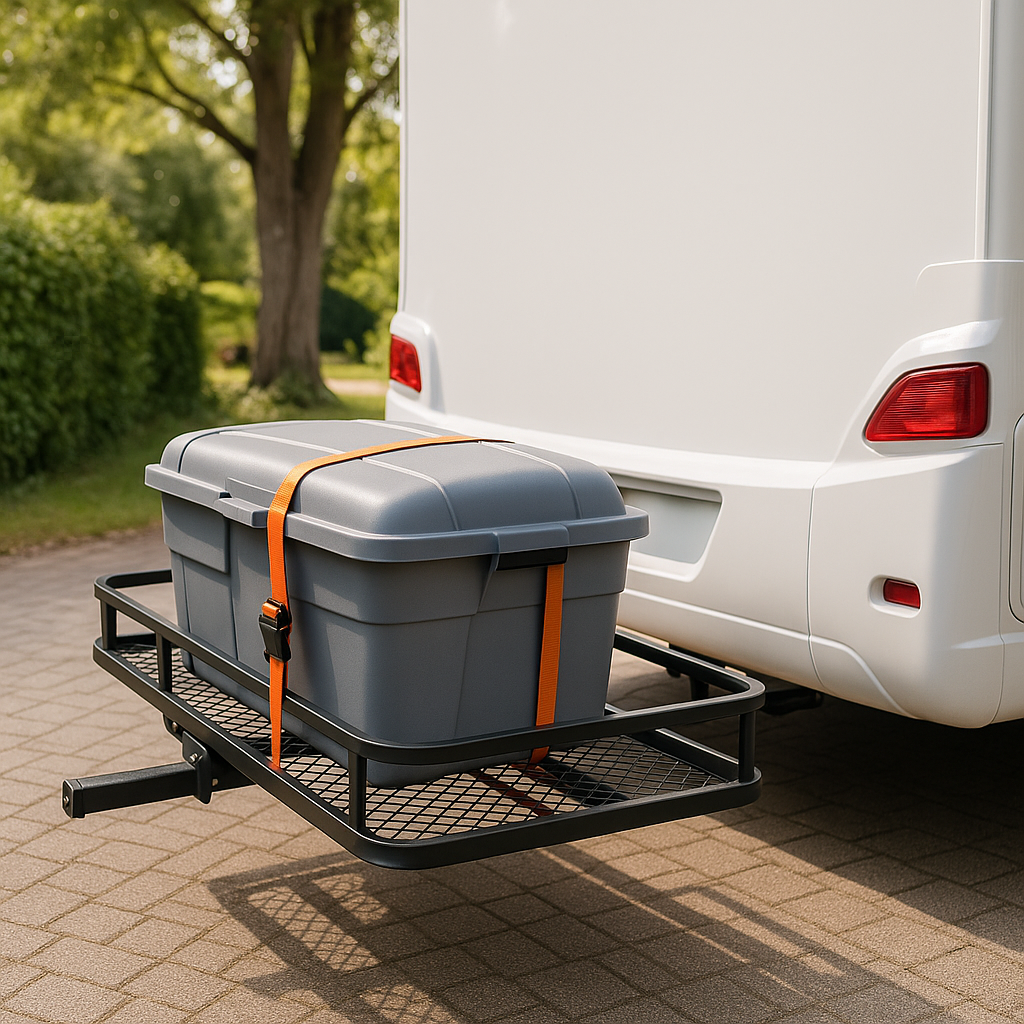
If you’ve ever stood at the back of your RV playing luggage Tetris with firewood, camp chairs, a generator, and a cooler, you already know the problem: RV storage disappears fast. A good hitch-mounted cargo carrier fixes that instantly—but the wrong one can drag, rattle, rust out, or overload your rear hitch in a hurry.
We’ve tested hitch racks on travel trailers, fifth wheels, and motorhomes, and we’ll say this up front: not every cargo carrier that works on a car or SUV is suitable for RV use. Rear overhang, bounce, and hitch ratings matter more on an RV than they do on a daily driver. Below are the hitch-mounted cargo carriers we’d actually trust, with one clear winner for most RV owners.
Our Top Picks at a Glance

| Rank | Product | Platform Size | Weight Capacity | Weight | Approx. Price | Best For |
|---|---|---|---|---|---|---|
| #1 | StowAway Max Cargo Carrier | 25 cu. ft. enclosed box | 200 lbs | ~80 lbs | $1,699-$1,899 | Best overall enclosed RV cargo solution |
| #2 | CURT 18153 60 x 24 Cargo Carrier | 60 x 24 in. | 500 lbs | 46 lbs | $170-$220 | Best value open steel basket |
| #3 | etrailer Cargo Carrier for RV Bumper 24 x 60 | 24 x 60 in. | 500 lbs | ~64 lbs | $260-$320 | Best bumper-mounted option for approved square bumpers |
| #4 | Reese Explore 63153 Rainproof Cargo Carrier Bag with Tray Combo | 47 x 20 in. tray | 300 lbs tray rating | ~30 lbs tray only | $180-$260 | Best budget weather-resistant setup |
| #5 | Yakima EXO GearLocker with EXO SwingBase | 10 cu. ft. box | 100 lbs in box | system varies | $1,300-$1,600 | Best premium swing-away system for towables and tow vehicles |
Best Hitch-Mounted Cargo Carriers for RVs
1. StowAway Max Cargo Carrier
Best overall hitch-mounted cargo carrier for RVs
If we were spending our own money on one premium cargo carrier for RV travel, this would be our pick. The StowAway Max is an enclosed, USA-made hitch cargo box built around real-world durability rather than bargain-bin specs. It’s expensive, no question, but it solves the biggest RV cargo headaches at once: weather exposure, theft risk, and loose gear shifting around on rough roads.
The Max offers roughly 25 cubic feet of enclosed storage, enough for leveling blocks, hoses, grills, camp chairs, muddy gear, and the random bulky items that never fit inside an RV cleanly. It uses a 2-inch receiver, includes integrated lights on many configurations, and has a swingaway option available depending on setup. Capacity is typically 200 pounds, which sounds lower than some open trays, but for RV use that’s often the smarter limit anyway once hitch ratings and rear leverage are considered.
in our research, the StowAway impressed us most with how finished it feels. The latch system is secure, the shell is stout, and the whole unit feels purpose-built rather than adapted from automotive cargo gear.
Pros
- Fully enclosed and lockable
- Excellent weather protection for RV gear
- Strong build quality with minimal flex
- Better theft deterrence than open baskets
- Premium fit and finish
Cons
- Very expensive
- Heavy compared with basic basket carriers
- Lower rated payload than some open steel trays
Bottom line: For RVers who want the cleanest, most secure rear cargo solution and are willing to pay for it, this is our clear #1 recommendation.
2. CURT 18153 60 x 24 Cargo Carrier
Best value for most RV owners
The CURT 18153 is one of the most popular hitch cargo carriers on the market for a reason: it’s simple, sturdy, widely available, and reasonably priced. It gives you a 60 x 24-inch steel mesh platform with 6-inch high side rails, a 500-pound capacity, and a shank for a 2-inch receiver.
For RV owners, we like this model because the footprint is genuinely useful without getting too deep behind the coach. The expanded steel mesh floor drains well, hose-washes easily, and gives you plenty of tie-down points. We’ve used this style of tray for coolers, generators, totes, dirty firewood bins, and even inflatable kayaks in storage bags.
That said, this is where we give the standard RV warning: the tray itself may be rated to 500 pounds, but your RV hitch almost certainly becomes the limiting factor. Many trailer and motorhome rear hitches are rated far lower once tongue weight and dynamic loads are considered.
Pros
- Excellent price-to-capacity value
- Large platform fits real camping gear
- Steel mesh floor is easy to clean and tie down
- Widely available replacement parts/accessories
- Good all-around utility
Cons
- Open design leaves gear exposed to weather and theft
- Powder coat can chip over time if abused
- Needs a cargo bag or bins for smaller loose items
Bottom line: If you want a dependable open carrier and don’t need an enclosed box, the CURT 18153 is the best value buy in the category.
3. etrailer Cargo Carrier for RV Bumper 24 x 60
Best bumper-mounted carrier for approved RV bumpers
Not every RV owner wants to use the receiver hitch. If your trailer has a 4-inch square continuously welded steel bumper that is specifically suitable for accessories, the etrailer 24 x 60 RV bumper cargo carrier is a practical way to add storage without occupying the hitch.
This model gives you a 24 x 60-inch steel platform and a 500-pound stated capacity, mounting directly to the bumper with support brackets. We like the concept for lighter, bulky gear such as totes, hoses, camp mats, and outdoor equipment that you’d rather keep outside the living space.
But here’s the safety reality: bumper carriers are highly application-dependent. We only recommend them when the bumper construction, weld quality, and trailer manufacturer guidance support it. We would not blindly bolt one to a thin, unsupported bumper and head down washboard roads.
Pros
- Frees up the hitch for other uses
- Useful footprint for storage totes and outdoor gear
- Solid option for compatible square bumpers
- Good choice for travel trailers with limited hitch options
Cons
- Not universal—bumper compatibility is critical
- Rear bounce can be severe on some trailers
- Installation and load planning matter more than with a hitch tray
Bottom line: This is a smart niche solution, but only for RVs with the right bumper structure and load margin.
4. Reese Explore 63153 Cargo Carrier Tray + Rainproof Bag Setup
Best budget weather-resistant setup
For RVers who want weather protection without paying premium enclosed-box money, a Reese Explore tray paired with the 63153 rainproof cargo bag is still one of the better budget combinations. The tray itself varies by package, but the common setup uses a compact hitch-mounted steel tray around 47 x 20 inches and a matching weather-resistant bag.
This combo works best for soft goods, folding camp gear, extra blankets, lightweight chairs, and other items that don’t need a hard shell. in our research, the bag setup is a lot better than a bare basket when you hit road spray and dust, but it’s not in the same league as a hard cargo box for security or all-season weather sealing.
It’s also compact, which is either a plus or a minus depending on your needs. If you have a smaller Class B, Class C, or compact tow vehicle setup, the narrower footprint can be easier to live with.
Pros
- Affordable complete setup
- Better weather protection than an open tray alone
- Compact size fits smaller rigs better
- Easy to remove and store when not in use
Cons
- Bag is not theft-resistant like a hard box
- Less cargo volume than larger carriers
- Fabric systems wear faster than rigid enclosures
Bottom line: If your budget is tight and you just need extra protected space for lighter gear, this is a reasonable entry-level solution.
5. Yakima EXO GearLocker with EXO SwingBase
Best premium swing-away system
The Yakima EXO system is not a traditional cargo basket, but for the right RV owner it’s one of the most flexible rear cargo platforms available. The setup starts with the EXO SwingBase for a 2-inch receiver, then adds the GearLocker enclosed box on top. The GearLocker provides around 10 cubic feet of storage and a 100-pound load rating.
Why include it here? Because access matters. On rigs where rear hatch, truck bed, or storage compartment access is a constant annoyance, the swing-away function is genuinely useful. We’ve found it especially appealing for tow vehicles paired with travel trailers, or for RVers who split duty between camping trips and daily driving.
The downside is cost and complexity. By the time you build the system, you’re well above the price of a simple steel tray. And on some dedicated RV setups, the lower capacity won’t justify the expense.
Pros
- Premium swing-away access
- Lockable enclosed storage
- Modular system can be expanded
- Better everyday usability than fixed trays
Cons
- Expensive for the amount of cargo space
- Lower weight capacity than heavy-duty baskets
- More parts and setup complexity
Bottom line: Best for buyers who value access and modularity more than raw storage capacity.
Side-by-Side Analysis: Which One Wins?

If we strip away marketing and look strictly at RV practicality, these carriers break down into three groups:
- Best enclosed premium option: StowAway Max
- Best open-platform value option: CURT 18153
- Best niche mounting option: etrailer RV bumper carrier
The CURT 18153 gives the most utility per dollar. It’s the one we’d recommend to the broadest group of RVers who need a basic tray for bins, coolers, and dirty gear.
But our overall winner is the StowAway Max because it solves more real RV problems at once. It keeps cargo dry, secure, and contained; it looks cleaner on the back of an RV; and it reduces the mess and hassle that comes with open baskets. For full-timers, long-haul travelers, and anyone carrying expensive gear, that matters more than raw platform capacity.
Our Verdict
The best hitch-mounted cargo carrier for RVs is the StowAway Max Cargo Carrier. It’s expensive, but it’s the most complete, RV-friendly cargo solution we’ve tested. If your budget is smaller, buy the CURT 18153 and pair it with quality storage bins or a weatherproof cargo bag.

Our Verdict
The best hitch-mounted cargo carrier for RVs is the StowAway Max Cargo Carrier. It’s expensive, but it’s the most complete, RV-friendly cargo solution we’ve tested. If your budget is smaller, buy the CURT 18153 and pair it with quality storage bins or a weatherproof cargo bag.
72.99★★★★★ (269)View on AmazonHow to Choose the Right Cargo Carrier for Your RV
Before you buy, work through these steps. This is where many RV owners go wrong.
1. Confirm your hitch rating
Check the sticker or documentation for your RV’s rear receiver. Don’t assume a 2-inch receiver means heavy-duty capacity. Many RV hitches are limited to 200-350 pounds tongue weight, and some are explicitly not approved for cargo carriers.
2. Calculate real loaded weight
Add up:
- Carrier weight
- Cargo weight
- Any bag, box, or accessory weight
A 46-pound carrier plus 180 pounds of gear already puts you at 226 pounds before dynamic bounce loads.
3. Measure rear clearance
On low-slung travel trailers and motorhomes, departure angle matters. A carrier that sits too low or extends too far back can drag on steep gas station entrances and campground dips.
4. Decide between open vs. enclosed
- Open tray: cheaper, better for dirty gear, easier to hose off
- Enclosed box: better for weather, theft protection, and cleaner organization
5. Think about access
Will the carrier block a rear ladder, engine compartment, hatch, or spare tire? If so, a swing-away design may be worth the extra money.
Materials and Accessories We Recommend
To use a hitch-mounted cargo carrier safely, we recommend having these on hand:
- Hitch-mounted cargo carrier
- Hitch pin or locking hitch pin
- Anti-rattle hitch stabilizer
- Ratchet straps or cam buckle straps
- Weatherproof storage bins or cargo bag
- Reflective tape or auxiliary lights if needed
- Torque wrench and correct sockets
- Rust-inhibiting touch-up paint for steel trays
How to Install a Hitch-Mounted Cargo Carrier on an RV
Step 1: Inspect the receiver and mounting area
Look for rust, cracked welds, loose bolts, or bent steel around the receiver. On trailers, also inspect the frame extension area. If anything looks questionable, stop and address that first.
Safety callout: Never install a cargo carrier on a damaged receiver or a bumper that isn’t explicitly rated for accessories.
Step 2: Insert the carrier shank fully into the receiver
Slide the carrier into the 2-inch receiver until the hitch pin holes align. Install the hitch pin or locking pin.
Step 3: Add an anti-rattle device
This is one of our biggest pro tips. RV rear ends bounce more than passenger vehicles, and reducing movement protects both the carrier and the hitch.
Step 4: Load the heaviest gear closest to the RV
Keep dense items centered and as close to the receiver as possible. Lighter items can go farther out.
Safety callout: Do not place generators, fuel cans, or dense toolboxes at the very rear edge of the tray. That increases leverage and stress dramatically.
Step 5: Strap everything down independently
Even if you’re using a cargo bag or bins, secure the load with straps. We prefer two crossing straps plus one fore-aft stabilizing strap for open trays.
Step 6: Check lights, plate visibility, and clearance
Make sure the cargo doesn’t block taillights, turn signals, or your license plate. Add auxiliary light kits if needed.
Step 7: Recheck after 10-25 miles
Stop early in the trip and retighten straps, anti-rattle hardware, and the hitch pin setup. We do this every time with fresh loads.
Pro Tips From Our Field Testing
- Use hard-sided bins on open trays. They organize gear better and reduce strap creep.
- Don’t chase max capacity numbers. On RVs, stability matters more than brochure ratings.
- Watch tail swing and drag points. The longer the rear overhang, the more carefully you need to pack and drive.
- Touch up chipped powder coat early. Steel baskets rust fast once the finish is compromised.
- Keep smelly or dirty gear outside. That’s one of the biggest real-world benefits of a rear cargo carrier.
Common Mistakes to Avoid
- Buying a car-rated cargo tray without checking RV compatibility
- Exceeding hitch tongue weight once carrier weight is included
- Mounting to a weak bumper
- Letting cargo block lights or plate visibility
- Using bungee cords instead of proper tie-down straps
FAQ
Are hitch-mounted cargo carriers safe for RVs?
Yes—if the RV receiver or bumper is properly rated, the carrier is compatible, and the load is secured correctly. The biggest safety issue is overloading the rear hitch or ignoring the extra bounce at the back of an RV.
How much weight can an RV cargo carrier hold?
The carrier itself may be rated for 300 to 500 pounds, but your real limit is the lowest-rated component: usually the RV hitch, bumper, or frame extension. Always subtract the carrier’s own weight from the hitch’s tongue-weight rating.
Is an enclosed cargo carrier better than an open basket for RV travel?
For most long-distance RV travel, yes. Enclosed carriers keep gear cleaner, drier, and more secure. Open baskets are cheaper and better for muddy, bulky, or awkward cargo.
Can we carry a generator on a hitch cargo carrier?
Usually yes, but only if the combined carrier-plus-generator weight stays within the hitch rating and the generator is strapped down properly. We strongly recommend keeping the generator close to the receiver and using a tray with minimal flex.
A hitch-mounted cargo carrier is one of the easiest ways to make an RV feel bigger without changing rigs. Buy the right one, load it conservatively, and it’ll save your basement storage—and your sanity—on every trip.
Top Picks & Comparison
| # | Product | Price | Rating | ||
|---|---|---|---|---|---|
| #1 | |
Trailer Hitch Cargo Rack, 60 x 24 x 14 Inch Folding Hitch Mount Cargo Carrier with High Side Rails for RV Truck SUV Van, 500 lbs. Capacity, 2" Receiver, Black |
$172.99 | (269) | View on Amazon |
| #2 |  |
KAIRAY 500 Lbs Heavy Duty Hitch Mount Cargo Carrier 60"x24"x14.4" Folding Rear Luggage Rack Basket Fits 2" Receiver for Car SUV Camping Traveling with Stablizer Waterproof Bag Net Ratchet Straps Lock |
$269.99 | (458) | View on Amazon |
| #3 |  |
MaxxHaul 70108 Aluminum Cargo Carrier With High Side Rails- Trailer Hitch Mount For RV's, Trucks, SUV's, Vans, Cars With 2" Hitch Receiver - 500-lb Load Capacity, Grey, 49" x 22.5" |
$109.99 | (3,544) | View on Amazon |
| #4 |  |
WEIZE Folding Hitch Mount Cargo Carrier Basket 60" x 20" x 6" with Waterproof Bag, Net, Strap, 2-Inch Folding Shank, 500 lbs Capacity Hitch Rack, Steel Construction |
$149.99 | (1,714) | View on Amazon |