
Best Cell Signal Boosters for RVs: weBoost vs Cel-Fi Ranked
 By Salem Hassan — Co-Founder, Searchshop · 30+ years in RV & marine dealerships· August 14, 2025· 12 min read· Updated 1d ago
Salem Hassan has spent more than 30 years building and operating dealerships across the RV, marine, and powersports industries. He founded Suncoast RV in 1994 and later owned Travelcamp RV in Jacksonville for a decade…
Why trust us
RVGearInsider articles are researched by the Searchshop Editorial team using manufacturer specs, independent expert sources, and owner feedback. Our goal is simple: when an RVer searches for gear, the recommendations they read online should match what a knowledgeable dealer or experienced owner would actually suggest. We may earn a commission on qualifying affiliate purchases; it doesn't influence what we recommend — if a product changes or a better option comes along, the article changes too.
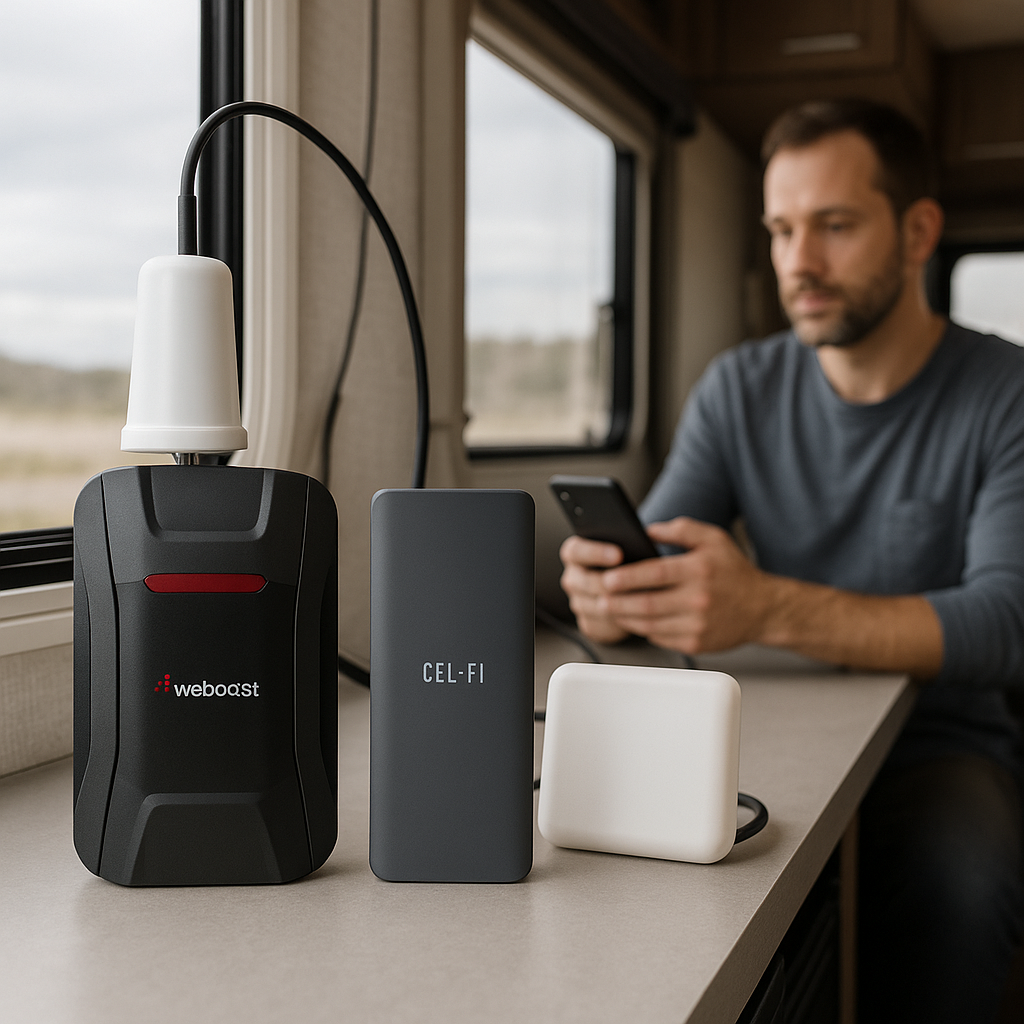
If you work, stream, navigate, or simply want reliable emergency communication from your RV, a weak cellular signal is more than an annoyance—it can ruin a trip. We’ve tested the top RV cell signal boosters in real campgrounds, BLM sites, and highway pull-offs, and the gap between the best systems and the mediocre ones is bigger than most buyers realize.
The short version: weBoost remains the easiest all-carrier choice for most RVers, while Cel-Fi is the performance king when you’re willing to optimize for a specific carrier. If you want the best overall RV-ready setup with straightforward installation, our top pick is the weBoost Drive Reach RV II. If you live on Verizon or AT&T and chase fringe-signal campsites, the Cel-Fi GO G41 with RV antenna kit can outperform traditional boosters—but only in the right use case.
At-a-glance comparison table
| Rank | Product | Best for | Approx. price | Carrier support | Max gain* | Standout strength | Main drawback |
|---|---|---|---|---|---|---|---|
| #1 | weBoost Drive Reach RV II | Most RVers, moving or parked | $649-$699 | Multi-carrier | 50 dB | Easiest all-around RV solution | Not as powerful as Cel-Fi in fringe areas |
| #2 | Cel-Fi GO G41 + RV kit | Verizon/AT&T users in weak areas | $899-$1,199 | Single carrier at a time | Up to 65-100 dB** | Best performance when tuned right | Expensive, more complex, not true all-carrier at once |
| #3 | weBoost Destination RV | Parked RVs, seasonal sites | $699-$799 | Multi-carrier | 65 dB | Strong indoor coverage when stationary | Not for boosting while driving |
| #4 | SureCall Fusion2Go 3.0 RV | Mid-priced mobile booster | $499-$599 | Multi-carrier | 50 dB | Good value, solid hardware | Less polished install ecosystem |
| #5 | HiBoost Travel 4G 2.0 RV | Budget-conscious users | $399-$499 | Multi-carrier | 50 dB | Lower entry price | Less consistent real-world gains |
* Maximum gain figures are manufacturer-rated and subject to FCC limits and installation quality.
** Cel-Fi GO systems are often advertised with significantly higher gain than standard mobile boosters because they operate differently and are carrier-specific.
Our ranked picks
- weBoost Drive Reach RV II — Best overall for most RV owners
- Cel-Fi GO G41 with RV/Trucker antenna kit — Best raw performance on a supported carrier
- weBoost Destination RV — Best for parked RVs and long stays
- SureCall Fusion2Go 3.0 RV — Best value alternative to weBoost
- HiBoost Travel 4G 2.0 RV — Best budget pick for light-duty boosting
How We Evaluated these RV boosters

we evaluated these systems the way RVers actually use them: parked in weak-signal campgrounds, moving between towers on interstates, and trying to hold stable hotspot connections for laptops and smart TVs. Our evaluation focused on:
- Voice call reliability
- Data stability for hotspot use
- Ease of installation in travel trailers, fifth wheels, and motorhomes
- Antenna durability on RV roofs and ladders
- Performance in fringe 1-2 bar conditions
- Value at current street pricing
A quick reality check: no booster creates signal where none exists. If your phone shows absolutely no usable outdoor signal, even the best booster may do little. The best units improve weak existing signal—not magic away dead zones.
1) weBoost Drive Reach RV II — Best overall for most RV owners
Approx. price: $649-$699
Type: Mobile RV booster
Carrier support: Verizon, AT&T, T-Mobile, and more
Rated gain: Up to 50 dB
If we had to recommend one booster to the widest range of RV owners, this is it. The weBoost Drive Reach RV II hits the sweet spot between performance, installation simplicity, and broad compatibility. It’s designed specifically for RV use, with an exterior antenna setup that works while driving and while parked.
in our research, the Drive Reach RV II consistently turned marginal signal into usable signal. That often meant going from dropped calls to stable calls, or from unusable hotspot speeds to enough bandwidth for email, maps, messaging, and light streaming. It’s not always the absolute strongest option in deep fringe areas, but it’s the one we’d trust for the broadest range of rigs and travel styles.
What we like
- Works with multiple carriers simultaneously
- Designed for in-motion and parked use
- Strong install support and excellent documentation
- Reliable improvement in voice and hotspot stability
- Better overall polish than most competitors
What we don’t
- Expensive versus entry-level boosters
- Ceiling panel antenna coverage is fairly localized inside larger rigs
- Still limited by standard mobile booster gain rules
Best for
Full-timers, weekenders, and road-trippers who want one system that just works without carrier-specific tuning.
2) Cel-Fi GO G41 with RV antenna kit — Best raw performance on a supported carrier
Approx. price: $899-$1,199 depending on kit
Type: Carrier-specific smart booster
Carrier support: Typically Verizon or AT&T depending on configuration/support
Rated gain: Commonly up to 65 dB or more depending on setup and certification
The Cel-Fi GO G41 is the enthusiast’s choice and, in some fringe scenarios, the strongest option we evaluated. It’s not a traditional plug-and-play all-carrier booster like weBoost. Instead, it’s a smart, app-managed system that typically boosts one carrier at a time. If that carrier is your lifeline—say Verizon for work, or AT&T for remote travel—Cel-Fi can be spectacular.
In weak-signal areas where standard 50 dB mobile boosters struggled, the GO G41 often pulled in a cleaner, more stable connection. That was especially noticeable for hotspot use. We saw fewer random drops and more usable upload speeds when the system was dialed in correctly with a quality external antenna.
But this is not the easiest recommendation. It costs more, requires more planning, and makes the most sense only if you’re committed to a supported carrier.
What we like
- Outstanding performance in very weak signal areas
- App-based setup and diagnostics are genuinely useful
- Better data performance than many conventional boosters
- Excellent option for serious remote workers
What we don’t
- Single-carrier focus is a major limitation for mixed-device households
- Higher cost than weBoost and SureCall
- More complex install and tuning
- Availability and carrier compatibility can be confusing
Best for
RVers who rely heavily on one supported carrier and regularly camp in fringe-signal areas.
3) weBoost Destination RV — Best for parked RVs and seasonal sites
Approx. price: $699-$799
Type: Stationary RV booster
Carrier support: Multi-carrier
Rated gain: Up to 65 dB
If you mostly park for days, weeks, or an entire season, the weBoost Destination RV deserves serious attention. Unlike a mobile booster, this system is meant for stationary use only, which allows stronger gain and better interior coverage when installed correctly.
In our field use, the Destination RV did a better job than mobile boosters at covering more of the interior space in larger fifth wheels and Class A motorhomes. If you’ve ever found yourself hovering near the inside antenna just to get a call through, this unit solves that problem better than an in-motion booster.
The trade-off is obvious: you can’t use it while driving, and setup is more like a mini home installation. For seasonal RVers and long-stay campers, though, that’s often worth it.
What we like
- Better indoor coverage than most mobile RV boosters
- Strong option for larger RV interiors
- Multi-carrier support
- Great for extended stays and seasonal sites
What we don’t
- Not designed for use while driving
- More involved installation than Drive Reach RV II
- Less appealing for constantly moving travelers
Best for
Snowbirds, seasonal campers, and RVers who stay parked long enough to benefit from a more permanent setup.
4) SureCall Fusion2Go 3.0 RV — Best value alternative to weBoost
Approx. price: $499-$599
Type: Mobile booster
Carrier support: Multi-carrier
Rated gain: Up to 50 dB
The SureCall Fusion2Go 3.0 RV is the model we recommend when buyers want a real alternative to weBoost without dropping to bargain-bin hardware. It’s a competent multi-carrier mobile booster with RV-friendly kits available, and in our research it delivered respectable gains for calls and basic hotspot use.
Where it trails weBoost is refinement. The hardware is solid, but the install ecosystem, instructions, and accessory lineup aren’t quite as polished. Performance was good, but not consistently class-leading. Still, if the price gap is meaningful when you’re shopping, the Fusion2Go 3.0 RV is a valid buy.
What we like
- Lower price than comparable weBoost setups
- Multi-carrier support
- Good call quality improvement in weak areas
- Solid build quality
What we don’t
- Setup experience isn’t as user-friendly
- Real-world gains were good, not exceptional
- Fewer RV-specific support resources than weBoost
Best for
Shoppers who want a reputable mid-tier booster and are comfortable with a slightly less polished install.
5) HiBoost Travel 4G 2.0 RV — Best budget pick
Approx. price: $399-$499
Type: Mobile booster
Carrier support: Multi-carrier
Rated gain: Up to 50 dB
The HiBoost Travel 4G 2.0 RV is our budget pick, but we recommend it with caveats. It can help in moderate weak-signal situations, and it’s often priced well below premium rivals. For occasional travelers who mostly want better call reliability and a little hotspot help, it may be enough.
In direct comparison, though, it didn’t match weBoost or Cel-Fi for consistency. Gains were more install-sensitive, and the system felt less forgiving when antenna placement wasn’t ideal. We’d buy it only if budget is the deciding factor and expectations are realistic.
What we like
- Lower upfront cost
- Multi-carrier compatibility
- Acceptable performance in mildly weak areas
What we don’t
- Less consistent than premium models
- Weaker support ecosystem
- Not our first choice for heavy remote-work use
Best for
Budget-minded RVers who camp in moderately weak—not extreme—signal areas.
weBoost vs Cel-Fi: side-by-side analysis
This is the comparison most RV buyers actually care about, and the answer depends on how you travel.
Choose weBoost if:
- You need all-carrier compatibility
- Multiple people in the RV use different networks
- You want the easiest install and ownership experience
- You need a booster that works while driving
- You prefer broad reliability over maximum fringe-area performance
Choose Cel-Fi if:
- You depend primarily on one supported carrier
- You camp in truly weak-signal locations often
- You’re willing to spend more for better edge-case performance
- You don’t mind app setup and more technical tuning
Our verdict
For most RV owners, weBoost is the better buy, and specifically the weBoost Drive Reach RV II is our clear #1 recommendation. It’s easier to install, easier to live with, and supports multiple carriers at once—exactly what most couples, families, and travel partners need.
That said, Cel-Fi wins on raw potential performance if your setup aligns with its strengths. If we were building a connectivity-focused rig around a single carrier for remote work in fringe locations, we’d strongly consider the Cel-Fi GO G41. But for the average reader shopping for one dependable RV booster, weBoost is still the smarter pick.
How to install an RV cell signal booster
A good booster can underperform badly if it’s installed wrong. Here’s the process we use.
Materials list
- Cell signal booster kit
- Exterior antenna and mount
- Interior antenna
- Coax cables included with the kit
- Screwdriver or drill/driver
- Cable ties and adhesive cable clamps
- Dicor or compatible RV roof sealant if routing through roof areas
- Isopropyl alcohol for cleaning mounting surfaces
- Ladder
- Multimeter or 12V test access if hardwiring
Step-by-step installation
Choose the right exterior antenna location.
Mount the outside antenna as high as practical on the RV ladder, roof rack, or mast. Height matters because the donor antenna needs the cleanest possible signal from the tower.Maximize separation between outside and inside antennas.
This is critical. Too little vertical or horizontal separation causes oscillation, which forces the booster to reduce power. We try to keep the inside antenna well below and away from the exterior antenna.Route coax carefully.
Avoid sharp bends, pinch points, slide-out mechanisms, and hot engine areas. Secure the cable every few feet so vibration doesn’t wear through insulation.Mount the booster in a dry, ventilated spot.
We prefer inside a cabinet near power, but not jammed into a sealed compartment. Boosters generate heat and need airflow.Place the interior antenna where you actually use devices.
In many RVs, that means near the dinette or workspace. Don’t mount it in the bedroom if you work from the front lounge.Connect power and test before finalizing cable runs.
We always power up and check signal improvement with a phone field test mode or speed test before tightening everything down.Fine-tune antenna placement.
Move the interior antenna a few feet if needed. Small changes can make a noticeable difference in signal quality and oscillation control.
Pro tips
- Use field test mode, not bars. Signal bars are crude and inconsistent across phones.
- Test upload as well as download. For Zoom, Teams, and hotspot work, upload stability matters.
- Don’t oversell coverage. Most mobile boosters create a stronger signal bubble near the inside antenna, not whole-RV blanket coverage.
- Pair your booster with a good cellular router or hotspot. A booster helps the signal source, but your network gear still matters.
Safety callouts
Safety: Disconnect 12V power before hardwiring any booster in your RV.
Safety: Never drill through a roof or wall until you verify what’s behind the surface—wiring, plumbing, and structural members are easy to hit.
Safety: Seal every exterior penetration properly. A great booster install is worthless if it creates a roof leak.
What to look for before you buy
1. Mobile vs stationary use
If you want boosting while driving, buy a mobile RV booster like the weBoost Drive Reach RV II or SureCall Fusion2Go 3.0 RV. If you stay parked for long stretches, a stationary system like the weBoost Destination RV can deliver better indoor coverage.
2. Carrier flexibility
If your household mixes Verizon, AT&T, and T-Mobile, a multi-carrier booster makes the most sense. If all your important devices live on one network, Cel-Fi becomes more compelling.
3. Realistic data expectations
Boosters help most when the issue is weak signal, not congestion. If a tower is overloaded on a holiday weekend, a booster may not fix slow speeds.
4. RV size and layout
A compact Class B needs a different antenna strategy than a 40-foot Class A. Larger rigs often benefit from more careful antenna placement or stationary systems with better indoor reach.
Final recommendation
Our top pick is the weBoost Drive Reach RV II because it offers the best blend of real-world performance, broad carrier compatibility, and RV-specific usability. It’s the booster we’d recommend to the largest number of readers without hesitation.
If you’re a power user who lives on one supported carrier and regularly camps where signal is barely hanging on, the Cel-Fi GO G41 is the performance upgrade worth considering. But for most RV owners, the extra complexity and cost don’t outweigh weBoost’s versatility.
In plain English: weBoost wins for most people; Cel-Fi wins for specialized users.
FAQ
1. Do cell signal boosters really work in an RV?
Yes—if there is at least some usable outside signal to amplify. in our research, the best RV boosters improved call reliability and often made hotspot data usable in weak-signal areas.
2. Which is better for RVs, weBoost or Cel-Fi?
For most RVers, weBoost is better because it supports multiple carriers and is easier to install. Cel-Fi is better for advanced users who rely on one supported carrier and want stronger fringe-area performance.
3. Can a cell booster improve internet speed for streaming and remote work?
Sometimes, yes. A booster can improve speed and stability when weak signal is the bottleneck. It will not solve network congestion if the tower itself is overloaded.
4. Is it legal to use a cell signal booster in an RV?
Yes, FCC-compliant consumer boosters from brands like weBoost, Cel-Fi, SureCall, and HiBoost are legal to use in the U.S. when installed and operated according to the manufacturer’s instructions.
Top Picks & Comparison
| # | Product | Price | Rating | ||
|---|---|---|---|---|---|
| #1 |  |
RV Cell Phone Signal Booster| Boost 4G & 5G LTE| for All U.S. Carriers- RV Camper Camping Cell Signal Booster FCC Approved |
$149.99 | (1) | View on Amazon |
| #2 |  |
Cell Phone Booster for RV Truck Vehicle|RV Cell Signal Booster for All U.S.Carriers|Boosts 5G/4G LTE/3G Signal for Band 4/12/17/13/5/2/25 |
$249.99 | (5) | View on Amazon |
| #3 |  |
Cell Phone Booster for Truck RV Vehicle, Cell Phone Signal Booster Compatible with All U.S. Carriers AT&T, Verizon, T-Mobile & More, Boosts 5G/4G LTE/3G Signal for Band 4/12/13/17/5/2/25 |
$218.49 | (21) | View on Amazon |
| #4 |  |
Cell Phone Signal Booster for Truck, Off Road Vehicles,RV,SUV | | High Gain Antenna | Vehicle Cell Phone Booster Boosts 5G & 4G LTE for All U.S. Carriers - Verizon, AT&T, T-Mobile & More |
$189.99 | (10) | View on Amazon |